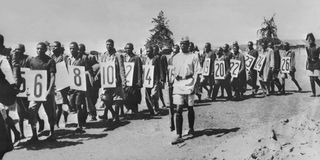
A colonial-era mystery of unburied remains from the Mau Mau fighting was revived this week during a global conference at the University of Nairobi marking the 70th anniversary of the declaration of the State of Emergency.
The government says it does not know what to do with bones belonging to 481 bodies, most of them killed by the freedom fighters during the emergency, that are stashed in a room at Nairobi National Museum.
The victims are believed to have been killed by the insurgents for collaborating with the British or in other violent confrontations.
Of the 481 skeletons, some 443 were of bodies gathered by colonial administrators as they went round the country, especially in central Kenya, collecting evidence of executions by Mau Mau fighters against collaborators.
This is indicated in a paper “The Unburied Victims of Kenya’s Mau Mau Rebellion: Where and When Does the Violence End?”
It is authored by David Anderson, a professor of African history, and Paul Lane, an archaeologist.
Prof Anderson is also the author of the book Histories of the Hanged: Britain’s Dirty War in Kenya and the End of Empire.
The paper is part of a 2016 book Human Remains in Society. Anderson and Lane say that as independence for Kenya approached, the lever for prosecuting Mau Mau fighters was disengaged.
“Seeing no further use for his burgeoning collection of corpses, (the then chief police pathologist Morris) Rogoff offered the skeletons to the Coryndon Museum (precursor to the Nairobi Museum), where the famous Dr Louis Leakey then presided as director,” they write.
There have been intermittent calls to bury the bones, which are kept at the museum’s Osteology Department, but officials have never seen enough reason to do so.
According to Heritage Principal Secretary Josephta Mukobe, authorities are in a dilemma.
“We are confused because these bones were brought during the colonial period and have been with us since then,” she told the Sunday Nation.
“We do not know the origin of some. You cannot say they are freedom fighters. Some were found in toilets, others in other places during the emergency when many people were being killed,” she added.
According to the paper, the other 38 sets of bones “were added to the museum from other sources”.
So, why can’t the 481 skeletons be interred?
“When something is taken to the museum, it is numbered. Removing it from there without a national consensus will become an issue,” Ms Mukobe said.
In a 2014 article in the Saturday Nation, Prof Gabrielle Lynch described the skeletons’ location as “a room that people rarely enter”.
“They are kept in cardboard boxes on dusty shelves,” she said.
“With little scientific or historical value associated with such a collection, the bones were then relegated to the storeroom where they remain.”
At the front of the box holding the cards that record facts about every skeleton is an explanatory note.
“The skeletons of this collection are the remains of Africans (mostly of the Gikuyu tribe) who were killed during the great emergency of 1952–1960. They were uncovered and exhumed by police and were then used as evidence against the Mau Mau by Her Majesty’s Police,” the note reads.
“This collection was generously donated to Dr Leakey by Dr Morris Rogoff, then the Chief Police Pathologist.”
In their paper, Prof Anderson and Mr Lane say the bones were gathered as a result of confessions by some of the people who admitted having killed pro-government locals.
“From 1955, the government introduced a programme of public confessions among villagers and also sought confessions via the interrogation of detainees, which led to the identification of many more burial places,” the historians write.
“None of the reference specimens is actually complete (that is, none comprises the full range of cranial and post-cranial elements). Skulls, several of which are missing their lower mandibles, form the most common component of the reference collection,” they add.
A lack of completeness of the bodies may reflect the circumstances from which the skeletal materials originally derived.
“Retrieved from secret hiding places, including remote shallow graves, latrines and pits, many of the burial sites had been disturbed,” the historians say.
Because some are named, the writers wonder why their relatives have never taken them for burial.
Kikuyu Council of Elders chairman Wachira Kiago says there must have been an element of shame among the victims’ relatives.
“Those who were fighting Mau Mau had grabbed our country,” he said.
“History is important. People need to appreciate how Mau Mau came about. All that happened must be documented,” he said.
“There is no need to discard evidence. Even if they were killed by Mau Mau, they had also killed Mau Mau.”