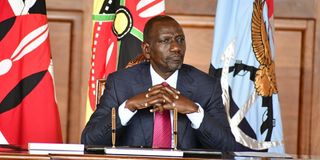
President William Ruto yesterday sought to pacify Kenyans ahead of Thursday's anticipated public protests, debunking misinformation around the government’s taxation plan for the year starting July 1, as he signed the Finance Bill 2026 into law.
The President dedicated a speech to mark the signing of the Finance Bill to explaining a number of contentious issues that have been associated with it, while courting ordinary Kenyans with goodies inside the last budget of his first term in office.
This was the first time that the Head of State has signed the crucial tax law before June 25 since coming into office, a date that has been met with public protests in the last three years.
President Ruto pitched his government as one that serves the ordinary Kenyan “the farmer, the boda boda rider, the mama mboga…and every young person striving for a better future.”
“We are pursuing tax avoidance, not taxpayers; offshore schemes, not ordinary wages; and leakages, not livelihoods,” the President said, striking a pro-citizen tone.
He then sought to clarify misinformation that has been rife in the public spaces around proposed clauses in the Finance Bill 2026, to assure Kenyans that the tax law will not harm them.
He explained that the law does not introduce taxes on freehold land, second-hand clothing (mitumba), bottled water, mobile money, phones and rental income.
“Contrary to propaganda, misinformation, disinformation, and fake news; the Government did not propose the taxes that were widely alleged. There was no proposal to introduce taxes on freehold land, mitumba, rental income tax, bottled water, M-Pesa or mobile money. The money you send to your family, your business, or your friends will move tomorrow just as it always has,” the President said.
His speech sought to debunk arguments across public for a that have associated the Finance Bill with some problematic amendments to tax laws, which are perceived as potential triggers to public anger ahead of June 25.
Last year, the President signed the bill into law on June 26, same as in 2023. In 2024 he declined to assent to the bill following countrywide public protests.
The President yesterday also dedicated his speech to wooing different segments of Kenyans with goodies inside the 2026/27 budget, specifically targeting the youth, farmers, teachers, Kenyans in the diaspora and small businesses.
He said the Finance Bill has increased duty on imported sugar from Sh7.5 to Sh40 per kilo to protect sugarcane farmers and extended mortgage benefits from bank borrowers only to microfinance institutions.
“To address concerns raised by returning travellers and members of the diaspora, we have increased the duty-free allowance from Sh39,000 to Sh260,000 for gifts and personal effects brought home upon their return,” he added.
This is in addition to the plan to hire 24,000 new teachers in the coming fiscal year and convert 20,000 more into permanent employment.
He courted university students with a message of high allocations to the Higher Education Loans Board (Helb), noting that it has grown from Sh15 billion in 2022 to Sh56.7 billion in the next fiscal year.
MPs received submissions from more than 170 organisations and over 100,000 Kenyans during public participation for the Finance Bill, 2026.
They approved the bill last Thursday, with some amendments from what Treasury had presented.
The President yesterday also said the government has allocated Sh129.1 billion towards primary healthcare in the coming fiscal year, to ensure that Kenyans seeking outpatient treatment are not turned away.
“As a result, no Kenyan should to pay for outpatient services at dispensaries, health centres, and sub-county health facilities in any Social Health Authority (SHA)-accredited public, private, or faith-based hospital. We will shortly make it criminal office for any health facility to charge any citizen for outpatient services,” he said.
In the Agriculture sector, he spoke to Sh20 billion funding for seed and fertiliser subsidies that are expected to support 6.5 million farmers, and said the government has put Sh12.4 billion for the National Youth Service to hire 10,000 youth.