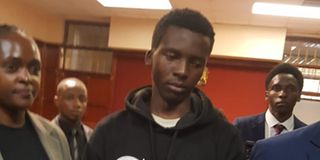
A university student charged with publishing fake news about a funeral procession of President William Ruto leaving the Lee Funeral Home under the escort of Kenya Army has been acquitted.
David Mokaya, 24, a finance student at Moi University, has been cleared of any wrong doing by the Milimani Law Courts in Nairobi.
Throughout the delivery of the judgement, Mokaya appeared deeply troubled, occasionally shedding tears while bent over the dock.
Mokaya was acquitted under Section 215 of the criminal procedure code. The magistrate observed that no direct evidence linked the accused to the alleged offence.
The magistrate said police failed miserably in their duty for obtaining evidence from Safaricom without any court orders.
“This student can't even talk due to mental trauma and shock that gripped him since he was charged in November 13 2024,” defence lawyer Danstan Omari told the court after the delivery of the ruling.
Mokaya was accused of publishing a controversial image on social media depicting a coffin bearing the photo of President Ruto draped in the Kenyan national flag.
While delivering her ruling, Ms Mugo cited glaring gaps in the prosecution’s evidence. She also criticised the police for failing to follow due process of the law merely because the name of the President was mentioned in a social media publication.
She reminded the police that they have a duty to observe the law even in cases when the names of high ranking officers or politicians are involved.
Mokaya is alleged to have published the post on platform X on November 13, 2024.
However, the court pointed out that at the time, Mokaya was managing three social media business platforms and that there was no evidence that he posted the offending publication.
In her judgment, the magistrate said she carefully considered submissions from the prosecution and the defence, as well as the testimony of six prosecution witnesses. However, she found that none of the evidence conclusively linked Mokaya to the offending post.
“The prosecution failed to establish a nexus between the accused and the social media account in question,” the magistrate said.
She further noted that there was no forensic or digital evidence, such as login records or device data, to show that Mokaya authored or uploaded the said post.
The court heard that Mokaya’s account was allegedly used for marketing purposes and was shared with three other individuals who were never called as witnesses.
This, the magistrate observed, created reasonable doubt as to who actually accessed or operated the account at the material time.
Further weakening the prosecution’s case was evidence on the accused’s location. While the alleged offence was said to have been committed in Nairobi, Mokaya was in Eldoret from where he was arrested.
The investigating officer admitted under cross-examination that he could not verify the origin, source, or geographic location of the post.
The officer also confirmed that the student’s personal data had been obtained from a mobile network service provider, later identified in court as Safaricom.
However, the officer was unable to confirm whether the SIM card linked to the account had been properly registered or whether unverified numbers had been deregistered at the time.
Law Society of Kenya lawyer Ian Mutiso strongly challenged the integrity of the investigation and prosecution, arguing that the prosecution failed to call key witnesses, including the complainant – President Ruto – and relied on unverified telecom data.
Possibility of fabricated post
“If it is a very old number, anybody could have been issued one,” the defence submitted.
In a pointed remark, the magistrate faulted the decision to prosecute, warning that cases touching on the presidency must be handled with caution and free from public or political pressure.
The ruling has reignited debate on digital privacy, freedom of expression, and compliance with the Data Protection Act of 2019, which sets strict standards on the handling of personal data in Kenya.
Meanwhile, Mr Omari and Mr Mutiso told the court they will sue State for maliciously prosecuting Mokaya.