Premium
Smart Cities Forum seeks high-tech solutions for urban survival basics

Fixing the Nation participants led by Eric Latiff (2nd left) and Mariam Bishar (2nd right) during a panel discussion at the Smart Cities Forum at Two Rivers Mall, Nairobi, on October 31, 2025.


As Kenya joined the world in marking World Smart Cities Day, conversations at the Smart Cities Forum 2025, which ended on Friday, shifted from high-tech ambitions to the basics of urban survival: water, food, and health.
Experts, together with policymakers, argued that digital transformation will mean little if citizens still struggle to access clean water, nutritious food, or affordable healthcare.
“Nairobi’s daily demand stands at about 930,000 cubic metres, yet we only manage to supply around 630,000. That gap tells its own story,” said Mr Josiah Gitu from the Nairobi City Water and Sewerage Company.


To bridge the gap, he said, Nairobi County is embracing digital innovation through the rollout of smart meters and Geographic Information System (GIS)-based mapping, which will allow residents to report leaks, check bills, and access services remotely.
“We are moving toward data-driven water management,” Mr Gitu said. “Whatever water we have must be distributed equitably, including to informal settlements.”

Nation Media Group Managing Director and CEO Geoffrey Odundo (left) and the National Treasury’s Director of Public Procurement, Eric Korir tour exhibition booths during the Smart Cities Forum at Two Rivers Mall, Nairobi, on October 30, 2025.
According to Millicent Okumu, the CEO of Agriflex Limited, the health of a city depends as much on its food systems as on its hospitals.
“A city cannot be healthy if its food systems are broken. Smart cities must feed their people before they can call themselves smart,” Ms Okumu noted.
The integration of urban agriculture, including rooftop gardens and hydroponic farms, into city zoning policies is aimed at lowering food costs and improving urban nutrition.
“With hydroponics, even apartment dwellers can grow their own food,” Ms Okumu said. “The same person who needs healthcare and clean water also needs access to good food. The systems must connect.”
Despite Kenya’s push for digital transformation, health systems remain unevenly developed, said Tim Theuri, the CEO of the Kenya Health Federation.
“It’s important for us to have a healthcare plan that defines how technology fits into people’s daily lives,” Dr Theuri said. “Access, affordability, and equity must come before digital solutions.”
Murang’a Governor Irungu Kang’ata also positioned his administration as a pioneer in digital governance, detailing a comprehensive tech-driven overhaul.
“All these things, from our healthcare to our revenue streams, have now been converted into software. This illustrates a countywide shift from manual processes to a centralised, data-driven system,” Dr Kang’ata said.
The governor further explained that the county's strategy began with automating core services, which has now matured into a full-fledged smart city programme.
He also showcased the digitisation of citizen-centred services—from land certification to business permits and a public complaints portal—all designed to make government more accessible and accountable.
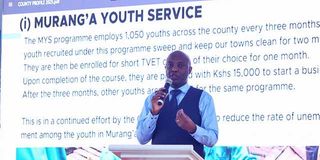
Murang'a Governor Irungu Kang'ata makes a presentation at the Smart Cities Forum at Two Rivers Mall, Nairobi, on October 31, 2025.
This multi-pronged approach, he argued, is essential for building an efficient and responsive urban society fit for the future.
Beyond healthcare, the Murang’a governor demonstrated how smart technology is being used to enhance transparency and service delivery. He revealed a new GIS mapping initiative for revenue collection.
“At the click of a button, you can know who has paid fees or county revenue or not, and you can locate that person physically using these GIS maps,” Dr Kang’ata said.
He reported that the county's 160 medical facilities are now fully automated, allowing for real-time tracking of patients and finances.
“We have 40,000 households, which translates to about 160,000 individuals. The county pays for your medical insurance scheme,” Dr Kang’ata said.