Somali youths are trapped in Libya’s trafficking cells.
Mohammed Abdullahi, 19, always dreamed of leaving Somalia for Europe but never knew the best way to get out of East Africa.
He grew up watching neighbours depart for Kenya, only to later hear that they had already made it to Europe.
Within months, more of their relatives would follow.
“Their lives changed very fast—from days of suffering and hardship to instant transformation and a smooth life. That is what I really wanted,” he said.
When Abdullahi turned 18, he pressured his parents, insisting he wanted to seek greener pastures abroad. He promised them he would do whatever it took to change his family’s fortunes if he reached Europe.
His parents admired his ambition and reached out to relatives and friends for help, but none was willing to commit.
“Despite the disappointment, I never lost hope and vowed to use any means to leave Somalia,” Abdullahi said. Soon, he was linked to agents in Kenya.
Through WhatsApp, he was handed from one contact to another. His journey from Mogadishu toward Europe had begun. But instead of opportunity, he was stepping into danger—with no one to help when things went wrong.
He recalls being bundled into tankers and lorries, never sure where he was headed.
“The only comfort was that I wasn’t alone, but most of the time we stayed silent and suspicious of one another. The journey was exhausting—I slept tired and woke up more tired,” he said.
Sh1.5 million ransom
In Libya, the supposed gateway out of Africa, Abdullahi’s nightmare deepened. He was kidnapped, separated from his group, and thrown into a cell run by abductors. They demanded his parents’ phone number and called for a ransom of Sh1.5 million.
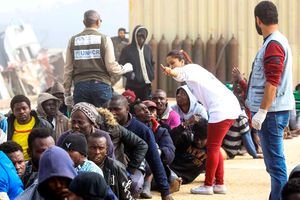
Illegal migrants, who were rescued by the Libyan coastguard in the Mediterranean Sea off the Libyan coast, arrive at the naval base in the capital Tripoli on May 6, 2017. | PHOTO | MAHMUD TURKIA | AFP |
“We were tortured, starved, and locked in overcrowded cells full of other Africans. Those whose families sent money were freed, but most of us remained in those filthy rooms,” he said.
Women were not spared. Halima, 22, told the Nation she endured 18 months in detention before being rescued in August.
“I counted months by the number of times I got my period. We were given very little food. The abductors mocked us, saying they had no budget for people like us. Sometimes they roughed us up as they forced us to call our parents for money,” she said.
Halima said she eventually lost all hope of release and resigned herself to death—until her sudden freedom, though she still doesn’t know how it came about.
On August 4, 2025, Mr Abshir Aden Ferro, a former French military officer and founder of Cruzen Group, was busy pursuing contracts when he received a call from Somalia: his nephew, Abdisalan Aden Mohamed, 25, had been abducted in Libya. The kidnappers demanded ransom.
Instead of sending money, Mr Ferro flew to Libya on August 7 to see the situation firsthand.
“I was very familiar with Libya’s reputation as a hub where migrants are detained, abused, and extorted. But I didn’t expect the scale of it,” he said.
What began as a rescue mission for his nephew quickly grew. Ferro discovered hundreds of Somalis trapped in cells.
“That’s how the journey to free more than 400 Somalis began. Some had travelled from Somalia, others through Kenya, only to end up in these prisons,” he said.
The images of torture and squalor still haunt him. He has since challenged the Somali government to act, saying the situation is far worse than reported.
“We need strategic plans to tackle this problem. The Libyan abductors don’t even spare women—it is terrible,” he said.
Investigations by the Nation reveal that Magafe, an umbrella network of traffickers and hostage-takers in Sudan and Libya, is exploiting Somalis desperate to leave East Africa. The group has agents operating even in Kenya.
Magafe—whose name means “the one who never misses”—has earned a ruthless reputation for capturing migrants.
Refugees in Kenya’s camps are already under immense strain. In 2024, the UNHCR’s Kenya programme reported receiving only 23 percent of its funding needs due to dwindling international aid.
According to Enact, which tracks organised crime in Africa, US cuts to foreign aid under President Donald Trump worsened the crisis.
“Limited access to essential government services has also exacerbated problems in obtaining refugee documentation, which impedes their ability to secure work permits. Due to these pressures, and under the belief that better opportunities must exist abroad, young refugees are vulnerable to recruitment by trafficking networks,” the organisation says.
Human trafficking
Like Abdullahi, Enact says many victims are targeted via TikTok and WhatsApp.
The traffickers use three main routes into Libya: Dadaab–Garissa–Mwingi–Thika–Nairobi–Busia (Kenya)–Kampala (Uganda)–South Sudan–Libya.
Another is Dadaab–Mombasa–Busia–Kampala–South Sudan–Libya, or Dadaab–Garissa–Isiolo–Samburu–Turkana (Kenya)–South Sudan–Libya.
Mandera County Directorate of Criminal Investigations (DCI) chief Pius Gitari recently told the Nation that some cases have been reported to police, though many families opt to raise the ransom money.
“We have launched investigations into human trafficking. Why many families take the decision not to report to us is baffling. Some people have been taken to court already,” Mr Gitari said.
The government recently admitted it is grappling with a rising wave of human trafficking syndicates originating in northern Kenya, which have become corridors for criminal networks smuggling migrants, weaponry, and narcotics towards Nairobi and beyond.
There are rising cases of foreigners using fake documents to access the country through the Moyale–Samburu–Isiolo highway, often using the bushy Barsaloi–Maralal road to avoid detection.
Intelligence reports show that the mode of operation used by the suspects is also being exploited by terrorist groups to sneak into the country with the intent to commit serious offences.
For instance, foreigners from Ethiopia and Eritrea have previously been charged in several courts in Marsabit, Maralal, Isiolo, and even Meru for being in the country unlawfully.
During previous court proceedings on the cases, courts were told that criminal networks were exploiting porous borders and the region’s remoteness to smuggle victims—mostly women and children—into the country.
Interior Cabinet Secretary Kipchumba Murkomen during a security forum at Sarova Woodlands Hotel in Nakuru on August 12, 2025.
Interior Cabinet Secretary Kipchumba Murkomen, while on a tour of Samburu last week, admitted that cases of human trafficking and smuggling of drugs and narcotics are rampant along the Moyale–Marsabit–Samburu–Isiolo highway, and that perpetrators are targeting Nairobi.