A rights activist has moved to court seeking to invalidate new rules governing pay and benefits for State and other public officers, arguing that Parliament interfered with the independence of the Salaries and Remuneration Commission (SRC).
Eliud Karanja Matindi wants the High Court to strike down the law requiring Parliament to approve SRC regulations before publication, as well as the rules gazetted on June 19, 2026.
He also says the approval process breached the Constitution and that SRC failed to submit the published regulations to Parliament within the statutory deadline of seven sitting days after publication.
“The SRC did not comply with the Constitution and the law when it failed to transmit the regulations to the National Assembly in accordance with Section 11 of the Statutory Instruments Act,” he says.
The dispute is who has authority to make public-sector pay rules. Article 230 gives SRC responsibility for setting and reviewing remuneration and benefits for State officers. Mr Matindi argues Parliament cannot control regulations made by an independent constitutional commission.
The contested rules set a four-year cycle for reviewing public-sector pay and require the SRC to consider the cost of living, government affordability and the value of different jobs when setting salaries and benefits.
They also set procedures for job grading, performance-based rewards, retirement benefits and negotiations between public bodies and trade unions, requiring employers to seek SRC’s advice on pay items funded by taxpayers. They also set procedures for collective bargaining and retirement benefits.
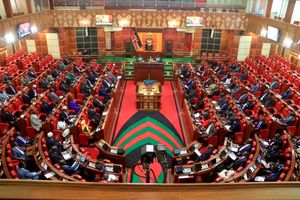
Members of the National Assembly during a past sitting.
Photo credit: Dennis Onsongo I Nation Media Group
Mr Matindi argues that Parliament’s approval of the draft rules before publication undermined SRC’s constitutional independence, and that the commission failed to submit the gazetted regulations to Parliament within the legally required period.
The petition names the National Assembly, SRC and Attorney-General as respondents. Katiba Institute and Transparency International-Kenya are listed as interested parties.
Mr Matindi challenges Section 26(2) of the SRC Act, which requires the commission to submit draft regulations to the National Assembly for approval before gazettement.
He wants the provision declared unconstitutional, null and void, alongside Legal Notice No.106 of 2026, which contains the new regulations.
SRC sent draft regulations to the National Assembly on July 14, 2025. The Committee on Delegated Legislation recommended approval on March 12, 2026. MPs approved the draft on April 7, before SRC gazetted the regulations on June 19.
Mr Matindi argues that Parliament was given a role in shaping rules that should be made by SRC. He says Section 26(2) “gives powers to the national assembly to direct how SRC, an independent constitutional commission, carries out its duties and functions.”
He relies on a May 2022 High Court judgment that invalidated a similar requirement for parliamentary approval of election campaign financing regulations made by the Independent Electoral and Boundaries Commission.
He also cites Section 11 of the Statutory Instruments Act, saying that as of October 12, SRC had not sent the Legal Notice to the National Assembly clerk for tabling within the prescribed period.
He argues that Parliament’s oversight under the Statutory Instruments Act begins after regulations have been made and published, when the House may consider whether to approve or annul them. He says the prior-approval requirement lets MPs intervene before SRC has made its rules.
Mr Matindi also asked the court to certify the case as urgent and suspend implementation of the regulations while the dispute is heard. Justice Patricia Nyaundi declined both requests and ordered full trial.
“I do not consider this an appropriate application for issuance of ex parte orders,” the judge stated. She directed that the application be heard together with the main petition to expedite determination.
The case is scheduled for mention on November 25, 2026, before the court to confirm compliance with its directions and give further directions.