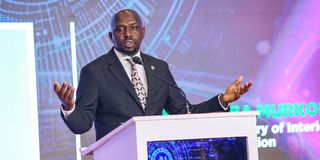
The national government is turning to artificial intelligence to confront a widening spectrum of insecurity, from street-level crime to cyber intrusions, betting on data-driven policing and real-time surveillance even as officials warn that the same technologies are reshaping the threat landscape.
Interior Cabinet Secretary Kipchumba Murkomen on Wednesday said the state has rolled out a plan of embedding AI across policing systems, from how crimes are reported to how officers are deployed, while the National Intelligence Service said it will shift its intelligence gathering towards algorithmic governance.
The new strategy is designed to respond to a new reality in which insecurity is no longer confined to physical spaces, but increasingly unfolds across digital networks, where misinformation, cyberattacks, and synthetic media are complicating law enforcement and national stability.
During the national AI hackathon hosted by the National Intelligence Research University, CS Murkomen framed the transition as both urgent and inevitable.
“We are now undertaking a procurement process to establish a digital OB… so that you can report a crime from your home or at the scene. This will help us take advantage of artificial intelligence… to know which areas struggle with which kinds of crimes.” Mr Murkomen said.
Alongside the digital reporting system, the government plans to roll out surveillance infrastructure across police stations and public spaces, including internet-connected devices and CCTV cameras intended to both deter crime and monitor officer conduct.
“We are also going to be rolling out digital gadgets… including ICT systems and digital CCTV cameras,” Mr Murkomen said, linking the technology not only to crime prevention but also to accountability within police stations.
NIS Director General Noordin Haji said the government has been battling with a number of security challenges such as the hacking of government systems, hindering access to public services.
“Government services and critical infrastructure are increasingly exposed to cyber intrusions,” he said, citing attempts to breach systems such as e-Citizen as an example of the risks facing public platforms.
The threat environment, he added, is evolving rapidly, fueled by transnational criminal networks and the proliferation of sophisticated, and often inexpensive, digital tools.
“We require intelligent systems that can continuously monitor networks, detect and manage threats in real time, and adapt to evolving attack patterns,” Mr Haji said.
He said NIS will be seeking to fund research and development in the area of AI to boost security in the country.
“The question before us is no longer whether to adopt artificial intelligence, but how quickly and effectively we can integrate it into the core functions of our state and society. The next time we will have such a competition, we will involve a blend of the soft and hard tech and ensure that robotics is part of us,” Mr Haji said.
They were speaking during the finale of a six-month national artificial intelligence hackathon hosted by the National Intelligence Research University, where winners were awarded after a competitive process that drew thousands of submissions from across the country.
A team from Meru University of Science and Technology, Caroline Gakii, Daniel Maitethia, and Ezekiel Otieno, was awarded as winners of the 2025 National AI Hackathon, marking the culmination of a six-month programme designed to translate emerging technologies into practical national solutions.
The trio secured the top prize for developing a low-cost AI-powered digital microscope capable of supporting early diagnosis of cancer and malaria, a project judges said demonstrated both technical ingenuity and strong potential for real-world deployment.
The competition drew more than 5,600 registrations and generated over 2,500 submissions from across the country, reflecting what officials described as a rapidly expanding pool of digital talent. Through a structured incubation process, selected participants were guided from concept to minimum viable products, receiving technical mentorship, ethical AI training and commercialisation support.
Other finalists presented solutions spanning critical sectors, including financial fraud detection, cybersecurity, sign language translation and public service delivery, underscoring the growing role of artificial intelligence in addressing both economic and security challenges.