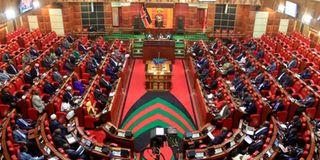
A response on a question by West Mugirango MP Stephen Mogaka on how narcotics is being transported in Kenya from neighbouring countries degenerated into a heated debate on whether to legalise bhang or not.
A section of lawmakers advocated for legalising bhang arguing that criminalisation of the substance by the government has failed to curb its use in the society.
Those supporting legalisation of bhang pointed out that despite its ban, the substance is easily available, even to children.
Ugenya MP David Ochieng confessed to having used bhang to manage severe back pain after doctors advised against surgery.
“Five years ago, I suffered from serious back pain. I was recommended for surgery in India, but a certain doctor told me I was too young for back surgery. For a whole year, I procured bhang every evening at 10pm. I would boil it and drink it before going to sleep,” Mr Ochieng said.
According to Ochieng, the treatment helped him recover and questioned the effectiveness of Kenya's long-standing anti-cannabis policies.
“People who are inclined to consume bhang will consume it whether it is legalised or not,” he said.
“They have been impounding bhang since the 1950s and 1960s from Uganda and it has not stopped. Therefore, impounding it or talking about the police will not help,” Mr Ochieng said.
The lawmaker argued that Kenya should move away from what he described as a colonial-era enforcement approach and instead focus on regulation and public education.
“It cannot be that bhang is a useful medicine in Mexico, America and South Africa but illegal in Kenya. We need to get real and acknowledge that bhang has been here for a long time.”
Dagoretti North MP Beatrice Elachi decried that despite the illegal status of bhang in the country, its use especially among the people has always been on the rise.
“It is very sad that right now in our political rallies, that is the cigarette our young people are using. You cannot tell any Nairobian at a rally not to use it. They are even smoking it in front of you when the police are present,” Ms Elachi said.
“We just have to think through and ask ourselves how we can regulate it to be legal,” she added.
Nairobi Woman Representative Esther Passaris admitted that bhang is readily available nowadays and can even be ordered online and it’s delivered at your doorstep.
“The late Ken Okoth suffered from cancer and I had the privilege of visiting him in Paris while he was receiving treatment. At that time, he was using cannabidiol oils, which are a component of cannabis, and it was relieving him of a lot of pain,” Ms Psaris said.
However, Kilifi North MP Owen Baya dismissed Mr Ochieng's argument as defeatist.
"Just because bhang is smuggled and the police keep impounding it does not mean that we should now make it available for everybody. It is just like saying that because people are being killed every day, we should allow other people to kill,” Mr Baya said.
“Draft a Bill, bring it here, let us debate it, let us undertake public participation and let us hear what Kenyans have to say,” he said.
“The mere fact that something has become available does not make it better. There could be very many benefits of psychotropic substances that are far outweighed by the losses they bring to our society,” Mr Sunkuli said.
“I am an uncle to one gentleman who completed his master's degree but is now a zombie as a result of bhang,” Mr Rindikiri said.
Trans Nzoia Woman Representative Lillian Siyoi said legalisation would send the wrong message to young people already grappling with addiction.
“We should not legalise something that we have already seen the results from among the youths that we have at the moment,” she said.
Seme MP James Nyikal cautioned against confusing the medicinal properties of cannabis with unrestricted use.
"The fact that something is therapeutic is the reason it should be controlled. Morphine and codeine are derived from opium and are therapeutic, but that is not a reason to say they should be legalised," Dr Nyikal said.
The law strictly prohibits the possession, use, cultivation, sale, or trafficking of cannabis in any form. Individuals found with bhang can face serious consequences, including fines and imprisonment, depending on the quantity and intent.