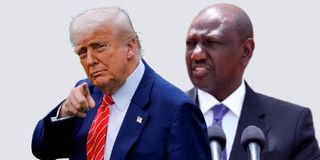
Idaho Senator Jim Risch, who also chairs the Senate Foreign Relations Committee, has proposed changes to the US National Defence Authorisation Act for the 2026 financial year, in which he wants Congress to order a review of Kenya’s MNNA status.
The senator will seek re-election on a Republican Party ticket in 2026 and has been endorsed by President Donald Trump.
Risch wants Washington to investigate Kenya’s actions, which he believes could be contrary to US national interests.
In the proposed amendments, Risch says Kenya could have used intelligence and security support from the US government to abduct, torture and rendition civilians.
The statements in the US Congress documents do not specify which individuals could have been victims of misuse of US intelligence and security support.
In the proposed period under review, President Ruto’s administration has come under focus for human rights violations following killings, injuries, arbitrary arrest and abductions of unarmed protesters.
Kenya also faced criticism after the abduction in Nairobi of seven Turkish nationals by intelligence officers from Ankara in October, 2024.
Mustafa Genç , Abdullah Genç, Huseyin Yesilsu, Necdet Seyitoglu, Oztürk Uzun, Alparslan Tasci and Saadet were picked up in different parts of the country following their criticism of President Recep Tayyip Erdogan’s administration through the Gulen movement.
Turkish national Necdet Seyitoglu was among the seven people abducted in Kileleshwa, Nairobi on October 18, 2024.
Photo credit: Wilfred Nyangaresi | Nation Media Group
Genç, Uzun, Tasci and Yesilsu were flown to Turkiye, where they face multiple charges. The four were in Kenya and had been granted refugee status as they awaited asylum in other countries.
“An assessment of the use by the government of Kenya of US Security assistance and intelligence support and sharing including potential impacts on state and non-state sponsored actions against civilians to include abductions, torture, renditions and violence against civilians,” one of the Amendments in the Bill reads.
The investigation, if allowed, will focus on Kenya’s activities after June 24, 2024 when MNNA was officially conferred on the country.
If passed into law, the amendments will compel US Secretaries Marco Rubio (State), Pete Hegseth (Defence) and Scott Bessent (Treasury) to work with National Intelligence Director Tulsi Gabbard to begin the review and investigations within 90 days.
Further, the bureaucrats will have to submit a report to Congress within 180 days of the amendments taking effect.
Signs of Risch’s push to revoke Kenya’s MNNA status emerged in May this year when he addressed the Senate Foreign Relations Committee.
Risch said it was time to review US ties with countries that have pledged allegiance to China, specifically mentioning Kenya.
“Many African nations maintain troubling ties with China – including key national security partners. Just last month, President William Ruto declared that Kenya – a Major Non-Nato Ally – and China are co-architects of a new world order,” he told the committee.
“That is not just alignment to China; it’s allegiance. I submit for the record the text of that speech. Relying on leaders who embrace Beijing so openly is an error. It’s time to reassess our relationship with Kenya and others who forge tight bonds with China”.
President Ruto made the remarks at Peking University in Beijing on April 23, 2025.
Three months earlier, President Ruto and US Secretary of State Marco Rubio had a phone call in which they discussed bilateral relations.
If given the green light, the investigation could find itself in a Kenyan political landmine as it would touch on sensitive matters such as the deaths, injuries, arbitrary arrests and abductions of anti-government protesters.
Of interest is the fact that the killings, arrests and abductions of protesters and people the government claims have been funding unrest through the demonstrations started a day after the country was formally conferred the MNNA status.
Kenya National Commission on Human Rights (KNCHR) records indicate that more than 1,400 people have been apprehended in relation to the protests in 2024 and 2025, with nearly 100 abductions reported.
Some of the abducted individuals are still missing, according to their relatives.
President Ruto’s decision to host the RSF leadership while arbitrating a ceasefire could also come into sharp focus.
The RSF, a paramilitary group labelled in some quarters as rebels and led by Mohamed Hamdan “Hemedti” Daglo, announced at Kenyatta International Convention Centre in February plans to form a parallel government.
Kenyan officials may have assisted individuals blacklisted by the US to stash their money, the document says.
While Risch did not specifically name individuals, RSF commander Daglo is among those blacklisted by the American government.
President William Ruto (right) and RSF Leader General Mohamed Hamdan Dagalo at State House, Nairobi.
Photo credit: PCS
“An assessment of Kenya as a financial safe haven for individuals and entities on the Office of Foreign Assets Control Specially Designated Nationals and Blocked Persons list and foreign terrorist organisations, including such individuals and entities based in South Sudan, Sudan, Uganda and Somalia; and an assessment of the relationships of the government of Kenya and key officials of Kenya with non-state armed groups and violent extremist organisations, including the RSF and Al-Shabaab,” the document in the US Congress reads.
President Ruto leads the Intergovernmental Authority on Development (Igad) sub-committee negotiating a peace agreement between Daglo and Sudan Armed Forces Commander Abdel Fattah Al-Burhan.
However, his decision to host the RSF in Nairobi has seen Sudan accuse Kenya of siding with the group. Gen Burhan has twice recalled Sudan’s ambassador to Kenya, most recently in February.
Delegates from Sudan's West Darfur State at the KICC in Nairobi on 18 February 18, 2025, ahead of the planned signing of the Government of Peace and Unity Charter.
Photo credit: Evans Habil | Nation Media Group
Sections of the international community and the United Nations frowned on President Ruto’s decision to host the group.
The Congress documents also says some Kenyan officials have ties to Al-Shabaab, which has claimed responsibility for attacks on Kenyan soil and elsewhere.
The raids include Westgate Mall in 2013 and 14 Riverside Drive six years later. The two deadly attacks were in Nairobi.
Risch proposes that Kenya’s trade ties with China be investigated, specifically targeting the roads sector and the Sh880 billion Nairobi owes the world’s second largest economy.
Public and private Chinese companies have dominated major taxpayer-funded road projects in Kenya since President Mwai Kibaki’s administration contracted Wu Yi, Sinohydro Corporation and Shengli Engineering Corporation to construct the 50-kilometre Thika Superhighway.
China is Kenya’s largest individual lender. As at the financial year ended June, 2025, Kenya owes China $5.4 billion (Sh700.9 billion).
In the 2024/25 fiscal year, Kenya paid Sh129.35 billion to China as debt-servicing. Most of the borrowing is tied to infrastructure projects.
There is mounting tension between the US and the two countries. Any close association with them could see the United States reconsider the depth of its relationship with Kenya.
Foreign Affairs PS Korir Sing’oei promised to get back to the Daily Nation over the Congress proposal but had not done so by time of going to press.