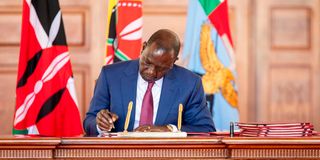
The government will compensate for death or injury arising from attacks by Sharks and Whales after President William Ruto signed into law a Bill that expands the scope of compensation for human-wildlife conflict.
President Ruto, last Wednesday, on October 15, 2025, assented to the Wildlife Conservation and Management (Amendment) Bill into law.
The new Act, sponsored by Lamu East MP Ruweida Obo, also seeks to extend compensation to victims of Stone Fish and Stingrays.
The new Act amends the Wildlife Conservation and Management Act, 2013 to include sharks, whales, stone fish, and stingrays among the wildlife species in respect of which compensation as a result of death or injury will be paid.
“The Third Schedule to the Wildlife Conservation and Management Act, 2013 is amended in Part A by inserting the following new words immediately after the word “Buffalo”-Shark, Stone Fish, Whale and Stingray,” the new changes to the Act states.
Currently, the Act allows compensation for death or injury arising from attacks by an elephant, lion, leopard, rhino, hyena, crocodile, cheetah, and buffalo.
The law also allows payment of compensation for crop, livestock and property damaged by elephant, lion, leopard, rhino, hyena, crocodile, cheetah, buffalo, hippo, zebra, eland, wildebeest and snake wild dog.
“This will ensure that persons who live along water bodies are entitled to payment of compensation as a result of death or injury from the specified wildlife species,” Ruweida Obo, said while moving her Bill.
Parliament in the Supplementary Budget 2022/23 allocated the State department for Wildlife funds to operationalise an insurance scheme to compensate victims of human-wildlife conflict whose claims stand at more than Sh2.6 billion.
The ministry has been developing an insurance scheme that will help clear compensation claims arising from human-wildlife conflict.
The National Assembly has, over the years, decried the wildlife compensation budget deficit, saying it will condemn more victims to a longer wait.
A compensation of Sh5 million is paid to the next of kin in cases of human death after verification.
The National Assembly’s Departmental Committee on Environmental and Natural Resources noted that some of the pending bills are for cases that date as far back as the financial year 2017/2018.
Victims have, in the past, decried the slow compensation process by the Kenya Wildlife Service (KWS).
Victims are compensated for crop destruction, livestock predation (where livestock is attacked and killed by wildlife), human injury and human death.
Kenya Wildlife Service (KWS) data shows that baboons and monkeys make up the leading causes of human-wildlife conflict in the country with a majority of the incidences being reported coming from areas where people depend on crop growing and livestock keeping for livelihood.
The KWS says the government has stepped up measures to resolve these conflicts by strengthening and equipping Problem Animal Control (PAC) teams with the necessary resources to ensure swift response when cases are reported.
Other remedies include the establishment of conservancies to act as buffer zones between people and wildlife and encouraging communities to have watchtowers to guard their farms.
Currently, over 16 conservancies have been established in Maasai Mara National Reserve.
The KWS is also considering collaring and tracking problematic animals in collaboration with other stakeholders and translocating them to avert deaths and destruction of property.