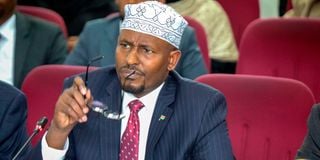
Wajir Governor Ahmed Abdullahi has been elected as the new chairperson of the Council of Governors, replacing his Kirinyaga counterpart Anne Waiguru, whose tenure ended after serving two terms.
The Monday election happened briefly before Ms Waiguru delivered the state of devolution address at Safari Park Hotel in Nairobi.
Nyeri county boss Mutahi Kahiga will now be the deputy chairperson of the governors’ governing body, effectively filling the spot previously occupied by Mr Abdullahi.
The race for the new CoG top seat was a tight, with five governors— Nairobi’s Johnson Sakaja, Kajiado’s Joseph Ole Lenku, Mr Abdullahi, Kahiga (Nyeri) as well as Muthomi Njuki ( Tharaka Nithi)— fighting it out.
Female governors were however not amused after they failed to land either the chairperson or deputy chairperson seat, with some storming out of the room where the election was being conducted.
This trend was however exacerbated when out of the 21 elective seats up for grabs, only one female governor, Wavinya Ndeti (Machakos), was elected to serve as the chairperson of the Trade and Cooperatives Committee, with the rest of the 16 committee chairperson slots being taken up by men.
Seven out of Kenya’s 47 counties are led by women— Ms Ndeti (Machakos), Gladys Wanga (Homa Bay), Kawira Mwangaza (Meru), Ms Waiguru (Kirinyaga), Cecily Mbarire (Embu), Susan Kihika (Nakuru) and Fatuma Achani (Kwale).
Other than Mr Abdullahi and his deputy Kahiga, the position of the CoG whip was filled by Nandi Governor Stephen Sang.
The Finance, planning and economic affairs committee will be chaired by Fernandes Barasa (Kakamega), Health Committee will be chaired by Muthomi Njuki (Tharaka Nithi) and mr Kenneth Lusaka (Bungoma) heads the Agriculture and Livestock committee.
Kisumu Governor Peter Anyang' Nyong'o will chair the Land, Housing and Urban Development committee; Environment, Forestry and Climate Change, Wilber Otichillo (Vihiga); ASAL and Disaster Response Management, Nathif Adam (Garissa); while Blue Economy will be led by Busia’s Paul Otuoma.
Education Committee will be led by Edwin Mutai (Kericho), Gender, Youth and Sport affairs, Simon Kachapin (West Pokot), Resource mobilisation and Partnerships, Simba Arati (Kisii), and Legal Affairs, Achillo Ayako (Migori).
The ICT and Knowledge Management committee will be chaired by Wesley Rotich (Elgeyo Marakwet), Security and Foreign Affairs committee, Benjamin Cheboi (Baringo), Tourism and Wildlife, Patrick Ole Ntutu (Kajiado), Transport, Infrastructure and Energy, Mohamed Ali (Marsabit), Water and Natural Resources Management, Joshua Irungu (Laikipia) with Nairobi’s Johnson Sakaj being chosen to steer the Human Resources, Labour and Social Welfare committee.
While delivering her last state of devolution address, Ms Waiguru said the counties had made significant strides in several sectors including health, education, tourism and energy, in the past one year.
However, the National Treasury did not disburse the full Sh385.4 billion as expected in the equitable share allocation for the 2023/2024, but instead disbursed some Sh354.6billion which was eight per cent short of the expected amount.
The targeted Sh46.36 billion classified as additional allocations from the national government and development partners was not met with only Sh29.07 billion being received by the counties.
Pending bills still remain a thorn in the flesh of counties with the outstanding bills yet to be paid being amounting to Sh182 billion.
“Nairobi City County accounted for 65 per cent of the total pending bills at Sh118.44billion with Elgeyo Marakwet, Nyeri and Lamu counties accumulating the lowest at Sh1.5million, Sh7.4million and Sh35.5million respectively. The high pending bills are largely attributed to delays in disbursing the equitable share by National Treasury,” Ms Waiguru said.
The journey to hit the own source revenue targets by several counties still remains riddled by bottlenecks with the devolved units managing to raise Sh58.95 billion against the projected target of Sh80.94billion.
However, this amount signified a huge improvement from the total of Sh37.8 billion that was collected last year.
Only the counties managed to surpass their annual targets. These include Turkana that attained 241 per cent of its target, then Vihiga at 136.3 percent, Kirinyaga (118 per cent), Lamu (116 per cent), Wajir (110), Garissa (108), Nyeri (106), Samburu (104) and Murang’a at 100.2 per cent.
Chief Justice Martha Koome, speaking during the event commended the governors for championing development in the devolved units but urged them to do more in the construction of more courthouses in the counties.
She highlighted how a total of 11 sub counties in Nairobi had no court house resulting in overcrowding of courts that exist in only six sub counties of the capital city.
“Counties are crucial for democratic governance. We want to join hands with you (governors) to work towards the betterment of service delivery and improvement of lives of people in the country,” she said.
Devolution Principal Secretary Teresia Mbaika said devolution is a critical cog of the development of the countries as it increases the trickling down of resources to all corners of the country and provision of much needed services to Kenyans.
She then revealed that her office had already finished drafting the devolution Policy 2024 and is currently awaiting Cabinet approval.
This policy, she said, will fine tune the government’s approach to devolution and assist in meeting the evolving needs of the devolved units.
“As we celebrate our achievements, we must be vigilant. Devolution is a journey. We have to ensure that our programmes only exist on paper but are actionable on the ground that everyone is involved in developing and actively shaping their communities,” she said.
Only through robust community mobilisation and effective policies will the governors be able to safeguard the interests of the devolved units and resultantly, attain a just, equitable and prosperous nation for all, PS Mbaika before welcoming the newly elected team on board.
On her part, nominated Senator Veronicah Maina, who was representing the Senate’s speaker, Amason Kingi, said devolution has greatly improved the country's struggle to attain equitable distribution of the national resources to all corners of Kenya.
Only through devolution did the transformative works happen in key towns in the country including Nakuru and Eldoret that have since been promoted to be cities bringing the total number of cities in the country to five.
This, Ms Maina said, was through the allocation of over Sh2 trillion that has so far been disbursed to counties since their inception in 2013.
The legislator however noted that several ills, including delayed disbursements by the national treasury, low inflow of own source revenue, failure by defunct municipal entities and the national government to relinquish functions to the counties as they should and the constant fights between governors and Members of County Assembly and their deputies, still hamper the strides made by devolution.
“Though the journey is rough at times, I urge you (governors) to continue rallying the leadership of counties to achieve the goals of devolution at all costs,” she said.