President William Ruto’s government has come under pressure over plans to establish a multi-billion-dollar joint regional oil refinery in Tanga, Tanzania instead of reviving the collapsed Changamwe refinery in Mombasa.
The development comes after MPs asked Energy and Petroleum Cabinet Secretary Opiyo Wandayi to come clean over the justification of the joint project, which will see Kenya pump billions of dollars in a neighbouring country.
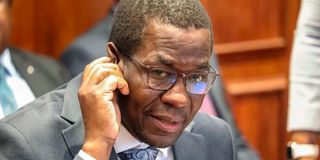
Appearing before the Senate on Wednesday, CS Wandayi was at pains to explain the viability of the Tanga project as Mombasa Senator Mohamed Faki raised concern over it.
The senator questioned why Kenya opted for the project instead of reviving and modernising the dead Changamwe refinery, which would need less capital investment.
“I hear the government is planning to jointly build a refinery in Tanga, Tanzania yet in Mombasa we are leasing our refinery to a Nigerian company without public participation,” said Mr Faki.
“Could he explain under what circumstances the government is investing in another country rather than in Mombasa where it would be cheaper to upgrade the refinery than to build a new one in another country?”
CS Wandayi said that Kenya has not pushed for the revival of the refinery because such a move does not make commercial sense.
He told senators that a refinery business is a matter of commercial logic and the Changamwe refinery does not to make business sense, which is why operations at the facility were discontinued.
Mr Wandayi argued that the envisaged crude oil production from South Lokichar in Turkana, set to be operationalised later in the year, is not adequate to commercially run a refinery.
The CS noted that the South Lokichar project is expected to produce 20,000 barrels of crude oil per day initially, before increasing to 50,000 barrels. He pointed out that a minimum of 300,000 barrels per day are needed to run a refinery.
“It must make commercial sense for one to undertake a refinery business. The quantities envisaged to come out of South Lokichar are not adequate to run a commercial refinery,” said CS Wandayi.
“Therefore, that informs the justification, reason, basis for plans to establish a refinery in Tanga that will not only serve Kenya but also other neighbouring countries.”
The Changamwe refinery, at the time East Africa’s only oil refinery, stopped refining crude oil in September 2013 after operating since 1963 processing up to 80,000 barrels of crude oil daily.
The refinery was discontinued over an outdated and inefficient plant, which made it expensive to run due to product quality and costs. It has since been transitioned into a storage facility for imported crude oil, managed by the Kenya Pipeline Company.
In January, residents of Changamwe urged MPs to push for the revival of the now-defunct oil refinery, saying it played a significant role in sustaining livelihoods and driving economic growth in Mombasa.
The refinery previously provided direct employment to both skilled staff and casual workers, while also sustaining traders and service providers operating around the facility.
“The revival of the Changamwe refinery will enable value addition to crude oil and create employment opportunities for local residents,” said Changamwe MP Omar Mwinyi.
But speaking last month in Nairobi at The Africa We Build Summit, President Ruto said the move to invest in the Tanga refinery is aimed at harnessing the region’s crude oil resources and strengthening energy security.
He pointed out that the proposed facility would process crude from across the region, including Uganda, the Democratic Republic of Congo and South Sudan, into refined petroleum products for regional consumption.
“That refinery will process oil from the DRC, Kenya, South Sudan and Uganda. We will then build a pipeline from Tanga to Mombasa, allowing finished products to move through infrastructure we jointly own with Uganda,” said the Head of State.
While on a two-day visit to Tanzania this month, the President doubled down on his earlier announcement, saying the proposed oil refinery is part of a wider regional strategy to promote industrialisation, create jobs and add value to East Africa’s natural resources.
Dr Ruto said that the construction of a regional oil refinery by Tanzania, Kenya and Uganda will reduce fuel costs and create jobs across East Africa.