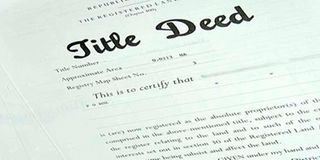
Land inequality remains the most enduring and destabilising injustice in Kenya, shaping who owns wealth, who accesses opportunities and who remains trapped in a cycle of marginalisation, with less than two per cent of Kenyans owning more than half of the country’s arable land.
A new report shows that so serious is this concentration in land ownership that it continues to determine the country’s political economy six decades after independence.
This is according to a report published by the Kenya Human Rights Commission (KHRC) on Wednesday titled: “The Who Owns Kenya? This captures this inequality starkly, noting that less Land is not merely an economic asset but the foundation of power, dignity, and mobility.
“Land ownership remains the single most powerful determinant of wealth, political influence, and access to opportunity in Kenya. This inequality is not accidental. It is the product of a long history that began with violent colonial dispossession when colonial authorities forcefully displaced communities, redrew boundaries, and allocated vast tracts to settlers and their local allies,” part of the report read.
Independence did not reverse this architecture; rather, the report explained, land was transferred from colonial hands into the control of political families and their networks, entrenching a system where access to land, and therefore wealth, was mediated by proximity to political power.
Today, the result is a deeply divided land economy. Smallholders, who make up the overwhelming majority, farm on shrinking, unviable parcels while a small elite holds vast tracts, often idle or used for speculation. The report shows how distorted this system is:
“A large majority, 98 per cent of the farm holdings in Kenya are small, less than 3 acres and occupy 46 per cent of the total farmed land, while large farms measuring an average of 494 acres are owned by 0.1 per cent of the rich in the country’s population but occupy 39 per cent of total land area”, the report stated.
This asymmetry, KHRC cautioned, undermines food security, agricultural productivity, and the ability of millions to generate income or build generational wealth.
“The consequences of land inequality are not limited to rural livelihoods. They shape the country’s fiscal architecture, revenue capacity, and the distribution of public services. Land, which the report identifies as the primary store of elite wealth, contributes little to national taxation,” Gladys Mong’are, Lead, Land and Natural Resources Justice, KHRC, said.
The report showed that land-related wealth remains largely untaxed, even though it represents the bulk of elite wealth in Kenya.
As such, the country’s wealthiest contribute comparatively little to revenue generation. At the same time, ordinary Kenyans, most of whom have little or no land, bear the burden of consumption taxes, fuel levies, and payroll deductions.
It is here that land injustice meets Kenya’s fiscal crisis. In the same event in Nairobi, the KHRC released another report that it jointly published with Oxfam, titled: The Economics of Repression.
This survey showed how runaway public debt, unhealthy borrowing, and bloated recurrent spending have choked the state’s ability to invest in public goods.
Debt servicing, the study explained, now consumes the majority of ordinary revenue, leaving a fraction for development and social protection. With land-related wealth undertaxed and public debt absorbing national resources, the state increasingly turns to regressive taxation; VAT, excise taxes, fees, and levies—to plug deficits.
Properties under freehold or leasehold tenure qualify to be rateable and to pay land rates, provided they fall within the jurisdiction of a rateable authority.
Photo credit: Shutterstock
This convergence of land inequality and fiscal austerity deepens poverty, especially among communities already excluded from land ownership.
“Counties with histories of land dispossession, underdeveloped infrastructure, and insecure tenure face compounded vulnerability as development spending shrinks. Many of these regions depend heavily on state investment for water, health facilities, agricultural extension, and climate adaptation,” Annet Nerima, Head of Programmes, Political Accountability and State Institutions, said.
But with debt obligations rising and essential services rationed, these communities are left exposed to hunger, displacement, and systemic neglect.
The relationship between land inequality and deprivation becomes most visible in food insecurity. Although agriculture contributes more than a fifth of GDP and employs millions, Kenya remains a food-insecure nation.
Productive land sits underutilised under speculative ownership while smallholders toil on plots too small to sustain families. Because land determines access to credit and investment, small farmers cannot modernise or scale.
The “Who Owns Kenya” report’s finding that “land scarcity… continues to be the cause of conflicts between individuals, communities and other entities in the struggle to secure their livelihoods” is evident in Kenya’s reality where hunger, conflict, and economic stagnation are rooted in unequal access to land.
Modern economic pressures have also created new layers of land injustice. The report warns that carbon markets, conservation models, and large-scale infrastructure projects risk becoming contemporary mechanisms of dispossession.
“Without strong safeguards, such systems may replicate colonial-style extractive models, turning communal land into private carbon assets. In these schemes, communities, particularly pastoralists, lose control over their territory, livelihoods, and decision-making autonomy,” part of the report stated.
At the same time, the country’s debt crisis limits the state’s ability to resolve historical land injustices. Compensation programmes, community titling, settlement of the landless, and restitution of stolen land require sustained public financing.
However, austerity measures due to strained fiscal muscles have constrained these initiatives, delaying justice for communities displaced decades ago and trapping younger generations in inherited poverty.
Davis Malombe, the KHRC Executive Director, said that Chapter Five of the constitution dictates how land should be utilised for sustainability and benefit all citizens.
Also, failure by the State to tackle to historical land injustices under the National Land Policy Constitution and National Land Commission Act combined with weak enforcement on the provisions of public finance in the constitution which calls for prudence and accountability in the governance of public resources, are largely to blame, he said.
“The political responsibility for this failure goes to Parliament because they have the mandate to ensure there is a ceiling on the wage bill and public debt, as well as adherence to proper frameworks for governance of land resources. We are calling on the Parliament and asking it to tame the executive because it is the one responsible for this impunity,” he said.
Together, the two reports illuminate a reinforcing cycle: land injustice creates inequality; regressive taxation entrenches it; public debt exacerbates it; and austerity blocks redress.
The burden falls overwhelmingly on those who already lost the most: families living on marginal land, communities without titles, pastoralists pushed out of grazing corridors, and urban residents crowded into informal settlements.
To rectify the situation, the “Who Owns Kenya?” report suggested numerous recommendations.
It argues that taxing land fairly, especially through land value taxation, offers a transformative opportunity.
“Taxing land, especially through robust land value taxation, offers one of the most powerful, equitable, and sustainable ways for Kenya to raise revenue,” it stated.