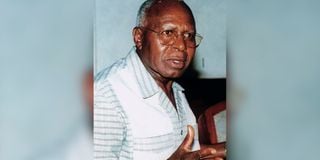
The High Court has dismissed a petition by a woman claiming to have been married to late politician and businessman Simeon Nyachae, and who sought to be included as a beneficiary in the multi-million estate alongside her three children.
The court said Ms Margaret Kerubo Chweya and her two children failed to prove that they were dependants of the estate of the late politician.
The court further praised Ms Chweya’s youngest daughter, Ms Patricia Moraa Odero, who distanced herself from the case and testified that she knew her biological father as George Gordon Odero.
“If they (the two sons who supported their mother in the case) are seeking their fathers, their fathers are still alive and testified in court. They have no moral claim to the estate of Nyachae. Their sister (Patricia) demonstrated maturity and morality by dissociating herself from the case,” said the court.
Ms Chweya claimed that she was the fourth wife of the former cabinet minister, although she admitted during the hearing that she was married to other men, in what she termed as marriages of convenience.
The woman, who resides in Los Angeles, California, admitted that she was married Mr James Leroy Totten, among other men, but the arrangement was later nullified.
In the Thursday decision, the court rejected her claims of marriage to Nyachae, saying photos alone were not proof that she was married to the late politician.
Quoting a publication by Nahashon Orera Onkwani titled Change and Continuity in Marriage among the Abagusii of Kenya during the Colonial Period, 1895-1963), the court noted that a traditional Abagusii wedding, known as Ekeremo , is a sacred, multi-stage, community-driven process.
The court noted that the process was not a one-day event but included multiple stages, beginning with courtship, negotiations, and culminating in the ekeremo.
“Evidence as to the formality must be proved to the required standards. The applicant claims that she was married to Nyachae through customary marriage. She has not in any way proved that the said ceremony was ever done. There is no witness to the ceremony. Pictures alone cannot be proof of marriage,” said the judge.
Ms Chweya was fighting join a succession case pending before the High Court and had sued Charles Nyachae, Angela and Eric, who are the administrators of the estate, which is estimated to be more than Sh2 billion.
The woman claimed that she was married to Mr Nyachae in a traditional ceremony sometime in 1973 and the dowry was paid to his uncle, Samson Obaga Okao, because her dad, David Chweya, passed on earlier in 1970.
Ms Chweya told the court that Mr Nyachae purchased her a house in Loresho in Nairobi, near his other house and maintained it while she and her children were away in the USA.
She said Mr Nyachae would occasionally visit the family in the USA and leave them money and part of the money she spent while studying abroad were derived from rent after the house was leased.
But the court noted that her daughter testified that she never met Mr Nyachae and produced pictures showing her father, who provided for them. The court further noted that Ms Chweya changed names over the years, as she got engaged to other men.
According to the court, the name change casts doubt as to whether Mr Nyachae was active in the lives of his alleged children.
The court Ms Chweya and to pay the costs of the case. The court, however, suspended the decision for 14 days, to allow Ms Chweya move to the court of appeal to challenge the judgment.