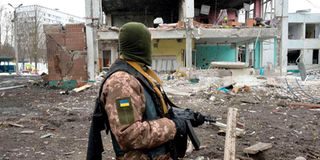
Russia invaded Ukraine in the early hours of February 24, setting off the worst conflict in Europe in decades.
We look back on a fortnight which has shaken the world.
Russian President Vladimir Putin announces a "special military operation" to "demilitarise and de-nazify" Ukraine and support Moscow-backed separatists in the east.
Ukrainian forces put up stronger-than-expected resistance, frustrating Russian plans for a lightning takeover.
With his troops getting bogged down, Putin puts Russia's nuclear forces on high alert on February 27.
Air spaces are closed to Russian aircraft and Russia is kicked out of one sporting and cultural event after another, including the World Cup. Major companies start to shut up shop in Russia.
The invasion also sparks a radical rethink in German defence policy, with Berlin massively hiking military spending.
During the first talks between Kyiv and Moscow on February 28, Russian rockets pound civilian areas of Ukraine's second city Kharkiv. Zelensky makes an impassioned appeal for "immediate" EU membership.
As sanctions bite and some Russian oligarchs call for peace, the ruble collapses.
On March 1, satellite images show a massive Russian column bearing down on Kyiv. But it makes slow progress.
Russian troops have far more success in the south, where the same day they lay siege to the strategic port of Mariupol on the Sea of Azov. Moscow is close to linking up its forces in separatist Donetsk with Crimea, which it annexed in 2014.
On March 3, a week after the offensive began, Kherson becomes the first city to fall to the Russians, with forces based in Crimea pushing onwards towards Ukraine's main port, Odessa, on the Black Sea close to the Moldovan and Romanian borders.
As civilian casualties mount, and hundreds of thousands a day flee the country, the UN General Assembly overwhelmingly demands Russia withdraws "immediately".
On March 4, Russian troops take over Europe's biggest nuclear power station at Zaporizhzhia after shelling part of it.
The same day Russia begins to block Western news sites and broadcasters, with the last of its own independent media closing amid the threat of 15-year jail sentences for "fake news" about the war.
More than 13,500 Russians are arrested across the country for protesting against the war.
On Tuesday the Red Cross describes the situation in besieged Mariupol as "apocalyptic", with hundreds of thousands of civilians trapped in the shelling for eight days without water, heat or power.
The next day a 12-hour ceasefire is agreed to allow civilians to flee from six areas that have suffered heavy Russian bombardment.
Russia accuses the US on Wednesday of "declaring economic war" after it bans imports of Russian oil and gas, with the EU cutting two-thirds of its gas imports.
Zelensky, whose calls for a NATO no-fly zone to protect his cities have fallen on deaf ears, pleads with Washington for airpower as lawmakers vote on a $14 billion aid package.
By Thursday, some 2.2 million people have fled the fighting.