Premium
Rio Olympics scandal: AK boss Tuwei defends Soi over allowances
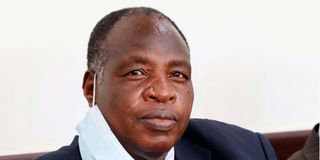
Stephen arap Soi at the Milimani Courts in Nairobi on September 15, 2021.

What you need to know:
- Tuwei praised Soi for steering Team Kenya to a historic performance, describing it as the country’s best since independence.
- He said that under Soi’s leadership, the Kenyan team made history by finishing as the top African country in the medal standings.
Athletics Kenya (AK) president Lt Gen (Rtd) Jackson Tuwei has defended former Rio 2016 Olympics Chef de Mission Stephen arap Soi, stating that he committed no wrongdoing in authorising the payment of allowances to officials who accompanied Team Kenya to Brazil.
“Soi did not commit any wrong by authorizing payments of allowances to sportsmen and officials since they had been budgeted for by the government and AK,” Tuwei told Milimani Chief Magistrate Lucas Onyina on Thursday.
Tuwei was testifying as a defence witness in the ongoing trial against Soi, who is facing charges of theft related to the 2016 Rio Olympics.

He is accused of stealing Sh25,907,705.82 from the government, the National Olympic Committee of Kenya (NOC-K), and Athletics Kenya.
Former NOC-K vice-president Pius Ochieng and Secretary-General Francis Kinyili Paul (F.K. Paul) are also co-accused in the case, which includes additional charges of fraudulently acquiring Team Kenya kits from Nike.
Tuwei praised Soi for steering Team Kenya to a historic performance, describing it as the country’s best since independence.
He said that under Soi’s leadership, the Kenyan team made history by finishing as the top African country in the medal standings.
“Despite a few hiccups in Rio related to doping and accreditation, the team performed excellently well,” said Tuwei.
“Kenya brought home six gold medals, six silver medals, and one bronze. We had actually clinched 14 medals, but one was later taken away.”
Tuwei noted that the only other time Kenya achieved comparable Olympic success was during the 1968 Games under Chef de Mission Edward Belsoi, where the country won two gold medals.
“The chef de mission is usually a military officer due to their high-level training and discipline,” he added.
He explained that allowances for athletes and accompanying officials are typically paid by both the government and Athletics Kenya.
As a former chef de mission for the 2000 Sydney Olympics and the 2002 Commonwealth Games in Manchester, he confirmed he had also authorised similar payments during his tenure.
Tuwei also addressed the Rio controversies. He said athlete Michael Rotich had been accused of doping, but the matter was resolved through the intervention of then-Sports Cabinet Secretary Hassan Wario and other officials.
Another issue involved John Azra, who had an accreditation dispute with a coach, which was also settled.
The court heard that Tuwei submitted a list of 18 officials to accompany Team Kenya to Rio, excluding medical doctors, physiotherapists, and nutritionists—though they still travelled to perform essential duties and stayed at the Olympic Village.
When questioned by defence lawyers Kimutai Bosek and Edward Rombo about his role during the crises in Rio, Tuwei denied claims that he had taken a back seat despite being AK president at the time. He reiterated his support for Soi, stressing, “The team performed excellently well.”
Bosek lamented that Soi was “stripped of glory” after his arrest at Jomo Kenyatta International Airport (JKIA), preventing him from returning the national flag to then-President Uhuru Kenyatta at State House, as is customary.
The court also heard that the allowances paid to athletes and officials were around USD 2,000 per person—an amount described as “too little” given the magnitude of the games.
The three accused are out on a cash bail of Sh 200,000 each. The hearing will continue on May 12, 2025.