Sugoi is a common Japanese word meaning "amazing" or "extraordinary". The expression lent its meaning to the motto – Every Second, Sugoi – of the 20th edition of the World Athletics Championships in Tokyo, Japan, between September 13 - 21.
No athletes expressed that slogan better than Kenya’s middle and long-distance female runners.
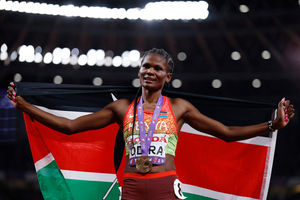
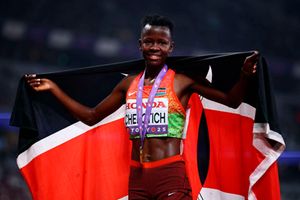
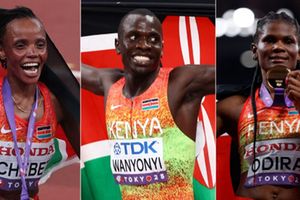
For the first time in the history of the championships, local female athletes saw one country, Kenya, win gold medals in 800 metres (Lilian Odira by breaking a 42-year-old championship record), 1,500m (Faith Kipyegon with a fourth title in the event) and 3,000m steeplechase (Faith Cherotich with a championship record). Others were 5,000m (Beatrice Chebet), 10,000m (Beatrice Chebet, again), and marathon races (Peres Chepchirchir).
Beatrice Chebet celebrates with her medal and national flag after winning gold in the 10,000m final at the World Athletics Championships in Tokyo, Japan, on September 13, 2025.
Photo credit: Aleksandra Szmigiel | Reuters
Including silver medals won by Dorcas Ewoi (1,500m) and Faith Kipyegon (5,000m), female athletes won eight of the 11 medals Kenya scooped in Tokyo. It is a ratio that advertises the stark contrast in performance between Kenya’s female and male athletes in Japan.
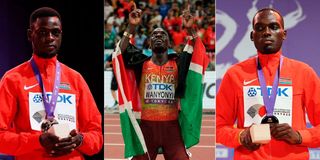
That disparity has restricted the medals won by Emmanuel Wanyonyi (men’s 800m gold with a new championship record), Reynold Cheruiyot (men’s 1,500m bronze), and Edmund Serem (3,000m steeplechase bronze) to headlining discussions about the declining performances of Kenya’s male athletes in recent editions of the Olympic Games and the World Athletics Championships.
Every conversation on the boy child crisis in Kenyan athletics traces the decline to the 2020 Tokyo Olympic Games. It was the first time, since the 1987 World Athletics Championships in Rome, Italy, that a Kenyan, or a Kenyan-born athlete, missed out on a gold medal in the men’s 3,000m steeplechase. Kenyan men have not won gold in the event since Tokyo 2020.
Adding that to their uninspiring performances in the 1,500m and marathon at the Olympics and World Athletics Championships since then, the dialogue about what is ailing Kenya’s male athletes is now transcending bar babble, barbershop chatter, street talk, and online chat.
The National Assembly, through its Departmental Committee on Sports, is scrutinising the poor performances by Kenya’s male athletes in major events lately. They will include their findings in a report of their assessment of Kenya’s performance in Tokyo. The Committee’s chairman, Daniel Wanyama, confirmed the process as ongoing to Sports PS Elijah Mwangi when he appeared before them on Tuesday, September 30.
Julius Kirwa, the national athletics head coach, is planning a stock-taking exercise – “a men’s conference” for Kenyan male athletes, coaches, and stakeholders.
"We are planning this engagement in October. This is an issue we want to address with the seriousness it deserves," Kirwa told Nation Sport in an interview.
One of the stakeholders who will most likely be involved in that “men’s conference” is Simon Biwott, a marathon silver medallist at the 2001 World Athletics Championships. In an exclusive interview with Nation Sport, Biwott recalled that male athletes contributed all of Kenya’s medals (three gold, three silver, and two bronze) at the 2001 event, the last edition of the competition where Kenyan female athletes did not win a medal.
Kenya's Emmanuel Wanyonyi celebrates with his national flag after winning gold in the men's 800m at the World Athletics Championships in Tokyo on September 20, 2025.
Photo credit: Reuters
"The tables have turned now and it is the men who are almost returning home empty-handed," Biwott, also the organising secretary of the Veteran Athletes Association (VAA), said. "This problem has developed over time due to our failure to respond to shifting dynamics and trends in athletes in the last 15 years.”
These trends, Biwott said, are: proliferation of foreign-owned athletics clubs, the new Diamond League format giving less priority to long-distance races, coaches wanting more involvement in preparing national team athletes, anti-doping rules narrowing the selection pool, and the neglect of the sport at the grassroots.
"Foreign-owned athletics clubs snatch the best talent leaving athletics clubs owned by the disciplined forces and other institutions, which focus on track races, scrambling for scraps," Biwott said.
Kirwa advanced Biwott’s thought by explaining how that trend, coupled with the current Diamond League format reducing earnings for long-distance runners, has contributed to young Kenyan male athletes focusing more on road races than track events. Interestingly, the current Diamond League format came into effect in 2019, two years before the alarm started going off on the poor performance by Kenya’s male athletes.
The country’s talent pool
"Kenyan men perform well in the World Athletics U20 Championships but once they transition to the senior level, their managers push them to road races because there is more money there than in track events," Kirwa said.
"This crop of athletes do so many road races in a year that it becomes hard for them to adjust their training for track events when needed because they are already exhausted. By then, there is also little time left to get them in good shape. Training for track races is different from that of road races," Kirwa said.
Biwott also said the focus on road races is also fuelled by disgruntled coaches encouraging athletes to shun track events.
"Coaches are never happy when their athletes go to major competitions without them. Athletics Kenya does not allow coaches to accompany runners yet their entourage always has more officials than athletes. Therefore, the coaches either encourage athletes to change nationality or focus on road races. These options help coaches to satisfy their craving for foreign trips while making money.”
Kenya's Faith Kipyegon celebrates after winning the World Athletics Championships women's 1,500m final at Japan National Stadium, Tokyo, on September 16, 2025.
Photo credit: Photo | Reuters
Kirwa admitted being aware of that trend but defended AK for denying some athletics coaches permission to accompany their athletes.
"Some coaches insist on accompanying their athletes yet they do not meet bare minimum coaching qualifications," Kirwa said.
It is that increased focus on road races that has reduced the country’s talent pool in races that Kenyan male athletes dominated, including the 1,500m and the 3,000m steeplechase.
Other factors that have narrowed the talent pool, as explained by Biwott, are changes to the selection criteria and new anti-doping regulations that require athletes to have been tested out of competition three times before competing at the national trials.
"Right now, it is so easy to predict the Kenya team because only few elite athletes get tested that much, as required," Biwott said.
Biwott further faulted the current selection criteria, which no longer sieve athletes from the ward level before the national trials.
"Previously, we had athletes that we nicknamed "Wakulima" because they rose from the grassroots to the nationals, through elimination competitions by AK. With the new anti-doping regulations, such athletes will remain confined to the periphery because they are out of the radar of the Anti-Doping Agency of Kenya (Adak)," Biwott said.
While Biwott insisted that the issue can be solved by Adak receiving support that increases its capacity to test more athletes, Kirwa was categorical that the regulation is not a factor that has influenced the deteriorating performance of Kenya’s male athletes.
"That rule applies worldwide. Even Ethiopians are feeling the heat. Check how their men have been performing," said Kirwa.
Kirwa agreed with Biwott that Adak should be adequately funded to improve its capacity to test athletes. Kirwa also concurred with Biwott that the sport should get more support at the grassroots, where facilities are needed to support the nurturing of talent.
"Athletics Kenya has nurseries that need more support. We need programmes and resources which can revive them. Also, coaches need support and incentives since they are ones who work with athletes daily," Biwott said.
Asked why these factors are not affecting Kenyan female athletes, Biwott and Kirwa argued that the rest of the world is yet to produce talent that matches the brilliance of Kenyan women.
"Kenyan female athletes are only getting competition from Ethiopians, Ugandans, and their counterparts who have changed nationality, such as Winfred Yavi," Biwott said.
The medal table for Tokyo 2025 supports Biwott’s point in a way that casts the decline of male athletes as an issue blown out of proportion.
Nine of the 18 medals up for grabs in middle and long-distance races in the women’s category were won by women of Kenyan descent – eight running for Kenya and Yavi, who won silver for Bahrain in the 3,000m steeplechase. The rest were shared by Ethiopia (3), Great Britain and Northern Ireland (2), Italy (2 – all by one athlete), and Uruguay (one).
Kenya's Faith Cherotich celebrates winning the women's 3000m steeplechase final at the World Athletics Championships in Tokyo on September 17, 2025.
Photo credit: Reuters
On the men’s side, Kenya led the medal standings for middle and long-distance races with three medals. France was the only country that won more than one medal in that category of races – Jimmy Gressier’s gold in the 10,000m and bronze in the 5,000m. The remaining 13 medals were shared by as many countries – Algeria, Belgium, Canada, Ethiopia, Germany, Great Britain and Northern Ireland, Italy, Morocco, New Zealand, Portugal, Sweden, Tanzania, and the USA.
A scrutiny of the medal standings of the previous two World Athletics Championships and the last two Olympic Games also reveals a similar trend – at least nine countries won medals in the men’s middle and long distance races, but Kenyan men scooped the most medals and provided the most medallists in those competitions.
In the women’s category, the story is the same – Kenyan women (including those who switched nationalities) took the lion's share, with Ethiopian women and women from a few other countries scrambling for the remaining.
If anything, those figures highlight just how important it is to win a gold medal. Perhaps, if Kenyan men won only gold medals in the 800m, 1,500m, and the 3,000m steeplechase at Tokyo 2025, talk of their decline would not have been this loud.