Kenya basketball coach calls for team's overhaul after early exit at Deaflympics
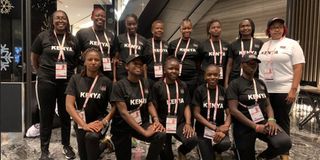
Kenya women’s basketball team at the Deaflympics in Tokyo, Japan, on November 15, 2025.

What you need to know:
- Kenya were drawn alongside Australia, Lithuania and Italy in Group ‘A’.
- Kenya struggled to impose herself in the group stage, failing to win a single quarter.
In Tokyo
Kenya women’s deaf basketball team will undergo a major rebuild following disappointing campaign at the ongoing 2025 Summer Deaflympics here in Tokyo.
The team, which is competing in Deaflympics for the fourth straight time, was on Thursday dumped out of the global showpiece without registering a single win.


Reflecting on the team’s performance, coach Mary Chepkoi acknowledged that her squad played better in their final Group ‘A’ match against Lithuania.
However, she stressed the need for more competitive matches for the team, and fresh blood to revitalise the squad. Chepkoi favours a total overhaul, and government-led talent development structures from secondary school level to feed national teams.
“Our shots weren’t going in. We were playing good defence but not scoring, which hurt us a lot,” said Chepkoi.
‘We showed improvement towards the end of the tournament, but we need more games before coming to such a tournament,” observed Chepkoi, who also coaches Jomo Kenyatta University of Agriculture and Technology Women’s basketball team Lynx.
Kenya were drawn alongside Australia, Lithuania and Italy in Group ‘A’ of the tournament, while Group ‘B’ had Greece, Ukraine and Japan. Group ‘C’ had Chinese Taipei, Turkey, USA and Poland.
Kenya struggled to impose herself in the group stage, failing to win a single quarter. They lost 104-30 to Australia on Sunday and later 114-42 to Italy. In their final pool match played on Wednesday, they fell 90-33 to Lithuania.
Stand-out players
Chepkoi said plans are afoot to register the team in one of the Kenya Basketball Federation’s women’s leagues to give the players regular playing time.
“I must take on the challenge of ensuring that we have a better team in future. Hopefully, next year we will register the national deaf basketball team in the hearing league. This will give us a team that can compete continuously,” she said.
Due to the lack of a local league for deaf basketball players, some members of the national team have joined hearing teams. For example, point guard Winnie Adhiambo, one of the stand-out players in Tokyo, plays for the Footprints in the Women’s Division One team.
“We need to go to secondary schools and recruit younger players. We’re not saying that we’re chasing the older players away. We want to help them transition into other roles, such as coaching and refereeing. Then we can bring in younger players. Then we will be able to compete with other teams,” said the coach.
Kenya has only ever registered one win in women’s basketball at the Deaflympics: a 98–11 victory over the host nation Brazil at the 2022 Games in Caxias do Sul.
After their match against Lithuania, the Director of Sport at the Ministry of Sports, Jackson Indakwa promised the government’s support in building a stronger side.
“I know you have not had much exposure because the Kenya Sports Federation of the Deaf has faced challenges. But those challenges are now over, and we will have a competitive team by the time we reach the next Deaflympic Games,” said Indakwa.
Swimming debutants
Meanwhile, Kenya made its long-awaited debut in swimming at the Deaflympics yesterday, with team captain, Francis Gichuhi, and Suheib Jimale competing in men’s 100m backstroke. Gichuhi was disqualified for taking the wrong turn, and Jimale fell short with a time of 1:51.92.
Nevertheless, both swimmers expressed their excitement at being the first Kenyans to compete in the Deaflympics, and promised to perform better in the remaining competitions.
“This was my first experience of the Deaflympics, and I was surprised by how the competition was organised,” said Gichuhi.
“There is a lot of pressure, but I hope I will do better in the next event. I was expecting to do well, and I know I did exactly that, even though the 100m backstroke is not my specialty,” said Gichuhi, who is also competing in the 50m and 100m breaststroke, and in 50m backstroke.
“I hope to do better in my next competition. I tried my best. I have learnt that I need to practice more, especially in wall turn, where we struggled,” said Jimale, who also competes in the 50m backstroke, 100 m freestyle and 50 m freestyle.