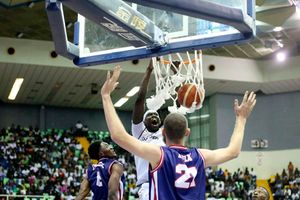
For Nairobi City Thunder, winning has become a habit. The club has claimed its third consecutive Kenya Basketball Federation (KBF) Premier League title, secured another ticket to the NBA-backed Basketball Africa League (BAL) and extended an extraordinary run of 90 unbeaten games across three years.
The title was anything but a walk in the park. Thunder had to dig deep twice to sweep aside Kenya Ports Authority (KPA) 3-0 in the best-of-five play-off final, winning 78-67 and 73-72 in the first two games played at the KPA Makande Gymnasium in Mombasa, before sealing the series with a 74-70 victory at Kasarani Indoor Arena in Nairobi.
The triumph capped an unbeaten domestic season and reinforced the club’s dominance on Kenyan courts.
But Thunder’s winning streak is only part of the story. Behind the trophies is a more radical transformation.
The club, which was once community-based, has become a professionally managed outfit. Players now earn six-figure monthly salaries and receive medical insurance, allowing them to focus on basketball rather than having to juggle the game with other jobs to make ends meet. In a country where professional sport rarely offers a reliable livelihood, that shift is significant.
Sandra Kimokoti, co-founder of Twende Sports, which owns Kenya Basketball Federation 2026 Premier League champions Nairobi City Thunder, at Westlands 44 on October 6, 2026
Photo credit: . Chris Omollo | Nation Media Group
Under the leadership of Sandra Kimokoti — a former rugby player — and her partners, Thunder is betting that treating basketball as a business can change the fortunes of both the club and its players. For the team, the brief is simple: play, win and deliver on the court. The commercial machinery around them is expected to build the brand, grow its following and turn success into a sustainable enterprise.
That ambition has attracted an unexpected name from beyond the basketball world when Hollywood star Lupita Nyong’o acquired a significant stake in the club.
“Our hope is that her involvement gives Thunder a cultural spotlight that few local basketball teams have enjoyed, which will help the club reach audiences well beyond the sport’s traditional fan base,” Kimokoti tells Nation Sports in a sit-down at her home in Nairobi.
When you look at an NBA game, who are always the attendees if not renowned celebrities? That kind of association is very key because it gives a club some good publicity,” she says.
Nairobi City Thunder celebrate with the Kenya Basketball Federation Premier League trophy at Nyayo National Stadium in Nairobi on 13th September 2025. Right: Hollywood actress Lupita Nyong'o.
Photo credit: Chris Omollo | Nation Media Group
Now, with the BAL weighing a shift towards a league that includes 10 permanent franchises next year, the prospect of a permanent place in Africa’s premier basketball competition offers Thunder the promise of a bigger stage, wider commercial opportunities and, potentially, substantial returns for Kimokoti and the investors who are trying to turn Kenyan basketball into a viable business.
She says that, together with her partners, the club is aggressively trying to build a professional sports business capable of paying its players monthly, attracting corporate money and turning a local basketball team into a recognisable African brand.
“It is an ambitious undertaking in a sporting environment where athletes often have to juggle their passion with other jobs to make ends meet. I mean, I used to earn Sh12,000 when I played rugby; how can you possibly make a living from that? That is the narrative we are trying to change,” she says.
Having played rugby for Kenya women’s national rugby team, Kenya Lionesses, Kimokoti understood the challenges facing athletes who wanted to compete at a high level without sacrificing financial security. But she also saw an opportunity to approach sport differently, treating a team not merely as a collection of players chasing trophies, but as a product around which a sustainable business could be built.
“I wanted to spend some time in the sports space,” says Kimokoti, who spent five and a half years working in management consulting in Nairobi before moving to New York to pursue a master’s degree in sports business.
Her return to the sports industry was not through rugby, but basketball, a game whose growing international profile offered the possibility of building something bigger than a domestic club.
Twende Sports Chief Business Officer Sandra Kimokoti.
Photo credit: Francis Nderitu | Nation Media Group
In 2021, a mutual friend introduced her to Colin Rasmusen — the man behind the initial vision for Twende Sports. He had approached Kimokoti and two other co-founders, Stephen Domingo, a former Nigerian National team basketball player, and Koshin “Kush” Diriye, separately, hoping to assemble a team with the skills to build a basketball ecosystem in Kenya.
Colin brought the overall business vision, while Kush had extensive experience playing in the local league and expertise in player relations. Stephen brought technical basketball knowledge, including experience in the NBA G League environment, while Kimokoti’s background in business development, revenue generation and brand building made her a natural fit to lead the commercial side.
The idea was to start with a professional team and use it as the foundation for a wider basketball enterprise, eventually expanding into youth development and other parts of the sport’s value chain.
For Kimokoti, the proposition was compelling. She was returning to a sector she understood as an athlete, but this time with the commercial training to help address one of its biggest weaknesses — the difficulty of making a living from sport in Kenya.
Basketball also appeared to be entering a promising phase. The NBA was expanding its presence in Africa, and the emergence of the Basketball Africa League offered a continental platform on which a well-run Kenyan team could compete, attract attention and build commercial value.
“We had this vision of really trying to build a basketball ecosystem in Kenya,” she says. “We'd begin with one team, but then around that team, we'd also build out its development and try to build out the infrastructure piece.”
The vehicle for that ambition was Nairobi City Thunder, a club that had existed for more than two decades before Twende Sports, co-founded by Colin, Kush, Domingo and Kimokoti, took over its management and commercial direction.
The arrangement was not simply a matter of buying a team outright. Under Kenya’s sports structures, clubs are organised around membership and officials such as chairpersons and secretaries-general. The task was to configure the existing arrangement to accommodate a more commercially oriented operation, giving Twende Sports the commercial rights and authority to guide the team’s management, including hiring.
The people who had run Thunder before the new management came on board also had to buy into the vision. Kimokoti credits them with recognising the potential of a different model and supporting the transition.
“That cooperation was important because professionalising a club requires more than money and a new management team. It means changing how decisions are made, how players are treated, how sponsors are approached and how the club measures success beyond the final score,” she notes.
Nairobi City Thunder’s Eugene Adera (centre) dribbles past Tobias Odhiambo (left) and Desmond Owili of KPA in game three of the best-of-five final series at Moi International Sports Centre, Kasarani on October 2, 2026.
Photo credit: Chis Omollo | Nation Media Group
For Twende Sports, the first principle was to build a product worth investing in. In the early days, Thunder had little of the audience that would eventually make it attractive to commercial partners. Kimokoti recalls that when the new management took over, the team had about 1,900 social media followers, including 1,200 on Facebook and 700 on Instagram. Those numbers made it difficult to persuade businesses to commit significant financial resources.
Partners could provide in-kind support, but the club had little evidence of a large, engaged audience to offer in return.
The challenge was, therefore, to build a competitive team and give people a reason to care about it. That meant investing in the squad, coaching and the conditions under which players worked, while simultaneously marketing games, capturing match-day content and telling stories that would draw people into the Thunder universe.
“In the sports space, you need patient capital,” Kimokoti says. “It’s not the kind of thing where you just come in year one, and then all the numbers work. You have to ask yourself, how long am I in this game for?”
The club’s approach was to grow the audience first, then use that audience to make a stronger case for sponsorships and other commercial partnerships.
The club has consequently worked to grow its digital community, rising to about 50,000 followers on Instagram and more than 200,000 on TikTok at the time of the interview.
“A larger audience gives the team something tangible to offer prospective sponsors. A brand can gain visibility on the club’s social platforms, during matches, on jerseys, or through activations such as a sponsored half-time shooting contest. The relationship is mutually beneficial. Sponsors gain access to an increasingly engaged audience, while their money helps finance the team and the experiences that attract more fans,” Kimokoti says.
At the centre of that strategy was giving players the security to play by treating basketball as a full-time job. Kimokoti describes the objective as providing players with a guaranteed living wage, health insurance and the peace of mind that comes from knowing they can meet their basic expenses and make a decent living.
“A player should be able to train in the morning, continue working on his game throughout the day and still know that rent will be paid at the end of the month. If an injury occurs, he should have access to medical care without the prospect of a broken bone becoming a financial catastrophe for him and his family,” she explains.
Word in the basketball circles is that Thunder players earn good salaries, with the highest earners taking home about Sh500,000. But Kimokoti declined to confirm the figures.
“I took a back seat from running the club; now I only sit on the board. For the figures, you will have to ask the CEO Colin.”
She did, however, explain the philosophy behind the model: players need conditions that allow them to focus on basketball rather than worry about how to survive. The financial commitment also changes what a club can reasonably expect from its athletes.
Creating right environment
“If players are to train consistently, improve their skills and compete against the continent’s best, the club must provide the structure to support those ambitions. Professionalisation is not simply about paying players. It is about creating an environment in which sporting performance becomes a job that can be pursued seriously,” she maintains, adding that players' wages are only one part of the cost.
“There are coaches to hire, logistics to organise, games to market, content to produce and people working behind the scenes to keep operations running. These are the less visible parts of the sports business,” she says.
Thunder’s commercial breakthrough depends on persuading people who may never have watched a basketball game to turn up at the arena. Kimokoti says the team began by appealing to basketball enthusiasts. The club has invested in promoting matches on social media, capturing short video clips, building anticipation around fixtures and making the atmosphere part of the story.
Thunder’s management also believes its success will mean more if other Kenyan basketball clubs become stronger.
“A club can build its own brand, but it cannot independently create an entire functioning league. If we can move as one, which is not the case at the moment, we can achieve so much more,” she says, arguing that the gains from better facilities and stronger league organisation would benefit every team, supporter and sponsor.
“A spectator does not necessarily have to understand every tactical decision to enjoy the pace, energy and spectacle of a live game. Some just come for the vibe and it is what they would spend on tickets, merchandise and even food and drinks. Kenyans love having a good time, and so we try to curate experiences around our games. Our idea is also to start having performances in between our games like the Super Bowl. You always see how huge the Super Bowl is, and it's because of the entertainment that also adds another layer of commercial revenue.”
The effort to broaden Thunder’s appeal extends beyond the court and into entertainment, music and popular culture, Kimokoti notes.
“It's not just Lupita; we also have Bien Aime on board. Having these well-known celebrities is a deliberate attempt to position the game as part of the wider entertainment economy.”
Kimokoti did not handle the direct conversations with Nyong’o herself, and declined to disclose the precise circumstances of how the relationship began. She says, however, that Thunder has been intentional about the kinds of people it wants associated with the team, while recognising that influential figures may also independently see value in becoming involved.
According to her, the attraction is not merely the publicity that comes from having a famous name attached to the club. It is the possibility of reaching people who would not ordinarily follow the local basketball league, but might become curious when a figure they admire publicly supports a Kenyan team.
“Nyong’o’s effect on Thunder has been massive; in particular, it's brought the club to the attention of audiences beyond the usual basketball fraternity. The following has increased on social media, and Kimakoti people are beginning to ask who Thunder is and why Lupita is having a keen interest in it. This is important because it has introduced Thunder to new audiences at home and abroad, created conversations around the brand, and helped demonstrate to potential partners that the team has relevance beyond its immediate sporting community.”
It is also a form of social capital. A respected public figure who associates with a team signals that the product is worth paying attention to, although the long-term commercial benefits depend on whether that attention translates into sustained engagement, ticket sales, sponsorships and support.
Kimakoti sees a larger national story in that association. Kenyans, she argues, want local sporting brands they can confidently support and feel proud of. The product must be good enough to justify that support, while its wider identity must give people a reason to rally around it.
With BAL, Kimokoti says, is both a sporting test and a commercial opportunity. |
“Competing against teams from across Africa exposes the club to new audiences, while providing a platform to demonstrate the value of Kenyan basketball to regional and continental partners.”
In the last two seasons, they played in BAL, Kimokoti says the club noticed increased interest from brands with operations across several African markets after Thunder qualified for its first BAL campaign.
“An airline, a financial institution or other regional business may be more interested in supporting a Kenyan team if that team can deliver visibility beyond Kenya’s borders.”
Participation also creates a new audience-development opportunity. During Thunder’s BAL campaigns, the club observed increases in social media followers and engagement from markets beyond Kenya, including South Sudan and Tanzania. The team also received interest from a club in the Democratic Republic of Congo about possible collaboration.
Twende Sports Chief Business Officer Sandra Kimokoti.
Photo credit: Francis Nderitu | Nation Media Group
“Preparing for the competition involves putting players into camp, securing training facilities, arranging flights and accommodation, and providing the additional technical support required to compete at that level. The costs accumulate before the team has even played its first game. It's enormous; we are looking at millions of shillings,” she explains.
The next phase of the BAL’s evolution into franchises could make that business-building exercise even more consequential. The league has been moving towards a model that combines teams qualifying through competition with permanent franchises. For ambitious clubs, the possibility of a more enduring place in the continental competition offers a different proposition from having to fight their way in each season.
Kimakoti is excited by the direction. She says the emerging model appears to favour organisations that can demonstrate economic viability and show that they are investing in their local basketball ecosystems, rather than assembling teams made up largely of short-term imports.
A permanent franchise would offer the prospect of greater continuity, but it would also demand a business capable of sustaining the costs of elite competition over time.
“The club would need to maintain its commercial relationships, retain and develop talent, attract supporters and demonstrate that it can contribute to the growth of basketball in Kenya. The ambition is not just to field a competitive side for a few weeks each year. It is to help create a market in which players can build careers,” she notes.
But beyond BAL, Kimokoti says Thunder is already thinking of developing an academy for emerging basketball players who would later on feed the team or even be sold to others.
“We receive regular enquiries from parents seeking opportunities for children as young as 12, as well as teenagers finishing secondary school who want to train with the team. This points to a large pool of potential talent we have in the country, but we cannot be able to absorb every promising player in the country. So we are considering how youth development could become part of our next phase of growth, creating pathways for players who might eventually join Thunder, move to other Kenyan clubs or pursue opportunities elsewhere on the continent and beyond.”
Nairobi City Thunder’s Eugene Adera (centre) dribbles past Tobias Odhiambo (left) and Desmond Owili of KPA in game three of the best-of-five final series at Moi International Sports Centre, Kasarani on October 2, 2026.
Photo credit: Chis Omollo | Nation Media Group
“International recruitment is intended to complement local talent, not replace it. BAL competition imposes roster requirements around local and African players. Each Basketball Africa League team is allowed up to five active foreign players on its roster, with a maximum of two foreign players who may be from outside Africa.”
According to Kimokoti, one of the lessons from Thunder’s first BAL campaign was the importance of building around Kenyan players who train and compete together throughout the domestic season. “The greater familiarity among players who have spent more time together can translate into stronger chemistry on court. The objective is to develop local players to a level where they can compete consistently at the highest level, then using international recruits to address specific needs in the squad while our local talent continues to improve,” she explains.
Over time, the club hopes that more of those gaps can be filled by players developed within the local system.
Thunder’s management also believes its success will mean more if other Kenyan basketball clubs become stronger.
For Kimokoti, it would be good to welcome investment in rival teams and recognises the value of competition, pointing to the challenge posed by Kenya Ports Authority during the domestic playoffs as evidence of how much more compelling the league becomes when opponents are well prepared.
“A stronger league creates better games, more attractive match-ups and a more compelling product for fans and sponsors.”
But Kimakoti argues that individual clubs cannot solve every problem themselves. Issues such as unreliable fixture schedules, poor facilities, inadequate lighting and unsatisfactory fan amenities require collective pressure on the sport’s administrators.
“A club can build its own brand, but it cannot independently create an entire functioning league. If we can move as one, which is not the case at the moment, we can achieve so much more,” she says, arguing that the gains from better facilities and stronger league organisation would benefit every team, supporter and sponsor.