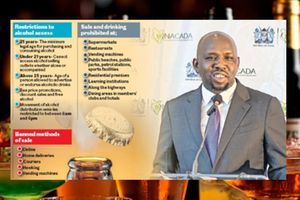
Among other recommendations, including increasing the legal drinking age from 18 to 21 years, the 76-page policy proposal, titled “National Policy for the Prevention, Management and Control of Alcohol, Drugs and Substance Abuse”, also proposes banning a manufacturer, importer, distributor, wholesaler, retailer, or any related agent of alcoholic drinks from naming or branding a sports team by the name an alcoholic drink’s product.
Under the same recommendation, Nacada also proposes the prohibition of the same entities sponsoring or branding a sports league, tournament, or a national team.
Tusker FC, founded in 1969, is sponsored by the East Africa Breweries Limited (EABL).
The football club derives its name from its eponymous beer, which is Eabl’s premier brand. Together with AFC Leopards (founded in 1964) and Gor Mahia (founded in 1968), Tusker FC is one of Kenya’s oldest and most successful football clubs. However, that history will go down the drain if Nacada’s policy proposal becomes law.
The policy proposal will not only affect Tusker FC, but also other sporting entities and events sponsored by alcohol manufacturing companies. In recent years, EABL has sponsored various sporting events using names of its flagship brands or alcoholic products that they distribute.
For instance, Tusker held the naming rights for the Kenya Premier League from 2012 to 2015. The brand has also sponsored the national rugby sevens circuit and the Safari Sevens, and golf events.
Kenya Shujaa players led by George Ooro and Samuel Asati celebrate with the Safari Sevens winners' trophy after winning the finals match against Shogun Rugby on October 13, 2024, at Kenyatta Stadium, Machakos County.
Photo credit: File| Nation Media Group
In the past, EABL, when known as Kenya Breweries, also sponsored the national darts championship and Pilsner, a beer brand distributed by the company, is known for its sponsorship of pool tournaments.
The Guinness brand is associated with the English Premier League and over the years, it has engaged football fans in pub quiz competitions, football challenges, meet-ups with famous footballers, and promotions to win tickets to watch an English Premier League match live.
Even when not owning title sponsorship rights, EABL has consistently maintained its visibility at sporting events. EABL occasionally holds activations at rugby matches, a sport with a deep tradition of fans following the action while sipping beer. Even without the activations, beer consumption is a common feature at football and rugby matches in Kenya.
However, Nacada’s policy proposal will put a stop to that habit, as in addition to the recommendations mentioned above, their policy proposal also recommends the enforcement of strict rules that prohibit the availability of alcohol and its access through certain means and at specific places.
As such, the policy proposal recommends the banning of the sale and consumption of alcohol at sports facilities.
Various sports facilities in Kenya, such as the Nyayo National Stadium and the RFUEA Grounds along Ngong Road, have establishments that sell food, beverages, and even alcohol. If Nacada’s policy becomes law, those establishments will either have to close shop or stop selling alcohol.
Further, Nacada’s proposed policy also bans the use of sports events and personalities to advertise, endorse, and promote alcoholic drinks, drugs and substances.
In their policy proposal, Nacada asserts that the recommendations are aimed at preventing, reducing, and controlling access to and availability of alcohol, drugs and substances of abuse while also protecting children, youth, and the public from excessive, misleading, or deceptive inducements of alcohol advertising, promotion, and marketing. When they become law, Nacada expects the involvement of the Ministry of Sports and Arts in enforcing them.
Enforcement of the proposed recommendations will see a reduction in revenue for sports teams, federations, and personalities that have endorsement and sponsorship deals with alcohol manufacturing entities and their related agents. As a result, some teams which rely on such entities for sponsorship will be forced to fold up.
Affected federations will also be forced to discontinue some popular events. Similarly, sports personalities who capitalise on their brand and influence to advertise and promote alcohol brands will see their earnings dwindling.
While the sports teams and federations have the option of finding alternative sponsors, the task will be a tall order as a majority of the sponsors of sports teams and events in Kenya are either alcohol manufacturing companies or betting firms, another industry that is crushing under the weight of regulations that restrict their advertising, promotion, and marketing.
Nacada’s proposed policy mirrors a French law known as Loi Evin (Evin’s law) which was introduced in 1991. In France, the law prohibits advertising and marketing of alcohol at sports events as well as sponsorship of football teams. As such, desire to circumvent the law has seen European and French beer companies engage in alibi marketing and using sports events, teams, and personalities to aggressively market non-alcoholic beers that they also manufacture.
This tactic, as several observation groups noted during the Uefa Euro 2016 football tournament hosted by France, led to a spike in beer adverts. At Uefa Euro 2016, as the observation groups noted, alibi marketing meant that beer adverts were seeing once a minute at matches played during the tournament.
Should Nacada’s policy become law, it would not be surprising to see such tactics employed on a grand scale to advertise and market alcohol and also, keep the sports industry in Kenya alive.