The culture of silence amongst perpetrators is the biggest impediment in the war on doping, according to a top Anti-Doping Agency of Kenya (Adak) official.
Peninah Wahome, the Adak Director for Standards and Compliance, who has also been the agency’s Acting Chief Executive Officer for the past six months, says athletes would rather go down alone than reveal names of their enablers.
“Athletes won’t say who gave them the drugs, who supplied it, who told them where to find it. That silence protects the cartels, and it’s our biggest obstacle,” admitted Wahome in an exclusive interview with the Daily Nation recently.
It’s a frank admission that goes to the heart of the systemic complexity Adak faces — an agency working with limited resources to root out doping in a country famed for its athletic excellence.
Wahome, who stepped into the role amid financial chaos last year, has seen firsthand how deep the rot runs and how high the stakes are — not just for the integrity of sport, but for Kenya’s international reputation.
In the 2024/25 financial year, Adak’s operating budget was slashed to Sh20 million from Sh290 million, a move that nearly crippled its programmes.
“We couldn’t roll out our non-athletics testing programme. Our education, outreach, intelligence gathering — all stalled,” Wahome says. Even day-to-day operations, such as paying rent, were compromised.
The tide turned recently when the government reinstated the agency's budget, promising Sh185 million for the remainder of the 2024-2025 financial year and hinting at a return to full funding in the 2025-2026 cycle.
For Wahome, a career sports administrator with over 25 years of experience, this turnaround was not coincidental.
“It took relentless lobbying, information sharing, and pressure from Wada (World Anti-Doping Agency), who flagged the budget cuts during an in-person audit. That audit was critical. It helped convince the government that we couldn't function — let alone comply with the global anti-doping code — without proper funding,” she said.
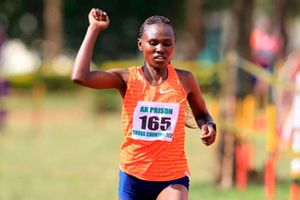
Despite Kenya’s position on Wada’s watch list since 2016, new doping cases continue to surface. The latest anti-doping case involves women’s marathon world record holder Ruth Chepng’etich, who was provisionally suspended by the Athletics Integrity Unit (AIU) on Thursday for use of the prohibited masking agent Hydrochlorothiazide.
Ruth Chepng'etich crosses the finish line in the 10km senior women's race during the Kenya Prisons National Cross Country Championship at the Kenya Prisons Staff Training College on December 17, 2024.
Photo credit: Chris Omollo | Nation Media Group
In June, long-distance runners Benard Kibet Koech and Morine Gesare Michira were sanctioned for doping.
Wahome, who has been with Adak for three years, argues that catching athletes isn’t enough. “Positive tests alone don’t deter doping,” she says.
“We need to go beyond the athletes. We need to identify who is aiding them — trainers, agents, doctors, suppliers. But athletes refuse to talk. We need to dismantle the supply chains and cartels behind the substances.”
That is why Adak supports stronger criminalisation of doping. The agency currently operates under Article 42 of the Anti-Doping Act, which allows criminal pursuit of violations. Still, Wahome believes the existing legal framework lacks sufficient teeth.
“We’re in the process of revising our Act to get it aligned with the evolving global code. We want to introduce stricter penalties that don’t just target athletes but the entire ecosystem — the enablers.”
When asked about accountability, especially involving high-profile athletes, Wahome was quick to emphasise Adak’s adherence to international standards.
“We operate strictly under the World Anti-Doping Code. Every violation category — presence, tampering, whereabouts failures — has clear procedures and sanctions. Athletes also retain the right to be heard. Even as we sanction, we ensure we respect due process.”
But compliance with international law is only one side of the coin. Public trust is the other — and it’s been hard-earned. “Many people have doubted our independence and fairness,” Wahome admits.
“Not because we aren’t doing our work, but because doping often fights back by those who benefit from it. They tarnish the agency’s name to protect their interests.”
Crucial to Adak’s work is its collaboration with Athletics Kenya, the Ministry of Sports, AIU, and Wada. Wahome dismisses the notion that Adak plays second fiddle to the AIU. “
They test elite athletes — the top tier. We test everyone else, especially emerging athletes and those outside global radar. We complement each other.”
In fact, Adak often handles on-the-ground investigations on behalf of World Athletics. “Any time you see an athlete banned for falsified documents, know that our team likely did the groundwork. We’ve built strong capacity in intelligence and investigation locally.”
Wahome’s vision is for Adak to evolve from a reactive agency to a proactive guardian of clean sport. “Testing is expensive and only addresses symptoms,” she says. “The real solution lies in education.”
One of the agency’s flagship approaches is values-based education — teaching children early about fair play, the value of hard work, and how to accept defeat.
“We’re working with the Kenya Institute of Curriculum Development to integrate anti-doping content into the school syllabus up to Grade Nine. And it’s not just schools. We engage churches, community leaders, training camps, anyone who has access to athletes.”
“They’ve been through the system. They understand the pressures and can mentor the younger generation.”
Despite these efforts, Kenya’s Category “A” classification by Wada continues to be a global red flag. Wahome sees both the burden and the silver lining in this designation.
“Being in Category “A” brought scrutiny, but it also helped us attract funding. We couldn’t reach athletes in remote camps before. Now we can. We’ve stepped up our capacity and can confidently say that no country is testing as intensively as Kenya right now.”
So, can Kenya exit Category “A” soon? “Yes, I believe so,” Wahome says. “We’re making the case, and I think our partners see the effort.”
Since its establishment in 2016, Wahome says Adak has received nearly Sh300 million cumulatively, with the most substantial funding arriving in 2023 under the Enhanced Athletics Programme.
That jump in support forced the agency to scale up fast, hiring more staff, building testing and education capacity, and expanding operations across regions.
Regardless of the annual allocation, Wahome emphasises that 70 per cent of Adak’s budget consistently goes toward core operations: education, testing, results management, and intelligence gathering.
Yet when the 2024 budget cut came, it caused immediate setbacks.
With a near-full budget likely returning for 2025-2026, Wahome remains cautiously optimistic.
“We’re playing catch-up now — making up for the months lost. But the government’s re commitment is encouraging. What we need now is stability — and ring-fencing of funds so we’re not constantly disrupted.”
Now that she’s settled into office, what is Wahome’s long-term goal? “To reshape perceptions. To restore public trust in Adak. To show Kenyans and the world that clean sport is possible here,” she says.
“Every day brings a new challenge, especially in investigations. But that’s also what motivates me. The stakes are real. We have so many clean athletes whose careers are jeopardized by the few who choose shortcuts.”
Wahome envisions an Adak that is not only feared by cheats but respected by athletes — a watchdog, yes, but also a mentor, a guide, a protector of integrity.
“My legacy? I want to leave behind an agency that helped shift the narrative, from suspicion to pride, from scandal to credibility. One where people say, ‘Kenya is doing it right.’ And we will — one case, one truth, one athlete at a time.”