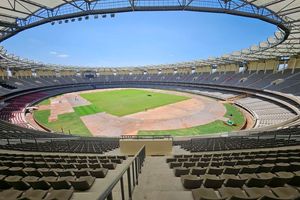
The pitch at the Moi International Sports Centre, Kasarani, is set to be replaced as part of Kenya’s preparations for the 2027 Africa Cup of Nations (Afcon) finals that the country will co-host with Uganda and Tanzania.
The 36th edition of Afcon, slated for June 19 – July 18, will be the first ever to be hosted by three different countries, and also the first in five decades, to be organised in the Cecafa region, since Ethiopia hosted it in 1976.
Concerns about the stadium’s playing surface emerged in October last year, with reports that the Confederation of African Football (CAF) had rejected the quality of grass planted there.
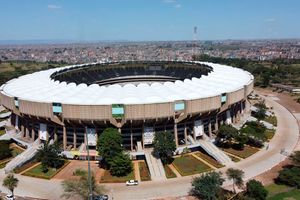
A view of a section of Moi International Sports Centre, Kasarani.
Photo credit: Sila Kiplagat | Nation Media Group
Then Sports Cabinet Secretary Kipchumba Murkomen assured the public that CAF’s recommendations were being met ahead of the tournament.
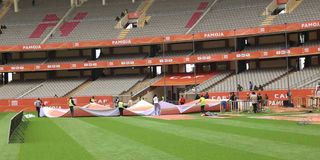
Many fans observed the rugged appearance of the pitch that lacked the sleek look of a quality ground.
Kenya’s Local Organising Committee (LOC) chairman Nicholas Musonye admitted that they were forced to apply green paint on the discoloured patches of the surface to improve the television look of the pitch during the final between Morocco and Madagascar.
Musonye told Nation Sport last week that replacement of the entire playing surface may start later this month.
The veteran football administrator, who served as the Cecafa Secretary General for many years, said experts had recommended that the entire ground be planted with bermuda grass, and not the mixture of bermuda and kikuyu grass currently grown on the pitch. Kikuyu grass is the species planted at Nyayo National Stadium.
“We are going to lay a new pitch there. According to the experts, all of it should be bermuda grass, not hybrid. Bermuda grass is the one recommended worldwide,” Musonye said, adding: “The kikuyu grass at Nyayo could also be replaced with bermuda grass.”
However, the species of grass is not the only consideration that Kenya needs to make when replacing the playing surface at the stadiums.
Moi International Sports Centre, however met all other requirements.
If His Excellency so wished, he could conduct matters of state from the stadium at a comfy office, and retire to a deluxe bedroom. Welcome to the new-look Moi International Sports Centre, Kasarani
According to the requirements outlined in Article 7 of Chapter II in the CAF Stadium Regulations, Edition 2022, the field of play must be smooth and level, and the height of grass at between 20 millimetres and 30 millimetres. The ground must also have a water sprinkler and drainage systems.
Maintaining the height of grass, between 20 and 30 millimetres has several benefits including allowing the ball to move smoothly and at the right speed. It also reduces the risk of injuries such as burns.
A water sprinkler system is essential in keeping the pitch moist. This reduces the risk of injuries. A drainage system ensures the pitch remains playable even during heavy rains by draining excess water to avoid flooding.
According to the CAF regulations, there should also be a boundary of either natural or artificial grass of a minimum width of 1.5 metres around the perimeter of the pitch.
The recommended length of a pitch should be 100 metres minimum, and 110 metres maximum, while the width should 64 metres maximum and 75 metres maximum.
A warm-up area for substitutes must be provided along the touchlines or behind the advertising boards behind the goal posts. If the warm-up area is located behind the advertising boards behind the goal, CAF demands that it must be made of at least artificial turf.
If warm-up areas are behind each goal posts, the recommended dimension for each warm-up area is 3m x 30m for six players and two officials in each area. If it is more practical to place the warm-up area behind the assistant referee, the dimensions would depend on the stadium set-up.
For artificial turf stadiums, they must meet several conditions, including being granted the required Fifa license, which can only be delivered after the turf has been tested by a FIFA-accredited laboratory and passed fit.
The turf must also meet all the requirements of the national legislation in force, its surface must be green and marked in white.