Threats by Ugandan President Yoweri Museveni to wage war on Kenya and gain access to the Indian Ocean have caused uneasiness in the increasingly volatile eastern Africa.
The statements, echoed by his son Muhoozi Kainerugaba, the Chief of Defence Forces, raise cannot be overlooked as they strike at the foundation of international law and the African Union’s principle of territorial integrity.
The rhetoric is a profound challenge to venerated legal principles balustrading international peace and security. It is a violation of Article 2 of the UN Charter, which states: “Members shall refrain in their international relations from the threat or use of force against the territorial integrity or political independence of any state, or in any other manner inconsistent with the Purposes of the United Nations.”
Uganda, like other UN members, is bound by this principle of international law. UN General Assembly Resolution 2625 of 1970, titled “The Friendly Relations Declaration”, and Resolution 3314 of 1974, “The Definition of Aggression”, prohibit the threat or use of force to acquire territory.
The AU’s Constitutive Act, to which Uganda is a founding member, prohibits “the use of force or threat to use force among member states” and mandates respect for the “sovereignty, the territorial integrity, the independence” of neighbours as well as the “borders existing on achievement of independence”.
President Yoweri Museveni’s son Major-General Muhoozi Kainerugaba.
Photo credit: File | Nation Media Group
The principle on borders, adopted in 1964, has been the bedrock of stability, preventing the continent, with its 109 international boundaries cutting across 177 cultural or ethnic communities, from being engulfed in border skirmishes and irredentist claims.
The legal framework for landlocked states’ access to the sea is robust and globally codified, rendering Uganda’s threats baseless. The UN Convention on the Law of the Sea grants landlocked states the “right of access to and from the sea and freedom of transit”.
This, however, is a right of transit, not a right to territorial acquisition or a sovereign corridor. It is to be exercised through bilateral, sub-regional or regional agreements with the transit states.
In the East African context, this right is fully realised through the Northern Corridor, an artery that connects the port of Mombasa to the landlocked countries of Uganda, Rwanda, Burundi and South Sudan.
Uganda is Kenya’s most important trading partner, and the Northern Corridor is the lifeline for the Ugandan economy.
More than 80 per cent of Uganda’s imports and exports pass through Mombasa, with the corridor handling millions of tonnes of cargo annually. The economic stakes are huge.
Uganda has a multitude of established channels to address any perceived interference with its transit rights. It can utilise bilateral mechanisms like the Joint Ministerial Commission it has with Kenya or the regional mechanisms under the auspices of the East African Community (EAC) and the AU, which provide frameworks for dispute resolution and economic integration.
Uganda can also take its grievances to the International Tribunal for the Law of the Sea and the International Court of Justice (ICJ).
The fact that President Museveni and his son have bypassed these established diplomatic and legal avenues to issue threats suggests a motive beyond mere transit rights. It signals a shift towards militarised diplomacy and a disregard for regional norms.
Kenya should be concerned by Uganda’s threats, as they are not isolated but part of a disturbing regional trend. In the last two years, Ethiopian Prime Minister Abiy Ahmed has repeatedly stated that his country’s landlocked status is an injustice and that access to the Red Sea is “a matter of survival” and “irreversible”.
The rhetoric echoes the sentiments that fuelled the 1998-2000 destructive war between Ethiopia and Eritrea.
The common thread in the Ethiopian and Ugandan cases is the use of historical grievance and existential rhetoric to justify a potential violation of a neighbour’s sovereignty. This is a clear and present danger to the AU’s foundational principle of uti possidetis juris – the respect for colonial-era borders.
AU’s failure to condemn these threats, instead opting for vague appeals for dialogue and restraint, sends a perilous message: that the threat of force can be a legitimate tool of foreign policy in Africa.
This policy vacuum must be filled with a strong, unified condemnation from the AU and the global community.
The most compelling argument that should worry Kenya is the possibility that the grand public threat of war for sea access is a red herring designed to distract her from Uganda’s quiet, piecemeal and encroachment on Kenyan territory.
Migingo Island lies in both Uganda and Kenya waters and this has created disputes regarding its ownership. File PHOTO
While the Kenyan public is fixated on the half-acre Migingo island in Lake Victoria – a dispute that has yet to be settled despite records showing it is in Kenya – Uganda is said to be engaging in adverse possession of significant chunks of western Kenya.
The boundary along the Malaba-Busia road is defined by the British Colonial Order in Council of February 1, 1926, as the centre of the course of River Kame – “thence by the centre of the course of that river to its intersection with the eastern boundary of the Mjanji-Busia-Malaba road, such boundary being 100 feet distant from and parallel to the centre line of the said road”.
Unfortunately, this definition is ambiguous and exploitable. Since the road is on the west side of the border, its maintenance, which is often unilaterally undertaken by Uganda, has effectively been shifting the border eastwards.
This means whenever a metre from the centre of the road is moved eastwards, Uganda acquires a territory the size of Nairobi’s CBD. This is a non-military form of territorial acquisition that exploits ambiguous boundary delimitation based on a colonial legal instrument.
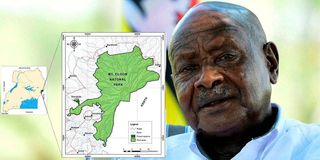
A more egregious and explicit act is Uganda’s arbitrary redefinition of the boundary on Mt Elgon. The 1926 Order in Council establishes the boundary from the source of River Lwakhakha to the highest point of Mt Elgon, which is Wagagai summit (4,321m).
However, the 1995 Uganda Constitution redefined this boundary, designating Sudek summit (4,303m) as the “highest point of Mt Elgon” and then drawing a line from Sudek to Wagagai.
This capricious delimitation has stripped Kenya of almost 20 square kilometres or 5,000 acres of high-altitude, ecologically valuable land. This is not a row over interpretation; it is a clear, documented and unilateral change to an internationally recognised boundary using a state’s constitution.
The Migingo dispute symbolises Uganda’s willingness to use force to enforce its claims. The island is a multi-million-dollar fishing and smuggling hub, strategically located to access the rich Nile perch fishing grounds. The dispute has been characterised by the presence of Ugandan security forces and the harassment of Kenyan fishermen, creating a state of perpetual low-level conflict and economic insecurity for locals.
The recent “amicable deal” announced by some officials has yet to translate into a final, legally binding demarcation that resolves the issue on the ground.
The Kenyan government has a mandate to protect its territorial integrity and sovereignty against external threats. The current situation, marked by Mr Museveni’s aggressive rhetoric, must be seized not as a crisis, but as a policy inflection point.
President William Ruto must move beyond diplomatic niceties and adopt a decisive, multi-pronged strategy. Kenya should elevate the issue to the highest levels of the AU Peace and Security Council and the UN Security Council, not just as a bilateral dispute, but as a threat to regional peace and violation of the uti possidetis juris principle.
Furthermore, Kenya should consider initiating proceedings at the ICJ to seek a declaratory judgment on the validity of the 1926 Order in Council and the illegality of Uganda’s constitutional redefinition of the Mt Elgon boundary.
The most critical long-term policy action is to convert the ambiguous 1926 Order in Council into a modern, mutually agreed-upon boundary treaty. This treaty must be followed by comprehensive, joint and technologically-driven demarcation and maintenance. The neighbours should sign a border treaty after reaffirming the colonial boundary with use modern technology to replace vague descriptions with precise GPS-based coordinates.
Second, the entire 814-kilometre boundary must be clearly marked with permanent, visible pillars, especially in the disputed areas of Malaba-Busia, Mt Elgon and West Pokot.
Third, the two countries must establish a permanent, well-funded Joint Boundary Commission with a clear mandate for regular inspection and maintenance of the markers.
Kenya must leverage its position as the transit state for the Northern Corridor. While maintaining the spirit of EAC cooperation, Kenya should make it clear that the stability of the corridor is contingent on the respect for its sovereignty. This is a statement of fact. Instability and military threats jeopardise the very infrastructure Uganda relies on. The EAC should promote alternative transit routes, such as the Lamu Port-South Sudan-Ethiopia-Transport (Lapsset) Corridor, to diversify regional trade and reduce the strategic leverage of one landlocked state.
The EAC and AU must be pressured to strengthen their security protocols. The AU Peace and Security Council and the EAC Council of Ministers should adopt resolutions that condemn the threat of force for territorial gain and establish clear, automatic mechanisms for sanctions against member states that violate principles guaranteeing peace and security.
In conclusion, Uganda’s threats are a dangerous distraction from a more insidious reality: a quiet, sustained campaign of territorial encroachment. The “maritime dream” is a smokescreen, a “red herring” for drawing attention away from the Malaba road and Mt Elgon territorial grabs.
For policy-making circles in Nairobi and across the continent, the message is clear: Sovereignty is non-negotiable and the rule of law must prevail.
Kenya must secure its borders, not just in conformity with the AU requirement, but as a concrete step to prevent the erosion of its territorial integrity and to safeguard the economic future of East Africa.
The time for decisive action – legal, diplomatic and infrastructural – is now as the stability of the EAC hangs in the balance.