From rogue settlers and safes sunk in mud to local resilience and restless ambition, Eldoret’s journey is less about titles than the contradictions that still define it.
A year ago, Eldoret residents marched in the streets, danced to music and cut ribbons as they celebrated elevation of their town to a city. With the charter, politicians queued to shower promises, businessmen rubbed their palms in anticipation of fortune, and even a statue — though crude in form — briefly stood sentinel before public outcry consigned it to a furtive midnight removal.
Yet now, a year later, the chorus has shifted. The same residents who once cheered the birth of their city now murmur with regret, weary of the burdens that accompanied the title they so eagerly embraced. They want to be a town!
From its founding, Eldoret has never marched in lockstep with order or orthodoxy. Instead, it has thrived on rumour, myth, gossip and sudden invention. Grand designs have always paled beside the unruly vibrancy of everyday life. It looks like Eldoret does not submit to the tyranny of plan, but dances, instead, to the anarchic music of its own making.
Perhaps Eldoret is still haunted by its past. From its birth, the town bore a divided soul. The Boer farmers who settled here after fleeing South Africa called it Sixty-Four, while the post office, with bureaucratic precision, registered it as Eldore River — a name borrowed from the stream that merged with the Sosiani nearby.
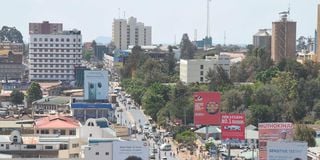
A busy street in Eldoret City, Uasin Gishu County on April 21, 2025.
Photo credit: Jared Nyataya | Nation Media Group
Until early 1911, Eldoret lived with this twin identity, shifting uneasily between the settlers’ rough pragmatism and the officialdom’s tidy record.
Girouard, with dry wit, refused: no settler could spell it, no African could pronounce it. Instead, he observed that the place’s current name had a happy resemblance to Eldorado, the land of promise. He urged the inhabitants to add a simple “t” to Eldore — in keeping with local place names — and so Eldoret was born.
The irony is that the twin identity has never really vanished. Then, the town could not decide whether it was Sixty-Four or Eldore River. Now, a century later, its people cannot decide whether they want a bustling city or a familiar town. Eldoret, it seems, has always lived with a double face — and perhaps that, more than anything, is its true inheritance.
It is good that Eldoret had buried some of its ghosts given that it is the only town in Kenya whose foundations were laid not by paragons of virtue but by South African and British rogues, renegades, and misfits.
At one point, Eldoret was the epicentre of colonial notoriety, a theatre of murders, and chicanery concealed in archives. Astonishingly, the city — or Eldy, as it is affectionately nicknamed today — has contrived to bury that ignominious past beneath layers of resilience and ambition, rising to become the fifth-largest urban centre in Kenya.
Residents of Eldoret city might do well to remember that their home was born out of struggle and sweat.
Its story is often told as beginning in 1909, when nearly 280 Boer families trekked into the Kenyan highlands from South Africa. They carried with them prefabricated houses, wagons, ploughs, cattle, and sheep, along with a fierce determination to build anew in unfamiliar soil.
They sought a homeland that echoed the veldts (open, uncultivated country or grassland in southern Africa ) they had abandoned — wide horizons, open skies, and the freedom denied them under the British yoke. But that is the single story told earlier.
The story claims that some boers led by Meneer Van Rensberg, landed in Mombasa in June 1908 aboard the German steamer Windhoek. From the humid coast they began their arduous journey inland.
Wagons creaked over rough tracks, oxen strained against mud and rock, families pressed close against the cold and rain. By July 18, they reached Nakuru, where exhaustion and uncertainty caused some families to splinter off. Yet the core of the group pressed onward with 42 wagons toward the Uasin Gishu plateau.
Commercial buildings under construction in Eldoret City, Uasin Gishu County on April 22, 2025.
Photo credit: Jared Nyataya | Nation Media Group
But Eldoret did not rise from Boer grit alone; it was African endurance, knowledge, and labour that made survival possible. Local communities guided routes, traded food, tended herds, and taught settlers how to work the land.
When fields were carved, it was African hands that broke the soil. When homesteads were raised, it was African builders who shaped them. As farms spread, Africans ploughed, harvested, and sustained the economy that transformed a precarious settlement into a thriving town.
What am I saying? Eldoret’s growth was rooted in African contribution. The city that stands today owes as much to the hands and wisdom of its local people as to the wagons that creaked into its highlands.
If Eldoret is to honour its past honestly, it must acknowledge that its foundations were laid not only by outsiders seeking new horizons, but by Africans whose toil, sacrifice, and spirit remain at the heart of its story. And that is why they must stand by the new city status.
Another character of Eldoret is that of a town born of faith. This is no exaggeration. Its streets, its stories, its survival rest not on blueprints or decrees but on the fragile, enduring conviction that people — left to their own devices — can build a town, a city, and perhaps even a future.
One of the colonial-era captivating stories was that of Eddy’s Bar —a watering hole so strange it supposedly had no bartender. None. Customers walked in, fetched their own drinks, left money on the counter, and—this is the best part—helped themselves to exact change. One night, two fellows found the door padlocked, broke it, fetched beer, paid, and left. From then on, the bar had no door. And thus, Eldoret should build on this trust and communal responsibility as part of its history.
This is well captured in the story of how the first bank was built in Eldoret. It is claimed that one wagon carried a massive safe. Somewhere near Eldoret, it toppled off and couldn’t be lifted back. The new arrivals, in their usual fashion, shrugged and built a bank around it. This became the Standard Bank.
The “safe story” captures the essence of Eldoret’s foundation: a community built on improvisation rather than planning, on defiance rather than obedience. If you see Eldoret cobbling things together on the spot, know it has a history.
Settlers’ refusal to use sterling, their resistance to permanent buildings, their disdain for the district commissioner — all reveal a town that rejected the orthodoxy of empire while indulging in its excesses.
The British never quite managed Eldoret. The settlers used Kruger coins instead of sterling. They resisted stone buildings in case they had to flee. They ignored the district commissioner, who had to refer every decision to Nairobi or Naivasha.
Pedestrians cross a street in Eldoret city after the county government's partial launch of traffic lights on some street lights in the city on June 11, 2025.
Photo credit: Jared Nyataya | Nation Media Group
By 1913, the first DC quit, unable to tame the rogue town. But alongside this notoriety, Africans were laying the foundations of a real community — trading, farming, building, and eventually populating the very town that outsiders claimed as theirs.
And now, when told to be a city, Eldoret shrugs and replies: “No, thanks.” It would rather remain Eldy — restless, unpredictable, alive with contradictions.
For its greatness has never come from titles or decrees, but from the people who made it thrive: farmers and traders, builders and dreamers, the countless Africans whose labour and ingenuity carried its promise forward.
It seems that Eldoret has always preferred the crooked path over the straight one. It was built on gossip as much as grit, on myths as much as milestones: a post office run by a failed farmer, a bar without a door, a safe sunk in the mud, and a name that may well have been a typo.
So perhaps it is fitting that when called a city, Eldoret both accepts and refuses. It is proud enough to stand among Kenya’s great urban centres, yet mischievous enough to laugh at the formality of it all.
For in the end, Eldoret is not just a city, nor merely a town. Eldoret is a story — improbable, unruly, resilient, and still unfolding.
John Kamau is a PhD candidate in History at the University of Toronto. Email: [email protected] ; On X: @johnkamau1