Kenya is on the verge of signing an agreement that will see it share information about infectious diseases in order to secure funding from the US government.
The MoU will guarantee Kenya limited funding from 2026 to 2030 while the US will get data from Kenya for 25 years.
Critics have labelled the deal lopsided and an effort by Washington to sidestep the World Health Organization (WHO) and other global agencies.
Information Kenya will be required to submit includes physical specimens of citizens. It will also share genetic sequence data of disease-causing organisms detected that have the potential to spread rapidly.
In the deal, whose details are being finalised, the US has to be notified of any infectious disease a day after its detection. Kenya is required to detect such diseases within seven days of their emergence.
Upon detection and alerting the US, Kenya will be expected to complete initial response actions. Nairobi should also consult Washington on the response strategy.
Failure to fulfil specimen and sharing commitments could result in changes in the assistance as specified in the MoU. It may also lead to the discontinuation of the agreement by the Americans.
The response to outbreaks will be American-grade, as Kenya is expected to adopt the standards of the United States Food and Drug Administration.
“Kenya commits to allow the United States Food and Drug Administration’s approval or Emergency Use Authorisation of Medical counter-measures to be a sufficient basis to use the medical countermeasures to respond to an outbreak in the country,” the MoU reads.
Infectious disease outbreaks
The pact is a tool under the America-First Global Health Strategy, which, according to the US government, “outlines a comprehensive vision to make America safer, stronger and more prosperous. It will protect the homeland by preventing infectious disease outbreaks from reaching US shores”.
The MoU has been replicated in Nigeria, Mozambique, Zambia, Cameroon, Tanzania, Namibia, Uganda, Cote d’Ivoire, Botswana, Ghana, Rwanda, Lesotho, the Democratic Republic of Congo, Eswatini, Ethiopia and Malawi.
Countries in Africa face financial and operational strain in HIV/Aids treatment and care programmes following a three-month halt of US foreign aid declared in January.
Despite assurances from the US that life-supporting initiatives would still be funded, few of the affected projects have fully resumed.
In exchange for Kenya’s data, the US government plans to fund an assessment of the country’s outbreak surveillance system, including safety procedures for pathogen sample collection, transport, storage, testing and disposal.
The US also commits to settle salaries and benefits to fund epidemiologists in every year of the agreement. The number of these experts is to be determined by the Kenyan government.
According to the deal, America will – subject to availability of funds – continue financing laboratory commodities it is financing, as well as frontline lab workers in 2026. The funding expected to decline gradually thereafter.
The US will also fund frontline healthcare workers – including doctors, nurses and community promoters – with Kenya committing to add 500 medical officers and nurses on government payroll in 2027. The same number will be added in every subsequent year until 2030.
Seasonal workers, such as those participating in malaria campaigns, are to be funded by the US government.
Any sample transport support, diagnostic network optimisation and laboratory quality improvement accreditation provided the US plans will be transitioned to Kenya by the end of 2027.
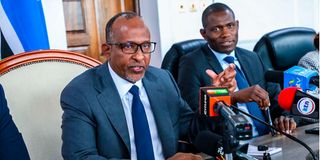
The meeting to deliberate on the MoU took place two weeks ago. It was attended by Health Cabinet Secretary Aden Duale and his National Treasury colleague John Mbadi.
Principal secretaries Chris Kiptoo (National Treasury), Korir Sing’oei (Foreign Affairs) and Ouma Oluga (Medical Services) were in the meeting.
Through his LinkedIn account, Dr Oluga said the ministry officials “held high-level discussions with representatives of the US government to align on the financial, policy and diplomatic pillars of our renewed health partnership MoU”.
“These talks build on months of constructive engagement since the Stop Work Order issued on January 20, 2025,” he said.
US government representatives included Brad Smith, a global health adviser in the State Department who oversees the reorganisation of the US President’s Emergency Plan for Aids Relief (Pepfar) and health grants from the now-defunct US Agency for International Development (USAID).
Another was Ms Susan Burns, the Chargé d’Affaires and acting ambassador.
“This new health partnership strengthens efficiency, sustainability and country ownership through a direct government-to-government approach,” Dr Oluga said.
“The milestone holds a special meaning for me. Before taking up my role as the Principal Secretary for Medical Services, I led the assessment of the Stop Work Order impact and the closure of USAID-supported health programmes. The extensive experience guides our efforts to establish a more resilient, accountable and truly Kenyan-led health partnership.”
In his announcement, also on LinkedIn, Dr Kiptoo said the discussions on the America First Global Health Strategy “reaffirm our long-standing partnership in strengthening Kenya’s health sector”.
“We appreciate the US government for its continued support in combating HIV, TB and malaria, and in advancing health system strengthening across the country,” Dr Kiptoo said.
“Both countries are finalising an agreement that aligns Kenya’s health priorities with the United States’ global health objectives, strengthening a partnership that saves lives and builds a more resilient health system for our nation.”
The MoU’s companion guide states that the objective is “to establish an understanding between the US Department of State and partner countries that will advance US interests, save lives and help countries build resilient and durable health systems”.
“To keep America safe from infectious disease threats, all countries should generally have the same vision: a surveillance and outbreak response system capable of achieving 7-1-7,” it adds.
The “7-1-7” refers to the policy of taking seven days to detect, one day to notify and seven days to complete early response actions.
Another provision in the agreement is that Kenya is to exempt from tax US government funds used to execute the MoU, including money deployed through local contractors and sub-contractors.
The US wants access to a range of data, including electronic medical records, health management and information systems, and outbreak response and surveillance data systems.
The MoU stresses that countries need to provide the US with “any data access or information needed to monitor compliance with applicable legal requirements, including to confirm no US government funding is being used for the performance of abortion as a method of family planning or to motivate or coerce any person to practise abortion”.
It stipulates that it is “not an international agreement and does not give rise to legal rights and obligations under international or domestic law”.
Experts say the deal places American interests above those of Kenyans. One of the sticky points is that the US would not offer Kenya any access to the health products that might be developed from the pathogen material Nairobi shares, or any co-authorship on research based on materials Kenya provides.
Mr Aggrey Aluso, the Director of the Africa Region for the Pandemic Action Network, described the agreement as lopsided, given its minimal investment, adding that it undermines African countries’ sovereignty.
He said the requirement for Kenya and other African countries to share data for 25 years in exchange for only five years of support is “severely unequal”.
“Countries enter into agreements with other countries. What is important is that the benefits are mutual,” Mr Aluso said.
“This negotiation is not in good faith. It is extractive, exploitative and undermines the multilateral systems in place that help drive solidarity-based responses to health emergencies.”
He added that in any response, one needs pathogens and genetic sequencing data to be able to make counter-measures.
“If somebody takes control of that, it means they will define the pathway on how you manage or respond to any health emergency. It is also not clear the benefits that will accrue to the people giving their data,” Mr Aluso added.
“It gives non-committal proposition that depending on resources from US, they may give certain benefits to countries that share their data. There is no guarantee.”
He said the decision to sign MoUs with countries points to a bid by the US government to position itself as the primary hub for rapidly sharing critical information about dangerous disease-causing organisms. In his view, this implies the US is undermining the authority of the WHO.
Currently, nearly all WHO member states (except the US and Argentina) are negotiating the Pathogen Access and Benefit Sharing (Pabs) system, a unified process designed to ensure swift international information-sharing and counter-measure development.
By becoming the gatekeeper of pathogen data through its own agreements, Mr Aluso said, America risks fragmenting and delaying the worldwide pandemic response.
Questioned about the agreement on NTV’S “Fixing the Nation” morning show, Ms Burns said she could not comment as the negotiations with the Kenyan government were ongoing.
She explained that it is a health partnership coming after the USAID withdrawals, “even though the United States has remained the top donor in Kenya on matters health, committing around Sh25 billion every year”.
The Office of the Data Protection Commissioner (ODPC) said it is aware of the agreement, adding that the Executive had reached out to it for advice, and that it had given directions regarding the same.
“We confirm that the Ministry of Health has proactively engaged the ODPC to seek an advisory regarding the data protection implications of the proposed US Government-Ministry of Health data exchange. We are providing the necessary guidance to ensure full compliance with the law,” Data Protection Commissioner Immaculate Kassait said.
“It is important to clarify that such agreements do not alter our privacy laws. They must operate within the robust framework of the Data Protection Act (2019) and the Data Protection (General) Regulations, 2021. To ensure Kenyan laws are upheld, the Ministry of Health (acting as the Data Controller) is required to conduct a comprehensive Data Protection Impact Assessment. This assessment identifies potential risks regarding the transfer and establishes mitigation measures.”
Contacted, Dr Oluga said the US and Kenya “are almost there” in finalising the process. The PS added that he would only answer questions about the agreement after it is signed.
“I’ve already given you the information on my LinkedIn,” he said, declining to comment further.
However, in a past interview with the Business Daily, Dr Oluga said that under the new agreement, the Kenyan government would assume direct responsibility for managing the finances and overseeing programme implementation, with the US continuing as the primary donor.
The MoU is reportedly nearing completion, following an agreement reached between President William Ruto and US Secretary of State Marco Rubio on the sidelines of the United Nations General Assembly in September. The agreement stipulates that while the US remains the primary donor, the Kenyan government will directly manage the funds and implementation of programmes.
“This is a mutual partnership anchored in shared priorities. The previous model worked for its time, but Kenya’s needs have evolved. We can no longer run parallel systems in public facilities. Most policy components have already been cleared by the Ministry of Foreign Affairs, leaving only the legal language to be finalised,” Dr Oluga told the Business Daily.
Health Committee chairperson in the National Assembly Dr James Nyikal.
Photo credit: Boniface Mwangi | Nation Media Group
Seme MP James Nyikal, who chairs the National Assembly Health Committee, said his team is not privy to the details of the Kenya-US agreement.
“I know it in broad principles, but don’t have the details,” he told the Sunday Nation.
According to Dr Nyikal, unless it’s a partnership that requires the ratification of Parliament, it becomes an Executive task.
“It is probably about funding arrangements following the withdrawal of the US aid. That is something the Executive does and it makes those arrangements. Definitely, when we come to the budget, we will ask them if there are other arrangements of health financing,” the lawmaker said.
“The Executive has the right to get into many negotiations. It can even negotiate loans and sign. Depending on what nature it is, it doesn’t have to come to Parliament. If it is a treaty between two countries, then the treaty will to Parliament, but if it’s an aid agreement, I don’t think so.”
Treasury Principal Secretary Chris Kiptoo.
Photo credit: File | Nation Media Group
Mr Mbadi, Dr Kiptoo and Dr Singo’ei did not respond to our questions and failed to pick several follow-up calls.