Since eruption of Gen Z-led anti-government protests in Kenya in June 2024, President William Ruto’s administration has leaned on what human rights activists say is a familiar authoritarian playbook — branding dissent as terrorism.
Human rights groups and legal experts warn that the state’s response to largely peaceful demonstrations is part of a regional trend in East Africa, where governments invoke anti-terrorism laws to stifle opposition and civil society.
From Uganda and Ethiopia to South Sudan and Tanzania, criminalisation of protest has become a repressive tool. Kenya, observers say, is following suit.
Protesters carry their injured colleague during Saba Saba protests in Nairobi on July 7, 2025.
Photo credit: Billy Ogada | Nation Media Group
In recent weeks, the Directorate of Criminal Investigations (DCI) has accused protest organisers, digital activists, and financiers of “terror-related activities,” invoking sections of the Prevention of Terrorism Act. The state claims the Gen Z movement is funded and coordinated by foreign actors to destabilise the country, a narrative mirroring those used by neighbouring regimes.
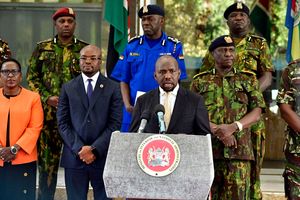
“Of these, 50 individuals are being investigated by the Serious Crime Unit (SCU) while 71 cases are being handled by the Anti-Terrorism Police Unit for offences related to acts of terrorism. The government cannot and will not tolerate lawlessness disguised as protest. We have a duty to protect lives and property from criminal elements hiding behind political causes,” Mr Murkomen said.
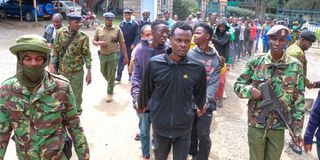
Those arrested face charges ranging from terrorism, murder, and robbery with violence to sexual assault, arson, and malicious damage to property. But human rights defenders say the charges are excessive, politically motivated, and intended to instil fear.
Some of the 86 suspects who were arrested for blocking Nakuru-Nairobi highway during Saba Saba protests on July 7, 2025 in a Nakuru Law Court on July 9, 2025.
Photo credit: Bonface Mwangi | Nation Media Group
“Imposing unreasonably tough bail conditions on Gen Zs charged with politically motivated terrorism offences violates the constitutional right to bail under Article 49(1)(h); reasonable bail conditions. Magistrates should avoid being perceived as an extension of the Executive,” Mr Muite, known for his pro-reforms push in the 1990s, wrote on X.
Former Chief Justice David Maraga said the state’s actions betray desperation and fear of youth mobilisation.
“The charges that have been preferred against the young people tell you the desperation the government is working in. Most of these young people are under the age of 25—imagine 18-year-olds being charged with terrorism in circumstances which, when you consider, you cannot see any terrorism act,” Mr Maraga, who has announced his intention to run for president in 2027, said.
These charges the former CJ said, are meant to instil terror for the young people and their families and control them.
“A terrorism offence is a very serious offence, and the reason they are being charged is so that they are denied bond, traumatised, and kept away from their families. These are trumped-up charges intended to control the young people and create fear in the country,” Mr Maraga said.
Former Law Society of Kenya President Nelson Havi also faulted the state saying the young arrested and charged in court are “kids”.
“I wish Murkomen could research the French Revolution and understand what led to the execution of King Louis XVI and his wife, Marie Antoinette. It was because they suppressed people’s discontent; the youth led the revolution,” Mr Havi cautioned. A coalition of civil society organisations under the Police Reforms Working Group also condemned the charges and arrests terming them politically motivated.
It demanded justice and full transparency over the deaths of 38 Kenyans during the July 7 protests, more than 500 injuries, and what they described as widespread human rights violations.
The coalition accused security agencies of turning peaceful protests into “killing grounds” and warned that profiling and arbitrary arrests based on perceived political affiliation or ethnicity violate the Constitution.
“The Constitution prohibits arbitrary pre-trial detention. Every accused person must be granted access to legal counsel, medical care, and the opportunity to challenge their detention in open court,” Amnesty International Kenya Executive Director Irungu Houghton said.
Transparency International Kenya’s Executive Director Sheila Masinde urged the Independent Policing Oversight Authority (Ipoa) to publish the results of ongoing investigations into the deaths and injuries.
The group also condemned the Office of the Director of Public Prosecutions (ODPP) for pressing disproportionate charges such as robbery with violence and terrorism.
“We are alarmed by the indiscriminate use of live ammunition in residential areas, especially in Kajiado and Kiambu counties. At least seven minors are currently being treated for gunshot wounds,” said Houghton.
Kenya’s current trajectory mirrors patterns observed in East Africa, where governments have relied on anti-terror laws to silence dissent. In Uganda, President Yoweri Museveni’s regime has a long history of using security laws to criminalise opposition. At least 36 opposition supporters were charged with terrorism in 2024 following protests linked to Robert Kyagulanyi’s National Unity Platform (NUP).
Youths carrying a fatally shot person in Kangemi, Nairobi, during Saba Saba protests on July 7, 2025.
Photo credit: Bonface Bogita | Nation Media Group
In Tanzania, opposition leader Freeman Mbowe and his co-accused- Halfan Bwire, Adam Hassan and Mohammed Abdillahi - were detained for eight months from mid-2021 to March 2022 on terrorism charges. The arrests followed demands for constitutional reforms.
In Ethiopia, Jawar Mohammed, a prominent opposition figure, was arrested and charged with terrorism in 2020, accused of inciting ethnic violence after the killing of popular singer Hachalu Hundessa.
In South Sudan, political activist Peter Biar Ajak was arrested in 2020 and charged with terrorism after eight months in detention. His arrest followed calls for democratic reforms and youth empowerment.
Legal scholars argue that Kenya risks walking the same path if security laws are politicised. “Terror laws were meant to address serious threats, not to intimidate protesting youth. Their misuse degrades democracy and turns civic activism into a criminal act,” constitutional lawyer Waikwa Wanyoike said.
The 2012 Prevention of Terrorism Act, enacted in the wake of growing threats from Al-Shabaab, is now being used against protestors wielding placards and hashtags.
This shift, critics say, distorts the law’s original purpose. Activists and lawyers warn that equating protest with terrorism not only undermines public trust in the justice system, but also violates constitutional freedoms of expression, assembly, and association.
“If the state labels every youth who disagrees with it as a terrorist, then we’re headed toward authoritarianism. The charges are not about justice- they’re about silencing Gen Z,” Njeri Mwangi, a human rights lawyer, said.
Legal aid organisations say hundreds of arrested protestors are languishing in remand, some unable to meet stringent bail conditions. Others remain unaccounted for. The Kenya National Commission on Human Rights (KNCHR) has demanded answers from the Interior ministry over the fate of those still missing. It has also called for an independent audit of police conduct during the protests.
A protester is cornered by anti-riot police officers during Saba Saba protests in Kangemi, Nairobi on July 7, 2025.
Photo credit: Reuters
President Ruto, who rose to power with the backing of the youth and a promise to lower the cost of living, now finds himself under siege from the very constituency that helped him win office. His critics argue that the turn toward security crackdowns - especially the invocation of terrorism charges- is a betrayal of that trust.
Kenya’s Constitution, under Article 37, enshrines the right to protest, the right to bail, and protection against arbitrary detention. But the recent events suggest that the state is selectively applying the law to protect itself from political pressure.
If history is any guide, using terror laws to suppress civic movements only deepens discontent. In the long run, such repression can backfire, radicalising a generation that had initially called only for dialogue, transparency, and dignity.
Kenya currently faces a crucial test, will it uphold democratic norms and constitutional freedoms, or will it drift toward a familiar regional pattern of repression?