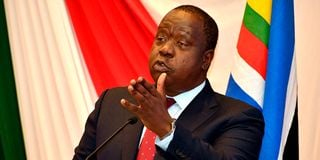
Former Interior CS and 2027 presidential hopeful Fred Okengo Matiang’i has left no doubt that he considers the Kenyan diaspora in the United States as a key fundraising and voter mobilisation constituency aboard.
Prof Reuben Marwanga, the Matiang’i Diaspora Campaign Coordinator, told the Weekly Review that over the last 12 months, the prospective candidate has held consultative meetings with Kenyans in Atlanta and Dallas Texas.
“In July 2025, he will have meetings in Baltimore Maryland and Minneapolis, Minnesota,” he said.
From a strategic campaign perspective, Baltimore, in the state of Maryland, hosts many Kenyans and Kenyan-born Americans. It is also connected directly with Washington DC – the seat of American power — and the state of Virginia that also has a big Kenyan community. The DMV (DC, Maryland, Virginia) matrix, is shaping up to be a key fulcrum to the Matiang’i campaign.
The former Cabinet Secretary is also targeting the Mid-Western state of Minneapolis and specifically the city of Minnesota, which is known for having thousands of Kenyans, with diasporans from Nyamira and Kisii counties dominating.
On why Matiangi is opting for these locations Prof Marwanga says: “Working at the World Bank in Washington DC for the last two years, Dr Matiang’i has been one of us, a member of the Kenyan diaspora. Now that he’s going home to seek the presidency, he has been meeting Kenyans in various parts of the US to give his vision for a future Kenya and receive the diaspora feedback.
Kenyans in the diaspora fully support his bid to run for president because we believe he has the will and the capacity to turn the country around and put it in the right trajectory of growth.”
Prof Kefa Otiso of Bowling Green State University also emphasises Dr Matiang’i is “one of us,” having worked in Washington DC until recently.
“It thus makes geographic sense for him to connect with other Kenyan diasporans in the US. He might have started in locations with many members of the Gusii community, for instance Dallas, but I expect him to reach out to all Kenyans here eventually. The Gusii also happen to be some of the largest components of the Kenyan diaspora in the US,” he says.
Prof Otiso adds that Kenyans abroad have the ability to financially support the Matiang’i campaign besides potentially voting for him and helping to popularise him in Kenya through their kin. He says other candidates such as Dr William Ruto have campaigned in the diaspora in the past.
Prof Eric Otenyo, a Political Science professor at Arizona State University, states that Kenyans in the diaspora are a fundraising constituency.
“Matiang’i is looking for all the support he can get. The diaspora has substantial resources into which he can tap,” he says.
Prof Otenyo also believes that those in America who have previously supported ODM leader Raila Odinga, for many years “with no tangible return” are now likely to gravitate towards Dr Matiang’i.
“Raising funds for candidates we support is one way in which we participate in these elections. Therefore, raising funds for Dr. Matiang’i’s presidential campaign will not only be normal for Kenya diaspora but is expected,” he says. He explains that a presidential campaign in Kenya is expensive and the plan for Dr Matiang’i supporters in the US to fundraise is important. This is so that the candidate does not have to worry about funding the campaign but can focus on marketing his vision and message to Kenyans. He further states that the Matiangi campaign is going to talk to anyone who cares about Kenya. This includes those in the US Congress.
He says Dr Matiang’i is targeting all Kenyans in the US as a voting constituency. However, the number of registered voters in countries selected by the electoral commission has traditionally remained low.
In 2017 4,223 registered to vote while 10,443 registered as voters for the 2022 elections.
“Our members have resolved to register in large numbers to participate in presidential elections in 2027. In addition, he will be seeking to engage with IEBC to request that they increase voting centres in the US, Canada and other countries to make it easier for Kenyans in the diaspora to vote for president. On this issue, if IEBC does not cooperate with the request, the Matiang’i campaign will go to court to compel the IEBC to implement this constitutional demand,” he says.
He states that the registration of voters, especially the youth, is key to the 2027 elections. Voter registration in Kenya and abroad is a top priority for the Matiang’i campaign.
Prof Otiso captures the locus of the Matiang’i campaign well when he states that Kenyans in the diaspora have long been disenfranchised but hopes things will be different this time.
“Few have truly ever participated in Kenyan elections. Anything Matiang’i can do to reach out and promote their voting rights would help him and the diaspora. Most Kenyan diasporans embody Washington DC’s mantra of ‘taxation without representation’ since many remit billions to Kenya yet are effectively excluded from voting by virtue of living far from our diplomatic facilities abroad,” he says.
Retired North Carolina State University Professor Philliph Mutisya has a cautionary note for the Matiang’i campaign as he thinks the former Cabinet Secretary should first start as a running mate of a seasoned candidate like Kalonzo Musyoka before seeking the top seat.