We must all fight political hooliganism
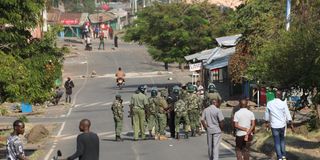
Armed goons dare the police. The youths blocked roads in Homa Bay ahead of Linda Mwananchi rally.
As we advance deeper into the electioneering period, the violence witnessed in Homa Bay, Migori, Garissa and Embu ought to be unequivocally condemned by all. We must delineate a clear boundary between vigorous political contestation and the deployment of intimidation and hooliganism to silence dissenting voices.
Vigorous contestation is the lifeblood of any functioning democracy; it is the clash of ideas, manifestos, track records and promises that allows citizens to make informed choices.
What has been happening lately in political rallies across Kenya signals a broader erosion of the norms that are supposed to govern how political actors treat one another and treat the citizens who come out to listen to them.


In Homa Bay County, the Linda Mwananchi rallies degenerated into violence, with reports of assaults, loss of life and destruction of property. Gatherings that were meant to be forums for political persuasion instead became scenes of fear and violence.
In Embu, one person was fatally injured, and six vehicles were torched during chaos that erupted at a public meeting presided over by Deputy President Kithure Kindiki. That such disorder could erupt at a meeting presided over by so senior a State officer underscores just how fragile the current political atmosphere has become.
When violence associated with political rivalry begins to engender fear, it ceases to be a mere local political disagreement and becomes a menace to our national democratic culture. This is not the Kenya we ought to be constructing. We must strive for a Kenya where every political entity is free to do politics and sell its policy in every nook and cranny unhindered. That freedom is not a courtesy extended by the powerful to the powerless; it is a constitutional entitlement that belongs equally to the smallest party and the largest, to the newest political entrant and the most established incumbent.
If a Kenyan cannot journey to another county to propagate a political idea without fear of assault, then every Kenyan’s democratic freedom stands imperilled.
As a party, the Green Congress Party condemns political hooliganism in the most unequivocal terms. We believe a political party ought to win the confidence of citizens through ideas, policy, integrity and leadership and not through fear. A party that must resort to fear to secure support has already conceded, in effect, that it cannot win the argument on its merits—and that concession ought to trouble its own leadership as much as it troubles the nation.
If a supporter of one political party cannot attend a rally convened by another without facing menace, then none among us can say that our democracy is secure. The right to attend, to listen, to weigh competing arguments and even to heckle peaceably is central to the democratic experience; when that right can only be exercised at personal risk, democracy itself has been narrowed.
The tragedy of Kenyan politics is that when political violence erupts, it is invariably ordinary young people who are thrust to the frontline, while their political patrons remain ensconced safely behind the scenes. Kenyan youth should not be conscripted, remunerated or manipulated into assailing political adversaries or despoiling property. A generation that is taught that violence is an acceptable form of political participation will carry that lesson forward long after the current electioneering period has ended.
We must also demand accountability. Condemnation in the aftermath of violence is insufficient. Statements of regret, however sincerely made, cannot on their own repair the damage done or deter future incidents; they must be followed by concrete, verifiable action. The police must investigate incidents impartially, perpetrators must be brought before the law and anyone who finances, orchestrates or facilitates political violence must be held to account irrespective of political connections.
Simultaneously, law enforcement agencies must guard against selective enforcement. Nothing erodes public confidence more swiftly than the perception that the law is applied unevenly according to political affiliation.
Also, other agencies, namely the Independent Electoral and Boundaries Commission, the Office of the Registrar of Political Parties, the National Police Service, religious leaders, civil society and political parties, all bear responsibility for ensuring that the electioneering period remains peaceful. But ultimately, accountability begins with political leadership.
We must abandon the rhetoric of incitement. We must cease rewarding belligerent crowds with political prominence. We must stop lionising politicians for their capacity to mobilise disruption against opponents. Each of these is a discrete, achievable commitment, and each is entirely within the control of the political class, requiring no new legislation or institutional reform to begin implementing immediately.
Follow ourWhatsApp channel for breaking news updates and more stories like this.
Mr Alila is the Green Congress Party leader.