Nirmala Sankaran is not what you’d typically call a math genius. She wasn’t even a top student in her class. Yet she co‑founded HeyMath!, a digital learning programme that uses interactive lessons to help children understand mathematical concepts while supporting teachers. Since its launch in 2000, it has reached over a million students, 10,000 teachers and more than 1,000 schools worldwide.
“In India, where I come from, math is one of the non‑negotiables,” she says. “Luckily, I was good at it. I had good teachers, and I loved the subject.”
Before HeyMath!, Nirmala spent 11 years at Citibank, working in Bombay, Bahrain and London. Though the job paid well, she grew restless. “I was earning well, but that’s just not enough in life. You have to have a purpose.”
Three developments caught her attention: the dot‑com boom, India’s rise as a software hub during Y2K, and a global shortage of math teachers. “At one point, America needed about 200,000 teachers in the coming decade,” she recalls.
Months of research convinced her that math was critical to every profession, yet fear of the subject was widespread. She linked this fear to poor teaching. “If a child doesn’t grasp something foundational, like adding fractions, it can come back to bite them later when they are learning algebra. Over time, they start hating the subject, and this can affect their self‑esteem.”
She also found studies showing how much teachers matter: “If you take two eight‑year‑olds with the same performance and give one a high‑performing teacher, by age 11 there is a difference of about 53 per cent in their achievements.”
To gain credibility, she turned to the University of Cambridge, drawn by its Millennium Mathematics Project. Early meetings were humbling. “They were asking us questions about the British curriculum, and we didn’t know anything. I bought every single mathematics textbook from Grade one to 12 to prepare.”
Eventually, they built a prototype around 80 universal concepts, using colour, art and animation. “The question was, how do we get the math to speak for itself so that when a child sees something moving and changing, they can see the math without needing someone to explain it?”
The next hurdle was finding a market. They chose Singapore, known for its visionary approach to education. Cambridge’s connections helped them test the prototype in two schools—one top‑performing, one struggling. Both schools saw positive results.
“For several years, I visited Singapore about 40 to 50 times a year. We were working with about 70 or 80 schools,” she says. Teachers wanted the programme to cover the entire curriculum, so Nirmala built a team of curriculum experts who studied thousands of textbooks worldwide.
The work earned HeyMath! an award from Singapore’s Ministry of Education, giving the company credibility to expand into India, South Africa, Tanzania, Brazil, Colombia and the United States. At its peak, HeyMath! employed 250 people, from teenagers to octogenarians, in a non‑hierarchical system.
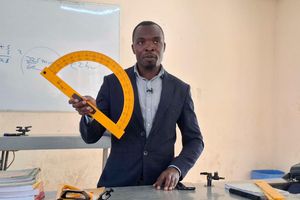
Nirmala Sankaran co-founded HeyMath!, a digital mathematics programme, in partnership with the University of Cambridge.
Photo credit: Pool
In South Africa, the team studied Nelson Mandela and Steve Biko, as well as industries like solar farms and diamond mines, to reflect local realities. “The localisation angle involves adapting stories, characters and names from local storybooks into the lessons, and using local voices so that when a child is learning, they can see and hear elements of their own lives.”
Localisation also determines how the programme is delivered. In countries with well-developed technology infrastructure like Singapore, HeyMath! can provide online access to every student. In under-resourced settings, however, the model becomes more teacher-led with offline access provided to teachers who can then share the content with their students. It also affects how the programme is priced.
“If it is a private school, we sign a two- to three-year agreement in which we outline the pricing, which is often $30 (Sh3,900) per student, per year,” she says. “The school pays us, then they add the charge to the fees and collect it from the parents.”
The Government pays for the programme in public institutions, but the fee is priced per school because the programme is delivered through a teacher-led model rather than giving every student individual access. Individuals can also buy the programme directly for about $60 (Sh7,800) a year.
“This is slightly higher since we don’t get the volumes with this option,” she says.
In Kenya, Nirmala says one of the greatest difficulties has been figuring out who has the authority to decide whether a school adopts the programme. While teachers may be receptive, getting a school to take up the programme can be more complicated, with principals, boards and parents potentially involved.
“Having a champion within the school who believes in the programme and is willing to navigate issues around teacher attitudes, infrastructure and getting parents on board can make a difference,” she says.
Nirmala’s next priority is developing an AI‑powered version to give teachers on‑demand help. She also wants to expand HeyMath!’s contest platform that has been running in Singapore since 2009 and bring it to Kenya.