Agricultural projects: Turn plans into enduring gains
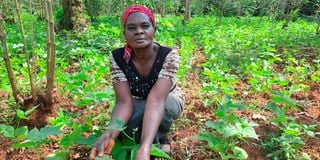
Mary Khasoa, a small-scale farmer in Bungoma County, at her farm.


Anyone who has worked in rural Kenya knows the closing ceremony of a donor-backed project. The tent goes up, certificates are handed out, the project banner is photographed, and vehicles bearing donor logos drive off down the murram road.
A season or two later, the demonstration plot is overgrown, the extension officer has no fuel allowance, and farmers promised a buyer are back to selling to whoever turns up at the gate.
As AGRA marks 20 years, that scene deserves more attention than any success story. Kenya does not lack successful projects; it lacks a dependable way of turning them into permanent systems. AGRA’s 20-year review of African agriculture calls this the capability trap: institutional, financial, policy and skills gaps that prevent good strategies from delivering lasting results.


It sits alongside a productivity trap, where output is low or vulnerable to shocks, and a value trap, where bigger harvests fail to translate into higher incomes. Kenya’s agricultural transformation will be decided in the counties, which hold the constitutional mandate for agricultural and trade development. Progress should be judged by one test: how many proven models continue operating and paying farmers after donors leave?
Consider eastern Kenya. Between 2022 and 2025, the Strengthening Regenerative Agriculture in Kenya project (STRAK), implemented by AGRA with support from the IKEA Foundation, worked across Makueni, Kitui, Embu and Tharaka Nithi, where failed rains are a familiar hazard. It reached 120,060 farmers with practices that rebuild soil and retain moisture, addressing the productivity trap on a continent where roughly two-thirds of productive land is degraded. It also trained 635 Village Based Advisors, local farmers who provide advice, sell inputs and aggregate produce for a commission.
Inadequate public financing
By the 2025 assessment, 506 were still working, roughly four in five. Together, they had earned Ksh66.6 million and moved 7,503 tonnes of cereals and pulses to market. Yet the project exposed the capability trap threatening every successful pilot: inadequate public financing, stretched extension services and weak coordination. It remained unclear whether agricultural advisory work pays enough to be sustainable.
All four counties incorporated regenerative agriculture and the advisor model into their 2023–2027 County Integrated Development Plans. A development plan is a promise; a budget line, staff establishment and supply contract are commitments. Kenyan agriculture keeps losing its best ideas in the distance between the two.
Devolution leaves little doubt about who should close that gap. Under the Fourth Schedule of the Constitution, agriculture, county roads, cooperatives and trade development fall under county governments, while national government retains responsibility for agricultural policy. Whether a harvest earns money depends on feeder roads, water points, market sheds, cooperatives, aggregation centres and extension officers, all shaped by county decisions. A farmer can double her yield and still lose money if a lorry cannot reach her village after the rains. That is the value trap, which farmer training alone cannot solve. Because the three traps must be tackled together, AGRA’s current strategy focuses on developing priority value chains end to end, anchoring secondary chains through commercial firms, strengthening national systems and supporting government priorities. Training farmers to grow more achieves little if buyers cannot absorb the crop; processors cannot expand if working capital is scarce and supplies unreliable.
Counties that back a few value chains with genuine demand give themselves a focus for coordinating extension, finance, roads, farmer groups, aggregators and processors. Anchor firms can organise sourcing and guarantee offtake, provided the terms deliver fair value to farmers, women and young people. The strongest objection is that counties are hardly flush with cash. Giving them responsibility, sceptics argue, merely shifts the cliff edge from the donor’s exit to the county treasury.
But this assumes counties must pay for everything. STRAK suggests otherwise. Advisors who earned Ksh66.6 million in commissions run businesses rather than draw allowances. They need targeted government support: incentives, transport, quality assurance and formal integration into county extension services. The task is to determine which services public funds must support and which commerce or farmer organisations can sustain. The same approach applies to digital advisory platforms, irrigation, aggregation centres, credit and insurance.
Agrifood financing gap
Capital exists if counties make their value chains attractive to investors. AGRA estimates Africa’s annual agrifood financing gap at about US$180 billion, including US$65 billion for small and medium-sized agribusinesses connecting farmers to markets.
This is an investment opportunity, not merely a development problem. Counties with clear priorities, passable roads and reliable supplies can attract lenders and investors; those spread thin across everything cannot.
Each county should therefore agree on an agricultural transformation compact with national government, development partners, lenders and agribusinesses, aligned with Kenya’s commitments under the Kampala Declaration on African agriculture. The compact should identify priority value chains, their constraints, who must address them and who pays. It should also change how progress is measured: farm incomes first, followed by produce sold, private investment attracted, jobs created and services sustained after projects close. Farmers trained and demonstration plots planted are not proof of lasting change. AGRA’s evidence is clear: farmers who cannot break even abandon new practices, however effective they may be. No two compacts will look alike because soils, rainfall and markets differ. What matters everywhere is the same: capable local institutions, viable commercial relationships and coordinated delivery.
Development partners will continue bringing money and ideas, and they should. After 20 years, however, AGRA and its partners should be judged less by what they started than by what outlasted them. Before Kenya launches another pilot, someone should be able to explain what has worked, what prevents it from spreading and which institution will sustain it after the tent comes down and the vehicles leave.
The Council of Governors should champion this agenda, mobilising counties to align policies, investments and partnerships around resilient, productive, market-oriented food systems that deliver higher incomes, food security and economic opportunity. AGRA remains committed to supporting this effort.
Follow our WhatsApp channel for breaking news updates and more stories like this.
Kenneth Lusaka is the Governor of Bungoma County. Alice Ruhweza is President of AGRA.


