This year’s United Nations General Assembly was an inflection point for an ill at ease world. US President Donald Trump delivered a blistering America First speech. He slammed the UN and world leaders across the key issues of trade, war, migration, international crime, and energy-cum-climate. Although the lambasting was expected, it has attracted fresh consternation around the world.
What is new is that several leaders delivered their own invectives in opposition to the America First policy approach toward UN-led multilateralism. Essentially, it has become a contest between the US and the rest of the world, with the UN as the theatre.
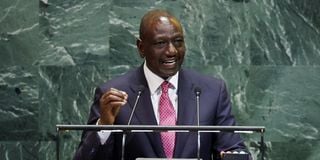
In the court of public opinion, one of the leaders who grabbed attention is Kenya’s William Ruto.
Listening to Ruto’s speech reveals a veiled repudiation of the US and, secondarily, other global powers. It recalls Ruto’s attempts at neo-Pan-Africanism in international fora in the early days of his presidency.
Analysts have long concluded that leaders often frame and set agendas through their speeches directly or indirectly. A reading of Ruto’s UN@80 speech uncovers Kenya’s foreign interests at these uncertain times in global governance.
Drawing parallels between the UN at 80 and its predecessor, the League of Nations (1920-1946), Ruto pointed out that “the United Nations never joined the League.” The subscript is that the US may be leaving the UN. An interpretation is that the world may be seeing the end of the UN, at least in its current form. It is hard not to believe that Ruto was referring to the US when he talked of mistrust instead of trust, fragmentation instead of solidarity.
Ruto opted for an indirect rather than frontal approach. In such instances of his address, one has to turn the questions he posed on their head. Thus, he fundamentally argued that the UN is no longer relevant to the demands of our times. The UN cannot serve humanity in the face of the current realities. And that it has become a relic of a bygone era.
Ruto narrated contrasts between the UN’s failures and successes. An example is the current raging wars in places like Ukraine, Palestine, and Sudan, against the cessation of conflicts in Cambodia to Liberia, among others. Such distinctions provided a segue into proposals for the renewal of the UN. It all gives him a front-row seat in the UN@80 Initiative, instituted by the United Nations Secretary General Antonio Guterres in March.
Several conundrums stand in the way of Ruto’s push “to re-imagine the original promise” of the UN based on his own speech.
The first example is that of the Multinational Security Support (MSS) mission in Haiti, led by Kenya. The abbreviated story is that Kenya deployed its police officers to Haiti in June 2024 on the strength of a UN Security Council resolution. Fifteen months later, Kenya is bearing the cost alone.
The Haiti matter was indeed the core, immediate, and strategic interest of Ruto’s speech. He allocated the most time and detail to the issue. However, the funds Kenya seeks from the US and other global powers will not be forthcoming. Will Ruto stick against the opposition at home and the indifference from global powers? This would test not only Ruto’s pledge for “unwavering” commitment to the mission, but also the credibility of Ruto’s bold UN reform address in New York.
More broadly, nearly all member states have competing interests that scupper attempts at consensus.
Secondly, on the tinder box issues of war, Ruto noted that the “voice (of the UN) is too often drowned out by the rivalries of great powers”. What are the scenarios of the possibility of the UN reforms that Ruto touted? The voting patterns on issues such as the war in Ukraine and Israel’s war in Gaza.
It is quite unlikely that the veto powers in the Security Council – the US, France, Britain, Russia, and China – will agree on things like cessation of hostilities in Ukraine or the repudiation of Israel. Just ahead of the UN General Assembly, for instance, the US vetoed a UN resolution demanding an immediate, unconditional, and permanent ceasefire in Gaza. In the case of Ukraine, it is unlikely that Russia would vote against itself.
The five permanent members of the Security Council have no interest in giving up their asymmetrical veto power. They are uninterested in admitting more members into the reified yet divergent club. Ruto’s idea of at least two African permanent representatives is not going anywhere, and hindsight backs this conclusion.
The more feasible aspect of Ruto’s proposition is African intra-dependence. The context is that reform of the World Bank and the IMF is a hard nut to crack. Perhaps the most portent Afrocentric illustration he gave was that of an emerging African financial architecture. Two of these are Institutions, such as the Alliance of African Financial Institutions and the African Credit Rating Agency. This is the essence of the notion of African agency.
Dr Wekesa is Director of the African Centre for the Study of the US at the University of the Witwatersrand, a Fellow at the University of Southern California, and Visiting Professor at Howard University.