Happening Now: NTV KENYA LIVE | Senate Proceedings
Premium
Caesar Handa and the evolution of opinion polls in Kenya
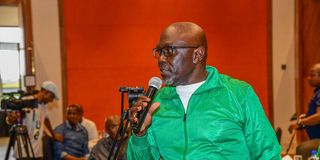
Caesar Handa, who played for Gor Mahia at some point, speaks during a Gor Mahia Legends meeting in Nairobi in May 2023. Handa died at the Nairobi Hospital on January 17, 2023.
Since I misfortunately missed the recent funeral service for Caesar Handa – a founding director of Strategic Public Relations (or SPR) and CEO of (its successor firm), Strategic Africa – I would like to share some recollections about him in print.
Earlier, I learned with shock and sadness about his passing. Since we hadn’t met for some time, a few months ago I phoned him to ask why he/Strategic had been “so quiet lately”, and to suggest a ‘catch-up-on-things’ chai-meeting after the holidays, to which he readily agreed. Sadly, this is now impossible.
I first met Caesar in 1996 after I had joined USAid-Kenya as an advisor in their Democracy & Governance office. This was several years after I had left the University of Nairobi’s Department of Government.


He invited me to join Strategic as a fellow-director while I was waiting (… and waiting for my USAid job contract; there was a long delay due to a long-jam in funding the US budget between a Republican-controlled Congress and the Democratic/Clinton White House).
But given my expected position with USAid, I said I had to decline the offer, though I was very grateful for it, and inspired to learn of Strategic’s plans, especially because there was really no political survey work going on in Kenya at the time. (There had been some pre-election polls in 1992 by the Institute for Education and Democracy (IED), then headed by the late Grace Githu, but that ended with the election itself).
However, soon after I started my job at USAid in May, I learned that our office had given a grant to IED to monitor how the Electoral Commission of Kenya was conducting voter registration and education ahead of the 1997 election. Peter and Caesar proposed to conduct a survey with those who had participated in IED’s program to see how useful they found it.
Though now I can’t remember if I disclosed my ‘connection’ with Strategic to my USAid boss and colleagues, I did convince them this would be a useful investment. However, soon after SPR began their interviews, Ms Githu became aware of their survey, and (somehow) that USAid’s decision to fund it was based on my strong support for it. She demanded a meeting with the USAid Director (Dr George Jones) to complain about SPR’s ‘spying’ on IED’s work – me as the chief culprit.
As was his usual practice (ie, complete transparency), Dr Jones invited me to attend the meeting, so I heard all of Grace’s complaints first-hand. But at the end of her diatribe, my boss simply asked: “If you are confident IED is doing useful work, why would you object to such an objective appraisal of it?” And that was the end of the matter. (I reconciled with Ms Githu some years later, by which time she was battling with the cancer that ultimately proved fatal).
SPR, with support from the Embassy of Finland, later undertook ground-breaking (but unpublished) survey work ahead of the 1997 election (as IED also did again). Later, one of my last tasks at USAid in 2001 was to facilitate the establishment of the Nairobi office of the International Republican Institute, whose first (American) director later went to work for the Congressional Research Service. Such facilitation (both before and after I had left USAid) including introducing the IRI Director to SPR, strongly encouraging her to contract them to do surveys on relevant issues on a regular basis, which she did. (Note that this was before other research firms that became active later such as Steadman, Infotrak, Consumer Insight and a few others had taken up political polling, or even existed).
In this role, SPR conducted various surveys prior to both the 2002 and 2007 elections for IRI, the latter including the exit poll that showed that Odinga had defeated Kibaki by about six per cent, the immediate public release of which was blocked by then-US Ambassador Michael Ranneberger (in violation of the contract between USAid and IRI). What impact the release of the exit poll results would have had on the (deadly) post-election situation) is unclear (to me, at least), but in an attempt to justify such censorship, the Embassy insisted that all aspects of poll be subjected to a rigorous, outside (academic) evaluation.
This was done, and SPR’s poll was found to be credible, though by the time this happened, the Kofi Annan-led AU team, had brokered the National Accord – and the rest is history (though the full details of Ranneberger’s role in ‘smothering’ the exit poll results have received the attention of very few (aside, apparently, from the then-IRI). Looking back, Caesar always stood by his firm’s work (even if we could not fully explain why, in final 2007 pre-election publicly released polls, SPR and Infotrak had Odinga leading by 10 per cent, whereas both Steadman and Consumer Insight gave him only a two per cent advantage).
Come the 2013 election, one local media house engaged three firms to conduct a series of polls in which the exact same questions and – to the extent possible – sampling distribution would be used with regard to the presidential race in particular. To ensure the latter, it was agreed that each firm would produce a GPS map showing the locations of all the interviews. Whereas Caesar on behalf of Strategic (and the other firm) put his ‘cards on the table’ in this regard, the third firm did not, resulting in the collapse of this undertaking – to Caesar’s expressed disappointment.
I should also recall my phone conversation with Caesar after the 2017 election (and the Supreme Court’s nullification of the August presidential contest) when I was trying to write an academic article about that election’s polling record. I asked him ask why Strategic had been ‘missing-in-action’ throughout the pre-election polling period.
He was blunt: “Given what has happened in the last three elections, we made a management decision that until and unless the country has an election commission that produces credible, and therefore uncontested, results, we will abstain from conducting such polls, at least for public release.”
Even if I felt that, on balance, such polls serve a useful public purpose despite doubts about the integrity of official results, I had to congratulate Caesar and his colleagues for taking such a principled position, given that nothing draws attention (and often brings business-revenue) to such research firms than such pre-election polls.
In a word, then, and while the loss to his family and friends is most significant and thus sorrowful, Kenyan public opinion research writ large has lost one of its most eminent and respected polling pioneers, someone who repeatedly put professional integrity above personal political preference.
For me, I am deeply sorry I delayed our planned chai-chat, and more broadly, that he has departed when he still had so much more to provide to his family, and to contribute to his profession, and to the country.