Sinking a well into the earth where millions still rely on erratic supply or unsafe surface water has become a lifeline. But many Kenyans don’t realise that it's not just about machinery and money, it's also paperwork, permits and compliance with environmental laws.
“People assume you just call a driller and start digging. But the truth is, drilling a borehole is a highly regulated activity. If you don’t follow the law, your investment could be shut down before you pump your first litre of water,” says Joseph Maingi, a hydrogeologist who has overseen more than 300 borehole projects in Kenya and the Horn of Africa.
As climate variability intensifies and piped water becomes increasingly unreliable, boreholes are no longer just a luxury for the elite. Even schools, hospitals and farmers are investing in groundwater as a solution.
The first step, says Maingi, is not drilling but permission. The process starts with the Water Resources Authority (WRA), the national body mandated to regulate all water usage, including groundwater abstraction.
Under the Water Act 2016, anyone planning to drill a borehole must first commission a hydrogeological survey by a licenced expert. This survey determines whether water exists underground, its depth and whether drilling could negatively affect neighbouring water sources.
“If you drill without a permit from WRA, you are committing an offence,” says Maingi.
The survey report is submitted alongside land ownership documents and project plans. A successful application results in a drilling authorisation permit. But that’s just the beginning.
With concerns about unsustainable water use and groundwater depletion, the National Environment Management Authority (Nema) has increased scrutiny of borehole projects.
“Any project that can affect natural resources requires an Environmental Impact Assessment (EIA),” explains Peter Njoroge, an environmental consultant.
“If you’re drilling for domestic use, you might get a screening exemption. But for institutions, industries or farms, an EIA is mandatory.”
An EIA typically includes community consultations, mitigation plans and post-drilling monitoring. Approval from Nema can take anywhere from two weeks to three months, depending on the sensitivity of the area. Failing to get Nema approval before drilling could result in penalties of up to Sh2 million and closure of the site.
Photo credit: Shutterstock
In places like Nairobi, Kiambu or Machakos, borehole drilling also requires a “No Objection” letter from the county water department or local water utility provider. These letters help avoid conflicts with existing pipelines or communal water sources.
“There are areas where boreholes can be banned temporarily,” notes Wycliffe Mbithi, a water engineer in Kajiado County.
Some counties also require construction permits, land-use approvals, or notification to Water Resources Users Associations (WRUAs), local watchdogs that monitor water sharing.
Once permits are in place, the real work begins. Only WRA-licensed drilling companies are legally allowed to carry out borehole construction. These firms must follow strict standards on casing, depth, yield testing and sealing to prevent groundwater contamination.
A typical borehole ranges from 100 to 250 metres deep, with costs averaging Sh1.2 million to 3 million or more, depending on location, geology and pump size.
“Don’t just go for the cheapest driller,” advises Maingi.
“Check their licence, equipment and references. A poorly drilled borehole can collapse, run dry or become a health hazard.”
After drilling, the contractor must submit a completion report to WRA, detailing depth, construction specs and water yield. The quality of water is also tested to determine its suitability for human consumption.
A water meter must be installed, and the user must apply for a Water Use Permit, which governs how much water can be abstracted daily.
“Water metering isn’t optional anymore,” says Maingi.
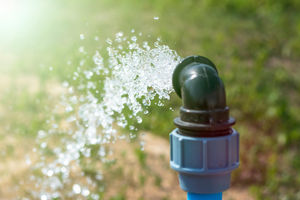
Water gushing from a tap.
Photo credit: File | Nation Media Group
Permits are typically valid for five years, subject to renewal, and users must submit annual abstraction reports to WRA. In some areas, WRA may limit usage during droughts or impose fees for large-scale abstraction.
For every compliant project, there are cautionary tales.
In 2023, a private school in Nakuru drilled a borehole without proper WRA and NEMA approval. A neighbour complained about lowered water levels in their well. Investigations found the borehole was over 300 metres deep — drilled through a protected aquifer. The school was fined, the borehole sealed, and a water truck now supplies them at four times the operating cost.
“It’s not worth the risk,” says Maingi.
“Follow the rules and your borehole will serve you for decades. Break them, and you lose everything.”
Strict groundwater governance
With Kenya’s water demand expected to double by 2040, experts warn that groundwater governance will only become stricter.
The Ministry of Water is working on a national groundwater strategy which includes digital registration of boreholes, satellite monitoring of aquifers and mandatory reporting via a centralised system.
At the same time, innovative technologies like solar-powered pumps, smart meters and automated chlorination systems are making boreholes safer and more sustainable.
“Boreholes are part of Kenya’s water future,” says Maingi.