Carrying Africa’s voice to the global table
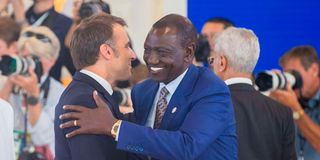
President William Ruto with French President Emmanuel Macron at the 50th G7 Summit in Italy on June 14, 2024

Kenya’s invitation to participate in the G7 Summit in Évian this June is a significant diplomatic moment. It reflects the country’s growing role in global affairs and the trust placed in Nairobi as a credible voice on issues that matter beyond its borders.
But this is not just about Kenya. It is about Africa.
In the coming weeks, Nairobi will host the Africa Forward Summit: Africa-France Partnerships for Growth and Innovation, bringing together leaders, top entrepreneurs from the continent and France, civil society, and youth innovators (such as Nova Garage platform) to define practical priorities for the continent. Those discussions will not end in Nairobi. They will inform what Kenya carries to the G7, ensuring that Africa’s concerns are not framed from the outside, but articulated by those who live them.


For a long time, Africa’s place in global forums has often been limited, with key decisions made elsewhere and later felt across our economies. That gap has been narrowing. African countries are increasingly stepping forward, not in confrontation, but with clarity about what is needed to unlock growth and stability.
Kenya’s participation in the G7 comes at a time when the world is facing multiple pressures. Conflicts continue to disrupt regions, economic recovery remains uneven, and climate shocks are becoming more frequent. In such moments, major economies often look inward. Yet global challenges cannot be addressed in isolation.
Africa must be part of the solution. The message Kenya will take to Évian is straightforward. Sustainable global growth will not be achieved without meaningful partnership with Africa.
Expanding markets
The continent is home to a young and growing population, expanding markets and vast natural resources. It is also central to global efforts on food security, energy transition and climate resilience.
The priorities are very vivid. Africa needs investment in industry, infrastructure and digital systems. It needs stronger support for intra-African trade under the African Continental Free Trade Area. It needs fair access to financing that allows governments and businesses to grow without being weighed down by unsustainable costs.
Equally important is the issue of climate. Africa contributes little to global emissions, yet faces some of the harshest impacts. Any global transition to clean energy must take this imbalance into account. Climate finance must be accessible and responsive, and commitments must translate into action.
Kenya enters these conversations with practical experience. The country has invested heavily in renewable energy, pushed for regional integration and remained active in climate diplomacy. This gives it both credibility and responsibility.
At the same time, representation alone is not enough. Africa’s presence in global forums must lead to tangible outcomes, whether in investment, trade or policy reforms that support long-term development.
Kenya’s approach has been to engage widely, build partnerships and remain consistent in its positions. From Nairobi to Évian, the focus is on ensuring that Africa speaks with purpose and is heard with seriousness.
The real measure of this engagement will be what follows. The goal is not only to be at the table, but to ensure that decisions taken there translate into opportunities for African economies and livelihoods.
As Kenya heads to the G7, it does so with a clear understanding: the voice it carries is not its own alone, but that of a continent ready to play a bigger role in shaping the global agenda.
Follow our WhatsApp channel for breaking news updates and more stories like this.
Dr Korir Sing’oei is the Principal Secretary, State Department for Foreign Affairs, and G7 Sherpa for Kenya