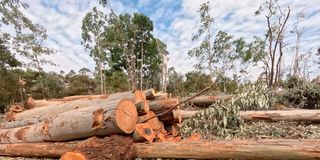
A section of Karura Forest where eucalyptus trees have been felled.

We are seeing, with increasing frequency, worrying instances of bureaucratic overreach. Some cases might be brushed aside as minor communication failures or blunders by overzealous paper-pushers.
However, there are also many examples right from the highest office in the land which send disturbing signals of political leadership run amok.
It was just the other day that the National Transport and Safety Authority announced the rollout of a new system by which instant fines would be levied on motorists captured by street cameras breaking traffic rules.
The new system was immediately challenged in court, mostly on the basis that alleged offenders would be prosecuted, tried and sentenced without the opportunity to defend themselves.
Now, I am a firm believer in the most stringent methods of bringing sanity to our roads. Kenya has probably the highest proportion globally of traffic police officers on the daily beat, which is quite ironic in that we also have about the highest road accident rate in the world.
Everyone knows that all the traffic police do is run extortion rackets. If the corrupt human interface could be replaced by intelligent automated systems, maybe fatalities on our roads would be greatly reduced.
Adoption of technology, however, must not mean doing away with the right to a fair trial. It was a rather shame-faced transport authority which last week realised that it had blundered, and withdrew the notice on instant fines pending further consultation.
Technical specifications
Then last week we saw the Communications Authority of Kenya forced to issue clarification on an earlier notice widely interpreted as banning the sale and use of the affordable kabambe mobile phones. Updating technical specifications is not necessarily bad, but the statement which any reader would interpret as a ban on low-cost phones was a big blunder.
Then there are ongoing activities which make a mockery of the government’s stated ambition to plant 15 billion trees by 2032. Instead of the public seeing a massive tree-planting campaign, what is visible is the accelerated destruction of existing forests.
Presently, there is a large-scale cutting down of trees in Karura and Ngong forests on the outskirts of Nairobi. The Kenya Forest Service has been trying to explain that eucalyptus and other imported species are being removed to be replaced by indigenous trees, but that has not stilled growing suspicion that our land-hungry leaders are plotting to grab more green spaces for so-called private developers.
Now, those are the minor ones, though how far-reaching they are cannot be overstated. That is because they stand as living examples of an unfeeling, uncaring government bureaucracy that does whatever it wishes, regardless of the people and their needs.
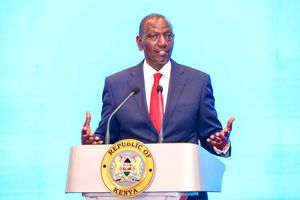
The drift towards a dangerously unchecked Executive is also very much in evidence. Just the other day, during former Cabinet minister Raphael Tuju’s “self-abduction” saga, President William Ruto chimed in with the suggestion that if the entrepreneur-politician wanted help with his well-documented financial problems, he should have turned to the right people rather than jump into the arms of the opposition.
That might have sounded like well-meaning advice. The president could be capable of bailing him out, but left unstated was that Mr Tuju would, in turn, have to join his re-election campaign bandwagon.
Also left up in the air was the question of whether the help offered would be in the form of calling off the courts that have consistently thrown out Mr Tuju’s attempts to save his properties from auction. This then raises the issue of undue Executive meddling in judicial operations.
Indeed, there are recent examples where the criminal justice system seems to be under pressure from the political class. On the Tuju matter, for instance, the Cabinet Secretary for Interior, Mr Kipchumba Murkomen, was breathing fire and brimstone when he purported to direct the courts to deal firmly with those who allegedly faked their own abductions. The Directorate of Criminal Investigations and the Director of Public Prosecutions subsequently moved against Mr Tuju with a patently defective charge sheet.
Recently, President Ruto also intervened in the Nairobi Hospital boardroom wars. He claimed to have acted in his capacity as patron of the troubled medical institution, but that honorary position does not give him authority to order the arrest and prosecution of anyone.
Not even his office as President of Kenya gives him such power. It is for good reason that the laws insulate the police and the prosecution from political interference. When that independence is ignored by those in power, and then when those protected from undue influence reduce themselves to errand boys for the political system, the country goes to the dogs.
Mr Gaitho, an independent journalist, is former NMG Managing Editor for Special Projects. [email protected]