Agriculture remains the backbone of Kenya’s economy and is essential to food security in our country, where millions of families in some parts are in dire need of relief food as a result of famine.
Food insecurity casts a long shadow over a nation’s progress, especially in a developing country like Kenya, where it directly affects the energy and productivity of its people.
Even more troubling is that food, which is a basic necessity, has become a political tool, with aspirants using promises to lower food prices and offer free foodstuffs in campaigns to win voters’ hearts.
This cycle often results in the election of leaders who vanish after the polls, only to reappear before the next election with the same empty promises, knowing that hunger makes people vulnerable to persuasion.
Robust policies and programmes, particularly by county governments to handle agriculture, are required to ensure sustainable food production.
Such measures would guarantee food security by keeping granaries stocked with enough food to sustain families until the next harvest season, while economically empowering rural communities through the sale of surplus produce.
When I became the governor of Kiambu just over three years ago, we made a conscious decision to put agriculture at the centre of our development agenda, not as tradition but as strategy.
We prioritised farmer empowerment, income growth and practical support systems that allow agriculture to serve not just as a means of survival but as a dependable source of livelihood.
What was required was a clear focus on how agriculture could directly improve household incomes while strengthening food security and creating opportunities for women and young people.
Our approach has, therefore, been intentional and grounded in the realities farmers face on a daily basis.
For too long, many smallholders in Kiambu were trapped in a cycle of low productivity, not because they lacked land or effort, but because the cost of fertiliser and quality seeds was beyond their reach.
That is why we rolled out a countywide programme to provide free fertiliser alongside certified maize and bean seeds, to enable households to grow enough food for their own consumption and have a surplus to sell.
To date, more than 600,000 farmers across the county have directly benefited from this intervention.
The impact has been real and measurable. In areas such as semi-arid Ngoliba and Ndeiya, which in the past depended on relief food during difficult seasons, farmers are now producing their own food.
Families are more secure, resilience has improved, and the need for external food assistance has sharply declined. These changes are not abstract. During my mashinani engagements across the county, farmers often approach me with green maize harvested from their own fields.
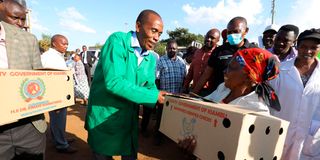
On several occasions, women have carried bunches of maize as a simple but powerful gesture of appreciation, and a warning to politicians that, come 2027, food scarcity will not be used as a campaigning tool in Kiambu. Building on this foundation, we have pursued a broader agenda of farmer empowerment and income growth. A central pillar of this effort has been the economic empowerment of women through agriculture.
Across all our 60 wards, we rolled out another programme to support women with improved kienyeji chicken. About 200,000 women have benefitted, with each woman receiving 10 chicks.
The results have been consistent across the county. Women have grown their flocks, organised themselves into groups and turned small-scale poultry keeping into a reliable income-generating activity.
Many are now regular suppliers of eggs, supporting their families while gaining greater financial independence. But production alone is not enough. Without access to markets, even the most productive farmer remains vulnerable. That is why we deliberately linked this initiative to our early childhood development and education feeding programme, where an egg is part of the meal.
We also introduced a livestock programme targeting men and the youth through the distribution of piglets to encourage agripreneurship by providing a productive asset that could grow into a sustainable enterprise.
Across Kiambu, what began as rearing a single piglet has blossomed into thriving pig farms, with beneficiaries now supplying pork and launching bustling meat businesses.
At shopping centres, young men who previously had little productive engagement are now actively involved in livestock farming, earning an income and building a stake in the local economy.
Still, if there is one lesson from our experience, it is this: agriculture responds fastest and most decisively when farmers are supported where it matters most—at the level of inputs.
The writer is the governor, Kiambu County