A renewed push by MPs to have a say in who becomes a village elder, how they are recruited and how much they are paid has exposed the battle for control of the 106,000-strong grassroots army, whose role becomes even more crucial as Kenya heads to the polls in August next year.
Just three months after 106,000 village elders across the country started receiving a monthly stipend of Sh3, 000, Members of Parliament now claim that genuine elders were left out by the government.
The lawmakers claim that local administrators, who were involved in identifying the village elders and creating a database for onward transmission to the Ministry of Interior in Nairobi, only picked their relatives and friends, leaving out the men and women who had been doing the job in the first place.
The lawmakers now want Interior Cabinet Secretary Kipchumba Murkomen to provide a list of all the 106,000 village elders the government is paying so that they can confirm whether genuine ones, who had previously been working without pay, were included.
The query emerged during Wednesday's Question Time, when Cabinet Secretaries appear before MPs to respond directly to questions on issues related to their ministries.
According to the lawmakers, genuine elders who were not in the good books of county commissioners, chiefs or assistant chiefs were left out of the register. Instead, relatives of the administrators were included and are now receiving the money despite not being elders or offering any services to the community.
Uasin Gishu Woman Representative Gladys Boss pointed out that an elderly woman in Langas Ward, Uasin Gishu, was left out of the list because she was not in the good books of the county commissioner.
National Assembly Deputy Speaker Gladys Boss Shollei during an interview at her home in Kitusuru, Nairobi on July 2, 2025.
Photo credit: File | Nation
“An elder was deliberately left out because the County Commissioner did not like her. This is just one case; there are several other cases across the country,” Ms Boss said.
“There are many people who have served as village elders at a time when they were not being paid. When the time came for people to be paid and confirmed, new persons were brought in, edging out those who had served diligently,” she added.
Kajiado South MP Samuel Parashina said the compilation of the village elders' list was marred by a lack of impartiality.
“Can the CS table a report on the criteria used to identify the village elders? When the chiefs were picking the village elders, some of them picked their friends and relatives. So we would like to know the criteria that the CS approved for identifying these village elders,” Mr Parashina said.
“Was there any favouritism in the selection? And is there any hope that those who were left out, despite having served the community, will be considered in future?” he asked.
Igembe North MP Julius Taitumu called on the ministry to provide details of the mechanism used to identify the elders.
Igembe North MP Julius Taitumu.
Photo credit: File | Nation Media Group
“The actual village elders who used to do their work on a voluntary basis were left out because the chiefs and assistant chiefs mainly concentrated on their friends and kinsmen when they realised that these people were to be paid,” Mr Taitumu said. Mr Murkomen told the House that the ministry had anticipated a scramble to become a village elder as soon as the Sh3,000 stipend was introduced.
“It’s now fashionable to be a village elder. Some people are now projecting themselves as village elders; some are genuine, some are not,” Mr Murkomen said.
He said the ministry would make available the records of all village elders at county commissioners' offices countrywide to allow the public to verify the genuine elders receiving government payments.
He revealed that, of the 106,000 elders, Safaricom M-Pesa services had processed 96,566 records and paid the beneficiaries through the Tunza Vijiji wallet. The remaining records had been referred back for reconciliation due to mismatches involving names, identity card numbers and phone numbers.
“The data update and reconciliation process is ongoing and will be finalised in a month's time to ensure the remaining elders are paid their stipends in arrears,” Mr Murkomen said.
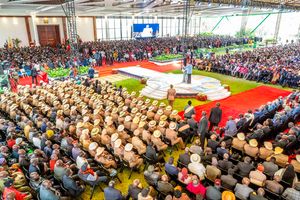
In August, President William Ruto launched the Policy on National Government Village Administration to formally recognise and facilitate village elders.
The policy facilitated the onboarding of 106,000 National Government Village Administrative Elders (NGVAE), integrating them as official administrators of village units.
The Ministry of Interior then undertook a nationwide data capture exercise for the elders, resulting in a national register for their recognition and facilitation.
At a meeting with the elders at State House last year, President Ruto said the move would give them a clearer role within the national administration structure and improve coordination between them and other government officials operating at the grassroots.
The President said village elders were an important link between the government and communities, given their proximity to citizens and understanding of local issues.
Under the current Constitution, Parliament enacted the National Government Coordination Act to provide for service delivery coordination units, a move that has since seen the number of National Government Administration Officers (NGAO) rise.
The 2019 Kenya Population and Housing Census shows that there are 2,427 locations manned by chiefs and 6,612 sub-locations headed by assistant chiefs.
However, the number of locations has since increased to 2,735, while sub-locations have also risen to about 7,000.
This has given rise to 106,072 village elders, 9,144 assistant chiefs and 4,008 chiefs across the country, all reporting directly to the national government.
Determined to bolster NGAO, the government has since published a policy document seeking to recognise and onboard village elders into the national government administration structure and facilitate them to streamline service delivery at the village level ahead of the 2027 General Election.
The government's plan is to integrate the village elders, to be renamed Village Administration Elders, into the national government administrative units, effectively granting them legal authority, clear responsibilities and financial clout.