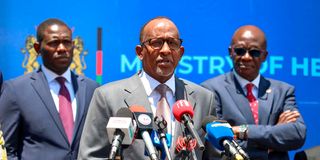
Cabinet Secretary for Health Aden Duale, accompanied by other government officials, addresses journalists during a press briefing at Afya House in Nairobi on October 6, 2026, after Kenya confirmed its first case of the Ebola virus.
People interpret health messages through previous experiences of the institutions delivering those messages.
The distrust surrounding the current outbreak also cannot be separated from previous institutional experiences.
This week, I spent time reading the responses to the Ministry of Health’s Ebola updates on X, and as a health worker, I believe we have a serious problem. A section of the public does not trust the information coming from the ministry. Some users describe the Ebola outbreak as a “scam”. Others question whether the reported patients exist, ask why neighbouring countries have not reported similar cases, accuse the government of creating the outbreak for financial or political reasons, or state that they would refuse to comply with measures such as quarantine or lockdown. Other comments raise legitimate questions. How did an infected traveller enter the country despite enhanced surveillance? Why were healthcare workers exposed? What systems failed, and what has changed since then?
One of the greatest public health threats of our time is misinformation and disinformation, and the wider infodemic they create during health emergencies. Misinformation is false or misleading information shared without necessarily intending harm. Disinformation is deliberately fabricated or manipulated information intended to deceive. Both can interfere with outbreak control by influencing how people understand risk and how they respond to public-health advice. Legitimate public questioning, however, is part of public accountability and should be answered with evidence, transparency and clear information. If people do not trust the institutions issuing that guidance, compliance becomes more difficult and misinformation can spread more easily.