As Rongo University was holding its eleventh graduation ceremony in Migori on Friday, the High Court in Nairobi was handing the county’s pioneer governor a 25-year jail term for the murder of the university’s former student, Sharon Otieno.
For nine years, he wielded immense political power as the governor of Migori, but now Okoth Obado is behind bars alongside his aide Michael Oyamo and former county clerk Caspal Obiero.
Obado will serve 25 years, the same as Oyamo; while Obiero will cool his heels for 18 years after they conspired to brutally kill 26-year-old university student Sharon Otieno.
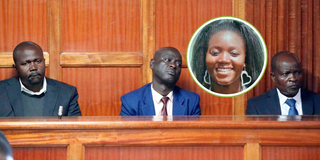
Migori ex-Governor Obado and two aides in court for sentencing in Sharon Otieno murder case
On the night of Monday, September 3, 2018, Sharon – a mother of three who was seven months pregnant – was abducted alongside then Nation Media Group’s Homa Bay-based journalist Barack Odour, who miraculously survived by jumping from a moving vehicle.
Unfortunately, Sharon did not manage to free herself and was later stabbed seven times in the stomach, bleeding to death together with her unborn child. The heinous act sparked nationwide public fury and calls for justice.
Delivering her verdict on July 23, Justice Cecilia Githua ruled that the web of circumstantial evidence left the accused with nowhere to hide.
“The circumstances presented in the case, taken cumulatively, formed a chain so complete that there was no escape from the conclusion that the accused persons, jointly with others not before the court, committed the offence charged,” Justice Githua stated.
The brutal killing took place between September 3 and September 4, 2018, in the Owade area of Rachuonyo, Homa Bay County.
Sharon Otieno's parents: Don't crucify Obado
An analysis of the case files reveals how detectives from the DCI Homicide Unit and State prosecutors meticulously connected every piece of the puzzle, building a watertight case that left the three co-accused persons with no escape route.
At the heart of the prosecution’s case was a bitter disagreement over Sharon’s seven-month pregnancy, for which Obado was responsible. While she insisted on keeping the child, he pushed her to terminate the pregnancy.
Testifying as the 30th prosecution witness, Sharon’s mother, Melinda Auma, told the High Court that her daughter had confided in her about the governor’s sudden change in behaviour. She stated that Obado became evasive, stopped picking Sharon’s calls, and cut off financial support, offering her Sh30,000 to procure an abortion – an offer she flatly rejected.
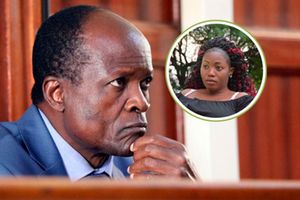
Ex-governor Obado leaves courtroom after 25-year sentence
What began as an intimate affair soon drew in former Homa Bay County MCA Lawrence Obonyo Owuor alias Mulla (now deceased), and journalist Barack Oduor. Then came the chain of events that culminated in her execution.
Since there were no direct eyewitnesses at the murder scene, the Office of the Director of Public Prosecutions and detectives from the Directorate of Criminal Investigations’ Homicide Unit relied on circumstantial evidence in what would turn out to be an eight-year trial.
They anchored their case on four key pillars, establishing a solid motive as the foundation of the case. With that, the prosecution built a case that left the defence with little wiggle room.
Former Migori Governor Okoth Obado at the Milimani High Court.
Photo credit: Billy Ogada| Nation Media Group
The prosecution presented screenshots of communication between Sharon and Obado on different occasions, as shared by journalist Barack Odour.
From snippets presented in court, theirs was a happy affair on some days, while on other occasions there was turmoil. In some messages, the late Sharon demanded to know progress on the three-bedroom house the former governor was planning to buy in Kisumu. He would then assure her that it was available.
However, on May 10, 2018, there was a tiff between the two after Obado responded, “Good morning”, and Sharon fired back, “You didn’t call me yesterday. If I don’t call you, you don’t call?”
The politician had to explain himself, stating that he was held up in Nyatike for almost the entire day as a disaster had occurred at a mining site.
One of the pieces of evidence that caught the court’s attention was ultrasound images of the foetus in her. Upon viewing them, Obado responded, “Sawa sawa. Best wishes.”
25 years in prison for ex-Governor Okoth Obado over Sharon Otieno murder
The other key part of the case was Mr Oduor’s evidence. While narrating his ordeal after narrowly escaping from the jaws of death when he jumped from the abductors’ vehicle, he stated that Sharon had played to him phone recordings of her conversation with Obado in vernacular, in which the governor pleaded with her to abort.
“He was telling her, ‘If you want to be a good girl, you should do what I have told you. I’m going to give you money to ensure you carry out the abortion. You know, I am a big person and can’t endure that kind of shame,’” Mr Oduor told the court.
Prosecution witness number 28, called Lawrence, told the court that in his meeting with Oyamo outside Tausi Hotel, Oyamo had asked him how they could get access to Sharon’s and Barack Oduor’s handsets since they contained evidence that could facilitate the production of media reports on the governor.
The late Sharon Otieno. Former Migori Governor Okoth Obado and two co-accused have been convicted of murdering the university student.
Photo credit: Pool
Another evidentiary pillar that led to Obado’s conviction was the chain of circumstantial evidence. The prosecution had over 70 witnesses but, with the help of DCI detectives, presented 42 witnesses that were found to be crucial. It also tabled 81 exhibits.
Mr Oduor’s daring escape from the speeding abduction vehicle, a dark-grey Toyota Fielder, provided a critical timeline.
“Sharon told me that the governor had asked his aide, Oyamo, to meet us in Rongo Town. I suggested Graca Hotel, where he joined us, but suggested we relocate to another venue,” Mr Oduor said.
When the vehicle began moving, Oyamo quickly alighted, and two men jumped into the back of the car from both sides, sandwiching Sharon in the back seat as the driver sped off.
Then Sharon and Mr Oduor were ordered to surrender their phones. According to Mr Odour, their abductors had crude weapons. In his recollection, the man next to Sharon started by asking her how she knew him.
“The co-driver interjected, saying, ‘You people wanted to meet the governor. We are taking you to meet him.’ That was the last conversation before I jumped out of the moving vehicle,” Mr Oduor told the court.
The cold-blooded murder of Sharon that night and the narrow escape of the journalist complicated matters. These events made Oyamo panic, and he presented himself at the Uriri Police Station in Migori on the morning of the following day.
Former Migori governor Okoth Obado in court.
Photo credit: File | Nation Media Group
His mission was to report an alleged kidnapping and robbery in Kisii, alleging he had lost Sh270,000 belonging to the governor in the process.
But, unknown to him, Mr Oduor had already reported the matter the previous night, first at Kadel Police Post and then at the Kendu Bay Police Station.
Security officials were on high alert, and as Oyamo was busy recording a statement of his fake incident, a call landed at Uriri notifying officers to look out for him. That was how he was arrested on the spot and taken to Homa Bay Police Station.
Not long afterwards, Sharon’s body was found in a bush near Owade River by Moses Onditi Oguta. That marked the beginning of Obado’s woes.
The discovery of her body, Mr Oduor’s account and the arrest of Oyamo prompted the DCI boss to dispatch a team of detectives from the Homicide Division in Nairobi to take over the investigations.
Initially, there was resistance to allowing the Nairobi team to take over, leading to tension at the Homa Bay Law Courts as the days granted to detain Oyamo were running out.
The homicide team wanted to seek an extension of the orders to allow time for more investigations, but the trial magistrate refused and directed that Oyamo be charged or be released immediately. This was despite the fact that Sharon’s body had just been discovered the previous day and investigations had not been done.
The decision by the court raised eyebrows; the homicide team devised another plan. As soon as Oyamo was freed by the station’s police boss, they pounced, re-arrested him and whisked him to Nairobi as investigations kicked off.
Phone records and witness testimonies proved that, as Obado’s personal assistant, Oyamo deliberately lured Sharon and Barack to the Graca Hotel in Rongo, effectively handing them over to the killers.
It was the digital footprint of the three co-conspirators that gave them away. The prosecution used the Toyota Fielder in the abduction. Detectives traced the firm that installed a tracking device on the car. The firm testified that tracking data indicated that the car’s tracking device was intentionally deactivated on the day of the abduction and reactivated the following day.
The court noted this was a calculated move to conceal the movement of the vehicle. The vehicle, which operated as a taxi, belonged to Olivia Oloo – who was the wife of Caspal Obiero, the third accused person. Its driver was Jackson Otieno Gombe, who testified as the 38th prosecution witness.
Extensive call logs, WhatsApp data and mobile phone tower tracking plotted the coordinated communication between Obado, Oyamo and Obiero in the hours leading up to and immediately following the murder.
The judge concluded that Obado and Obiero – who was a clerical officer in Migori County – or perhaps Oyamo using Obiero’s phone, were in constant communication from September 2-4 at 7.31 am.
The other factor that led to the conviction was the falling apart of the defence narrative. Obado had fiercely defended himself by presenting an alibi, alleging he was in Nairobi at the time Sharon was murdered. However, the prosecution ripped apart that defence by demonstrating common intention and the doctrine of joint criminal enterprise.
In her July 23 verdict, Justice Githua ruled that the prosecution had met the strict legal threshold required for a conviction based on circumstantial evidence.
“In applying the legal principles governing the application of circumstantial evidence to the case, I am satisfied that the circumstances presented, taken cumulatively, formed a chain so complete that there was no escape from the conclusion that the accused persons, jointly with others not before the court, committed the offence charged,” Justice Githua stated.
Former Migori Governor Zachary Okoth Obado (right), his co-accused Michael Oyamo at Milimani High Court in Nairobi on July 14, 2022.
Photo credit: Dennis Onsongo I Nation Media Group
In 2021, Obado and his co-accused – Oyamo and Obiero – attempted to delay the start of the full hearing of the trial, citing the Covid19 pandemic’s travel and safety limitations. The prosecution countered, proving that the governor had been travelling freely to Nairobi for shows in two vernacular radio stations.
Prosecution witness Lawrence Obonyo Owour alias Mulla – who was at one time the MCA for the Kanyadoto ward in Homa Bay County – testified as the 28th prosecution witness. Mr Owour died mysteriously after he had finished testifying in court.
He collapsed in Homa Bay town and was pronounced dead on arrival at the Homa Bay County Referral Hospital in May 2024, according to his family.
Police launched investigations into what killed the 60-year-old politician, who reportedly seemed okay prior to his sudden death.