Faith leaders are a vital defence against fifth-generation terrorism
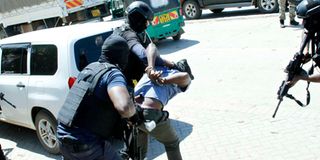
ATPU officers arrest a terror suspect in Mombasa on August 23, 2021.

In two decades spent working to keep young people in the Horn of Africa out of the hands of extremist recruiters, I have learned that the hardest person to reach is the one who doesn't believe in anything at all.
That lesson, formed in Nairobi, Mogadishu and beyond, is now showing up in Europe too. Europol's most recent threat assessment, published in July, flags a category it calls "destabilising ideologies": loosely organised online networks whose members often have no coherent political programme, growing fastest among minors radicalising alone at night, in a Discord server or a gaming lobby, drawn less by any cause than by the promise of belonging to something.
I recognise that promise, because I have spent my career watching what happens in households where the evenings have gone unsupervised, where friendships have migrated to a screen, where nobody left in a young person's daily life still has the standing to ask a hard question and expect an honest answer.


Our own Building Resilience Against Violent Extremism (BRAVE) programme, which I helped design and have run across Kenya and the wider Horn, exists because we saw this pattern repeat itself long before anyone in Europe was naming it.
Whichever community offers structure and belonging first tends to win, regardless of what ideology, if any, it eventually wraps itself in.
Filling that vacuum has very little to do with theology, and everything to do with earned presence. A rabbi who has known a boy since his bar mitzvah, an imam who watched a girl grow up in the same mosque as her mother, a pastor who sat with a family through a bereavement or a divorce, holds a kind of access that a stranger with a clipboard simply doesn't have.
Social workers
That history is what lets a faith leader ask the blunt but caring question: what is actually going on with you? In my experience, families working through something they are ashamed of- an addiction, a breakdown, a child who has gone quiet- bring it to clergy first, precisely because the relationship was already there before the crisis.
That kind of standing is scarcer across the rest of a young person's life than most policymakers assume. Teachers move on with the school year. Social workers are too busy to sustain the unhurried attention that catches a change in someone's affect. Police arrive once a threshold has already been crossed.
A congregation remains one of the few institutions left where an adult's relationship with a family is expected to run for a decade or more without interruption, surviving all big life changes.
That continuity is what makes the noticing possible before there is anything left for a database to record.
Safer communities
This was the argument I carried into Dublin this past August, at a conference co-hosted by law enforcement and the Interfaith Alliance for Safer Communities, bringing police and faith leaders together to work through what that continuity could look like in formal practice: confidential channels so a concern can move without branding an entire congregation, and joint training so a religious leader recognises a genuine warning sign against the ordinary churn of adolescent moodiness. It is not a new idea for those of us who have worked in this field.
I have seen the institutional commitment behind that recognition first-hand. The Interfaith Alliance grew out of Abu Dhabi in 2018, and is built on the premise that faith leaders are an essential stakeholder group in any effective anti-radicalisation system.
The UAE has backed that premise with action rather than statements ever since, including through the Community Service Award I was honoured to receive from its Ministry of Interior for work addressing extremism and violence. Hedayah, the UAE's counter-extremism research centre, treats engagement with faith communities as a core method of prevention rather than an afterthought.
The Sawab Centre, run jointly with the United States, carries the same logic online. The Abrahamic Family House, which places a mosque, a church and a synagogue on a single plot of land in Abu Dhabi -without being syncretic- makes the same argument in physical form: proximity between faiths, and between faith and the state, is a security asset, not a risk to be managed from a careful distance.
Those two decades of investment amount to something counter-extremism policy has too often asked in the wrong order, building better detection systems first and worrying about who staffs them second. Now we need a policy approach which responds to the emerging fifth-generation extremism and terrorism.
A key part of the answer is that law enforcement agencies need to invest time and effort in developing relationships with and learning from faith leaders. As respected figures in many communities around the world, they are truly in the business of being present, reliably, for long enough that a young person drifting toward isolation still has one adult left whose attention does not depend on a referral form ever being filled out.
As the threat becomes harder to categorise, their presence is one of the few tools still built for this fifth-generation extremism.
Follow our WhatsApp channel for breaking news updates and more stories like this.
Dr. Mustafa Y. Ali is a Director of the Interfaith Alliance for Safer Communities, the Executive Director of Arigatou International – Nairobi and the Secretary-General of the Global Network of Religions for Children (GNRC).