Food-chain claim reveals Putin’s power logic
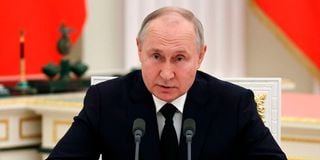
Russian President Vladimir Putin.

What you need to know:
- Science knows of no such food chain: killer whales are not known to hunt polar bears.
- More than four years into the full-scale Russian invasion, Ukraine remains unbroken.
Moscow’s catalogue of explanations for its war against Ukraine has never been short of invention. A few days ago, Mr Putin added yet another – this time involving killer whales and polar bears.
Speaking to future teachers, Putin claimed killer whales hunt polar bears in packs, “tear them to pieces” and demonstrate the natural “food chain”. Children, he said, should learn this to understand “what kind of world we live in” and why Russia is conducting its so-called “special military operation”.
I tried to fact-check the claim, from wildlife documentaries to scientific sources. All in vain.


Science knows of no such food chain: killer whales are not known to hunt polar bears. Yet the worldview behind this imaginary food chain is clear. Strip away the absurd zoology and the logic is old: power creates rights.
The stronger state decides whose borders matter, whose sovereignty is respected and whose history can be rewritten. Resistance becomes not self-defence, but defiance of a supposedly natural hierarchy.
Empires have always rested on the presumption that strength gives one nation the right to dominate another. The modern international order was built to reject that presumption – to make clear that power alone gives no right to rule, conquer or absorb another state.
Civilisation advances when nations turn power into knowledge, prosperity and opportunity. Imperial wars reverse that progress – consuming lives, wealth and generations to destroy what others have built.
More than four years into the full-scale Russian invasion, Ukraine remains unbroken. Unable to defeat the state, Moscow has increasingly pursued a campaign of attacks against civilians – striking homes, apartment blocks, hospitals, power grids and the infrastructure of everyday life in the hope that fear, darkness and exhaustion will achieve what its army could not. It is what military failure looks like when turned outward against civilians.
But Ukraine is no longer confined to absorbing the blows.
It is increasingly striking the machinery that sustains the war – military airfields, logistics, weapons facilities and the energy infrastructure that finances and fuels it. The effects are now measurable. Since early April, Ukrainian strikes have hit more than two-thirds of Russia’s major refineries, pushing overall refining volumes to a 20-year low. By late August, gasoline production was covering only around 70 per cent of domestic demand, forcing Moscow to restrict exports and turn to imports.
The intended prey has survived – and learned to bite back where it hurts.
Despite the enormous human cost and repeated calls from the international community to end the aggression, Moscow keeps feeding more lives into the war. Facing mounting losses, it has drawn foreigners into the fight, including Africans reportedly recruited through deceptive claims of civilian work. What began as an invasion of Ukraine is increasingly revealing a military machine that burns through its own manpower and then reaches abroad for more. And this is where the food-chain metaphor becomes uncomfortably real: the war is disrupting actual food supply chains.
More than four years of war have turned the Black Sea – one of the world’s great food arteries – into an increasingly dangerous place for civilian trade. Ukraine’s main Black Sea ports handled around 90 per cent of its grain exports. About 90 per cent of Russia’s seaborne grain exports have also traditionally moved through the Black Sea and Sea of Azov. Today, the war is disrupting the very maritime space on which both exporters depend.
Ukraine has proposed a mutual halt to attacks on civilian targets in the Black Sea. Moscow publicly rejected the idea, dismissing such a ceasefire as a “half-measure”, and has continued striking Ukrainian ports and export infrastructure. The consequences travel far beyond the Black Sea: disrupted shipping, higher insurance and freight costs, tighter grain supplies and, eventually, higher food prices thousands of kilometres away. For Kenya, this is hardly an abstract concern. Russia has in recent years supplied roughly half – and at times substantially more – of the wheat the country imports.
When Black Sea routes become less secure, the effects can move quickly from distant ports to flour prices and household budgets here in Kenya. A war driven by the ambition to restore Russia’s imperial stature is terrorising Ukrainian civilians, consuming Russian lives and drawing Africans into the fighting through deception. By attacking ports and food routes, Moscow is also exporting part of the cost of that ambition far beyond the battlefield. That turns much of Moscow’s rhetoric in Africa into little more than a sales pitch. And that is where the absurdity gives way to something more serious: the problem is not real strength, but its crude imitation – the belief that destruction, intimidation and the ability to inflict pain amount to power.
It becomes even more dangerous when the bill is handed to countries and people who had nothing to do with this distorted food-chain logic.
Follow ourWhatsApp channel for breaking news updates and more stories like this.
His Excellency Tokar is the Ambassador of Ukraine in the Republic of Kenya