When a state runs out of answers for a collapsing economy, it invariably goes looking for an enemy.
In Kenya today, that enemy has been conveniently identified as the small-scale foreign trader . From the bustling streets of Eastleigh to the crowded retail corridors of Nyamakima, non-citizens running modest kiosks and street stalls have suddenly been ordered to close shop by next week.
The official rationale coming out of State House is wrapped in the shiny paper of economic patriotism: protect local jobs for local youth. But strip away the populist noise, and what remains is a textbook exercise in political deflection.
Look at who is actually being targeted. Picture a Rwandan man sitting on a small wooden bench along a dusty Nairobi street, roasting groundnuts over a charcoal burner. He buys his raw stock from local Kenyan farmers, pays his daily market fees to county officials, speaks Swahili with everyone around him, and sells small bags of peanuts for Sh20 or Sh50. He does not control foreign exchange rates; he does not decide national tax policy, and he is not hoarding wealth in offshore accounts. He poses zero threat to Kenya’s national security or economic stability.
He is simply trying to make a living in a tough economy, working on the absolute margins of the informal sector. He is not the reason thousands of university graduates are riding boda-bodas for a living. He is not the reason manufacturing plants are closing down because of crazy electricity bills, or why millions of young people cannot find formal employment. Yet, under this new order, his tiny groundnut business is being blamed for Kenya’s broader economic struggles.
There is a deep and painful irony in all of this. For years, Kenyans were among the first to speak out against xenophobic attacks in South Africa whenever foreigners were targeted there. Kenyan commentators, leaders, and citizens rightly pointed out how wrong and dangerous it was for South Africans to blame migrants for unemployment, poor housing, and lack of opportunities. We all saw it for what it was: a government failing its people and letting them turn on fellow Africans instead of demanding better leadership.
Now, our own government is using that exact same tactic. Unable to fix the cost of living, deal with heavy public debt, or create a business environment that actually generates jobs, the administration is copying the worst kind of identity politics seen in Western countries.
Just as politicians abroad use immigrants as a convenient punching bag to win elections and hide their own policy failures, our leadership is trying to make foreign hawkers the scapegoats for a stagnant economy. Setting local traders against a foreign groundnut seller might create a dramatic show of protectionism for a few days, but it does absolutely nothing to fix the real problems in our country.
This habit of governing by sudden impulse and public proclamations goes far beyond market stalls and foreign traders. You can see the exact same pattern in how national economic policies and tax laws are being handled, particularly with the Kenya Revenue Authority.
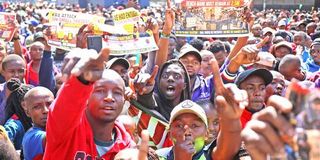
When tax officials recently raised the minimum valuation yield for consolidated cargo containers from Sh2.5 million to Sh3.2 million, small importers in Nairobi reached a breaking point. They shut their shops and went to the streets to protest a decision that threatened to kill their small businesses. Sensing that the political heat was getting dangerous, the President stepped in during a public gathering and declared that the rates would be rolled back to Sh2 million.
While those importers definitely needed relief from an unfair tax burden, the way it was done completely undermines the rule of law. If the President can wake up on any given morning, make a public speech, and single-handedly rewrite customs rules, tax rates, or trade regulations whenever protests get uncomfortable, it raises an obvious question: what are Members of Parliament actually for?
Taxation and public policy are not supposed to be run through executive pronouncements or rally speeches designed to calm angry crowds. In a functional democracy, Parliament exists to debate, draft, and pass laws through open, predictable procedures. The legislative branch is where policies are examined, economic impacts are weighed, and laws are built to give businesses and investors a stable environment where the rules do not change on a whim.
When tax rules are pushed up by bureaucrats one week and wiped away by a presidential statement the next, it destroys any sense of predictability in the economy. Serious business owners — whether they are local traders importing goods or foreign companies wanting to build factories — cannot plan or invest in a country where the law depends entirely on the political mood of the executive branch on a given day.
Targeting a Rwandan groundnut vendor or a foreign tailor will not build factories, reduce our national debt, lower electricity costs, or create real jobs for young Kenyans. All it does is spread unnecessary division between communities that have lived alongside each other peacefully, ruin our standing in the East African Community, and put the millions of Kenyans working in neighbouring countries at risk of retaliatory treatment.