For all the Raila mania and Raila phobia, we never truly knew him
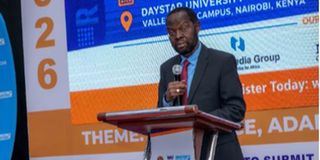
Kisumu Governor Prof. Peter Anyang’ Nyong’o delivers his speech at the Raila Odinga Memorial Lecture at Daystar University on October 9, 2026.


We voted for him, and our parents argued over him. At a memorial conference on his life, two millennials found out how much of Raila Odinga they had missed.
“The Raila I knew would have been uncomfortable with a conference devoted mainly to praising him,” said Prof. Peter Anyang’ Nyong’o during Raila Odinga Memorial Lecture at Daystar University on October 9, 2026.
He told the auditorium it was the first time he had spoken formally in public about his friend. He had known Raila since they were “young men in a hurry”.


Raila, he said, “would have demanded that we interrogate him and, more importantly, interrogate ourselves.”
We had spent 11 months organising the conference. As we listened, we realised we had spent most of our lives following Raila Odinga without ever doing what Nyong’o was asking.
We are millennials, and Raila has been part of Kenyan politics for as long as we can remember. We were in primary school when “Kibaki Tosha” rang out at Uhuru Park in 2002. In 2005 we knew the orange from the banana before we understood what a referendum was. In 2007 we watched the Pentagon campaign, then the violence after the election, and in 2008 the National Accord that made Raila Prime Minister.
By 2013 some of us were old enough to queue and vote for him. In 2017 we chanted “Tibim” and heard him promise to lead us to Canaan. The Supreme Court annulled that election. In January 2018 Raila was sworn in at Uhuru Park, and in March he stood with Uhuru Kenyatta on the steps of Harambee House.
Our parents either loved him or feared him, and many of us picked up those feelings without knowing where they came from. We knew his slogans. We knew very little about the man.
The Raila I knew would have been uncomfortable with a conference devoted mainly to praising him,” Prof. Peter Anyang’ Nyong’o
A class assignment that grew
The conference began as coursework. On November 16, 2025, five of us in the Daystar PhD cohort met in the office of Prof. Levi Obonyo, a veteran journalism scholar who had just been appointed executive director of Daystar’s African Institute of Strategic Communication, Journalism and Media Research (AfrISCom), which later hosted the conference.
We were there to plan a joint paper on RAO001, the Kenya Airways flight that carried Raila’s body home from India. We wanted to understand why a call sign and a water salute moved a grieving nation, and what that meant for the airline. Over coffee, he asked why we were seeking someone else’s platform to publish the Raila article and suggested we host a conference ourselves.
We issued a call for papers in January expecting a few dozen. Sixty abstracts arrived, and all sixty went into the book of abstracts. Along the way, the venue changed, some partners pulled back, promised funding fell through, and one night one of us drafted a cancellation notice at 2 am.
At 4 am a WhatsApp message came from Prof. Obonyo. Raila, he wrote, endured years of detention without giving up on the country, so we could not give up on a two-day conference. On October 8 and 9, thirty-four of those papers were presented, as many as the schedule could hold, alongside four panels.
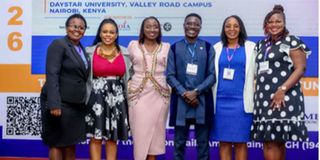
The RAO2026 organising team, which began as a PhD class assignment in November 2025.
What we learned about Raila
The idea that changed our picture of Raila most was a word we thought we already understood: Odingaism.
We had heard it used loosely, usually by his opponents, as shorthand for a tribal movement or a socialist hangover from his father’s era. Then one paper took the word apart and found something far more interesting.
Odingaism, it argued, is an African political philosophy that fits neither the liberal box nor the socialist one. It shares socialism’s passion for justice and fair distribution, yet it rests on communal identity, memory and collective struggle. Over the decades, what began as a political movement grew into a way that many Kenyans think about justice and about what it means to be a citizen.
Another paper asked a question that many of us had never found the courage to put into words: were the coalitions, handshakes and deals driven by principle, or by self-interest dressed up as principle? The paper read them as tools toward a single goal, a Kenya where marginalised citizens feel the state truly belongs to them, and then tested that reading against the record.
The 1991 opening and the 2010 Constitution hold up well. The 2018 handshake fares far worse, since the BBI it produced was struck down by the courts. And for our generation, the paper observed, constitutional belonging has still not become economic belonging.
Speakers kept returning to the way public debate about Raila swung between mania and phobia, leaving almost no room for his actual ideas. The socialist label he carried for years, partly inherited from his father Jaramogi, sat uneasily beside his record as a businessman and his own description of himself as a social democrat. Some of the fear reached back to the Moi years, when supporting him carried real risks. Some of it was manufactured by campaign propaganda, including the online targeting exposed in the Cambridge Analytica revelations about Kenyan elections. One speaker reached for King Lear to sum him up, calling Raila “more sinned against than sinning.”
Prof. Shem Otoi, the Daystar statistician, looked at his career through numbers: five presidential contests and four handshakes. Prof. Nana Busia, who flew in from London, asked a question that lingered in the room: how does an electoral system that kept declaring Raila the loser end up granting him more legitimacy than many of its winners?
Then Mr David Omwoyo, the CEO of the Media Council, revealed something that stopped us in our tracks. Raila never walked into a media house; the media houses always came to him. It left us wondering how one man could hold that much power.
The conversation also reached beyond the room. The analyst Tom Wolf, whose work we drew on, points in his writing to the issues Raila pushed that remain unresolved: corruption, the unimplemented report of the Truth, Justice and Reconciliation Commission, and the land question of squatters and absentee landlords.
Four panels covered the ground in between. The first brought together editors and media leaders to discuss how newsrooms covered Raila over four decades and how he, in turn, used the media. The second examined the devotion and fear he inspired, asking how loyalty is built and what happens when a polarizing figure dies. The third looked at his oratory, his storytelling and his years as a lecturer at the University of Nairobi. The last traced the reform journey from the detentions of the 1980s to the 2010 Constitution, and asked what reform is still pending.
Other papers followed his language and his image. They explored the protest rhetoric that ran from Saba Saba in 1990 to the Gen Z protests of 2024, the Canaan metaphor, the vitendawili, or riddles, that he used to hold rallies in his hand, and the memes that carried him across social media. They also traced how his death played out online. One paper turned to the quietest casualties of all: the children of political exiles, and what the struggle cost their families.

Scholars present research on Raila Odinga’s media, memory and rhetoric during a parallel paper session.
Nyong’o posed a question we are still thinking about. “Have we democratised power,” he said, “or have we just democratised the competition to possess power?” He described politicians lining up mourners at funerals to hand out cash, and rallies where the real business is sorting out the voters afterwards. A county, he said, and a country can become statistically richer while becoming socially poorer. Raila’s political life, he said, teaches that democracy “is not the art of winning every contest, but the discipline of refusing to destroy the republic when you are not declared the winner.”
Democracy is not the art of winning every contest, but the discipline of refusing to destroy the republic when you are not declared the winner, Prof. Nyong’o
He also told us a story. On the morning of the Uhuru Park rally in 2002, Raila sent him to round up opposition leaders he could not reach. As they walked from the Serena to the park, Raila held his hand.
“I knew he had something up his sleeve,” Nyong’o said. On the podium, Raila made his announcement without consulting any of them. That was the “Kibaki Tosha” we heard as children.
When he finished, he asked to be excused. It was his birthday, and his family was already waiting for him in Naivasha. The Daystar choir sang for him before he left.
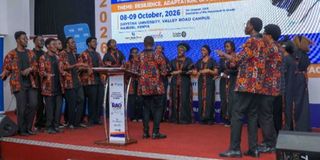
Daystar University Choir at the institution on October 9, 2026
“Sometimes you simply miss your dad”
Rosemary Odinga spoke for her mother, Mama Ida, then asked the hall if she could say a little as his daughter. “Many of you knew him as Baba,” she said. “For us at home we simply called him Dad.”
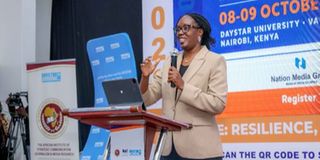
Rosemary Odinga addresses delegates on behalf of her mother, Mama Ida Odinga at Daystar University on October 9, 2026.
She described what it is like to share a parent with a whole country. You switch on the television, and there he is. You go to the shopping centre, and everyone has a story about him. “Each person knew a different part of him,” she said, and she thanked the room for “giving those pieces of him back to us.”
Many of you knew him as Baba. For us at home we simply called him Dad,” Rosemary Odinga
She said: “Sometimes you simply miss your dad.”
A year ago Kenya mourned Raila with large crowds and public ceremonies, and many people did not have a quiet moment to grieve. Hearing his daughter say those words in a university hall gave us that moment.
Reading the library
Nyong’o opened his lecture with an Igbo saying: when an elder dies, a library burns. He added his own warning. “A library does not burn only when its books disappear. It also burns when a generation refuses to read the books.”
Our generation has mostly known Raila through headlines. The papers from this conference will be published as Proceedings, which is our attempt to read the books. We came to Daystar thinking we knew him. We left aware of how much we still have to learn.
Nyong’o closed by saying Raila ran his marathon. “His place on the podium is now empty, his library is open and full, and the baton is in our hands.”
Follow our WhatsApp channel for breaking news updates and more stories like this.
William Dekker and Mercy W. Ndirangu are PhD candidates in Communication at Daystar University, a UNESCO-recognised centre of excellence in communication education, and members of the RAO2026 organising team.