M'Tuamwari came armed with 7,000 signatures of locals he had collected to prove that he was not alone in his opposition to the controversial project; that it was hugely unpopular. Yet when M'Tuamwari stood up to air his views, the meeting descended into pandemonium as attendees heckled him, threatening him with violence. Harsh words were hurled at him.
"I was scared a night earlier, and when we got to the venue... We had already gotten intel that they had organised people to go and approve the destruction of the forest," M'Tuamwari says.
He was forced to leave after it became apparent that his safety was at risk, speeding off in his car.
A special Sauti Sessions Network investigation by journalist, Ian Wafula, blew the lid off what transpired.
Some of the people who attended the meeting, speaking to Sauti Sessions Network on condition of anonymity, said that they had been paid to give the impression that they were in support of the construction of the inside Imenti Forest.
Mobile money messages shown to Sauti Sessions and which the network could not verify bear the name Caleb Mutethya Kibuko, a local politician serving as a current member of county assembly MCA) for the Municipality Ward, who is a supporter of the Imenti Forest airstrip.
Beyond being paid to disrupt the public participation meeting, they say they were engaged to do something far more sinister; violently attack and rape those demonstrating against the project.
This raises questions about whether the meeting was staged to create a certain perception, and wider concerns about how meaningful public participation exercises in Kenya are given that goons are deployed by politicians in pursuit of agendas that may not be in public interest. Can they really be viewed as public participation exercises when paid goons are involved?
As the clock ticks down to the 2027 general election, cases of violent attempts to disrupt political gatherings and sow chaos have been reported.
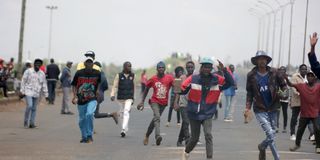
Chaos at Ndhiwa Centre as goons attack the Linda Mwananchi convoy with stones.
Photo credit: Alex Odhiambo | Nation Media Group
In June this year, goons stormed and disrupted a post-budget conference attended by civil society groups at the All Saints Cathedral in Nairobi with a cabinet secretary suspected to have sponsored the invasion.
These cases throw into sharp focus a dark side of Kenya's political culture, raising concerns about just how deeply embedded goonism in Kenya is and its implications for the country’s fledgling democracy.
Nerima Wako, the executive director of Siasa Place, who has seen how the goon menace has evolved over time since she was introduced to political mobilisation in 2016, says that years back, youths were used to provide security unlike now when they are deliberately used to cause chaos.
“I have seen it evolve into, now, counter goons, which wasn't there before, where people now are being paid and they are coming for violence where we’ve seen people coming with crude weapons, ” Nerima says.
“So they are coming to harm and, even when I see how they are stealing things, it's with entitlement. We have people protecting a meeting and those who have come to disrupt it. That rivalry is new to me.”
Nerima is not speaking from an ivory tower, the perspective of an expert with no real experience of the things she's talking about. She has experienced first hand the chaos and fear that are the hallmarks of gatherings disrupted by goons.
Recently, she attended a political meeting that was disrupted by intoxicated youths who appeared on motorbikes, stealing in the ensuing melee as people scampered for safety.
“It was very scary. There were more than a hundred people… They were not paid so it was a matter of we are going to grab what we can, ” she recounts the events of that day.
The Siasa Place executive director warns that goon culture is undermining public participation, an important tenet and pillar of democracy.
“It removes women from participating because of the fear, and when it does that, there's absolutely no women's engagement because of insecurity. It leads to even more marginalisation of one gender, which is already marginalised, ” Nerima says.
“If you were to look at the political rallies, it is mostly men who are part of the audience. We are already seeing it. Women will start keeping away because it's dangerous.”
Rape cases were reported during the June 25 anniversary demonstrations in 2025. One of the implications of such reports would be traumatised women not participating in public initiatives, which only serves to sideline an important segment of the population.
Nerima is concerned that women might not just keep away from political gatherings but also from polling stations on voting day, denying them the opportunity to exercise their democratic right to elect leaders of their choice because of the threat of violence. This ultimately disenfranchises women.
There is also the effect of women not offering themselves for elective positions out of fear of their safety being compromised. The implication of that is that the leaders that end up on the ballot and even elected might not be the best. “It now leaves us with the gangsters with the security machinery and gangs to go for the political seats. We are going to be led by the mafia, ” she opines.
What makes the problem even harder to address is that no one is willing to accept responsibility. Both the government and the opposition have accused each other of sponsoring goons to create chaos. This points to a fundamental lack of political goodwill to stem the tide of goonism.
Even with that stark reality, Nerima is convinced that an antidote to goon culture exists. It lies in an ironclad commitment to the rule of law, democratic accountability, and respecting constitutionally guaranteed rights like freedom of assembly and association.
Nerima holds the view that the prevalence of goonism is not necessarily a function of inadequate laws in the books but a result of poor implementation.
“For me it would be, can we just implement the kind of laws that already exist, ” Nerima Wako says. “The law should be followed to the letter, from the president to the MCA.”
She recommends that politicians found to have been involved in acts of violence be completely barred from seeking office. There has to be real repercussions for violent behaviour against not just those who are paid to do the dirty work but also the masterminds. This will go a long way in addressing the impunity that allows goon behaviour to thrive.
There also has to be a genuine effort to create economic opportunities for disadvantaged youths who struggle to secure employment. Nerima notes that the people who are used by politicians to cause goon trouble are desperate young people.
“They are mainly young people from the slums who want to make quick money, ” she adds. When these youths are meaningfully engaged to provide for themselves and their families then the pool of troublemakers is reduced. The media has a role to play. Nerima feels that the focus of coverage has been more on the goons and not on the masterminds of their dirty work, which doesn't give the full picture. “The news has been on the goons themselves and not on those paying the goons, ” Nerima observes.
The ‘big fish’ also need to be put on the spot to ensure that they are held to account. She urges the fourth estate to highlight cases of goons who have embarked on a reform path as this could show those still trapped in the goon culture that there's another path.
According to Nerima, civil society groups are instrumental in ensuring that these manifestations of political violence are recorded and evidence collected. It's only then that cases against those behind this violence can be built to ensure accountability. In the final analysis, Nerima distills the goon problem into its essence.
“The goon issue is not a goon issue, it's a rogue politicians issue. It's the fact that they are able to hire them and get away with it. That's the issue because if there was no money trickling down to them, we would not have them as an issue, ” she opines.