Premium
G20 inequality panel plan is a good idea
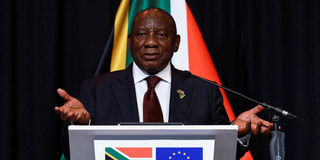
South African President Cyril Ramaphosa attends a press conference with European Commission President Ursula von der Leyen and European Council President Antonio Costa at the end of a South Africa–EU leaders meeting, ahead of the G20 Summit scheduled for November 22-23, in Johannesburg, South Africa.

What you need to know:
- Governance and poor political management can hinder a country’s development.
- Inequalities cause several consequences, including those related to economy.
More than 500 economists and other leading experts, including Nobel peace laureates and former US Treasury Secretary, have urged the Group of 20 Countries (G20) to establish an international panel to tackle extreme wealth disparities.
The panel can be modelled alongside the United Nations Intergovernmental Panel on Climate Change and will analyse all aspects of inequality – from land ownership to tax avoidance and seek to inform global policy making.
Six major factors affect global inequality, including physical environment and geography, where landlocked or mountainous countries often struggle to trade as easily as coastal nations, limiting their economic growth.


Secondly, is climate, where the tropical countries may experience slower development due to climate-related diseases that impact health and productivity. Temperate countries have more favourable conditions for agriculture and fewer health challenges related to climate.
Thirdly, are the natural hazards where countries prone to earthquakes, hurricanes, floods, and droughts face setbacks in development, as these events damage infrastructure, disrupt economies, and create health challenges.
Extreme poverty
Fourthly are the historical factors such as colonialism. European powers colonised many regions in the 18th and 19th centuries, exploiting resources and labour, leaving them with weak economies and unequal trade systems. The same is the case with neo-colonialism where wealthier nations dominate poorer ones economically and politically, through trade, aid conditions, and multinational corporations, limiting their development opportunities.
Fifthly, we have the political and economic policies with cases of open and closed economies, where the former encourages foreign investment and trade, tend to grow faster than the latter that restricts imports and exports.
Also, governance and corruption aspects, including poor political management and corruption, can hinder a country’s development.
Sixth is social investment, particularly health and education, where nations that invest in healthcare and education often develop more rapidly, as a healthy, educated population attracts businesses and investors.
Inequalities cause several consequences, including those related to economy. Extreme poverty with limited access to food, clean water and basic infrastructure, perpetuates the cycle of poverty.
Dr Giti is an urban management, PPP and environment specialist. [email protected], @danielgiti