How Olkaria was turned into a superpower
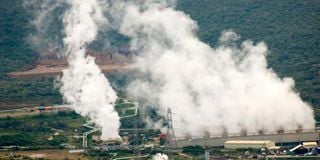
Kenya Electricity Generating Company’s geothermal wells in Olkaria, Naivasha, Nakuru County, in June 2020.

On a clear morning in Kenya’s Great Rift Valley, the earth exhales. White plumes of steam rise in soft columns from a scarred plain in Olkaria, drifting upward like signals from a buried world.
To the untrained eye, it can look volcanic, even apocalyptic, right from the gates of hell. But this is not destruction. It is infrastructure, the visible breath of one of the most quietly consequential energy revolutions of all time.
Long before climate summits and net-zero pledges, long before Silicon Valley discovered deep tech, Kenya began probing the heat beneath its soil. The story of how it got there, through colonial ambition, scientific failure, multilateral rescue, and eventual mastery, is less a straight line than a series of improbable turns. It is also a story that now reads like a preview of the global energy future.


The first geothermal well in Kenya was drilled in 1952, more than 15 years before the first geothermal power plant was commissioned in Iceland and even in the USA. At that time, what we now know as Kenya was still under British colonial rule.
The effort was led not by a nation, but by a consortium, anchored by the East African Power and Lighting Company, with partners that included British industrial firms better known for boilers than for geology.
Even at that time, there was a theory that the Rift Valley, one of the most geologically active zones on earth, might hold commercially viable geothermal energy. They were also, in many ways, guessing. But today, that guesswork is no longer a theory but a profit for Kenya.
Sustained steam discharge
The theories led to drilling of two deeper wells in Olkaria in the mid-1950s, reaching depths of roughly 950 and 1,200 metres. Even by today’s standards of more than 3,000 metres, that was deep enough. The results were, however, discouraging. No sustained steam discharge. No power. No proof of concept. Naturally, the wells were abandoned.
In the auditor’s language, the project became a sunk cost, a curiosity buried in technical reports. For nearly a decade, geothermal energy in Kenya remained a pipedream. It was a complete failure. And those who had earlier argued against it, including die-hard hydro engineers, had the data to back their pessimistic claims.
That failure could not have come at a worse time. The 1950s were years of political upheaval in Kenya, culminating in independence in 1963. Energy planning, like much else, was in flux. Hydropower, as it is today, was cheaper, proven, and easier to finance; it naturally became the baseload.
Geothermal, on the other hand, requires not capital but patience and more advanced technology.
The early drilling approach was archaic to say the least. Just because you can see steam on the surface does not mean you will get enough of it when you drill. In fact, geologists say better wells are found in places with zero surface steam.
What Kenya needed, therefore, was not another well. It needed a different way of seeing. That shift came from an unlikely source, the United Nations. What business did they have in energy at that time? Did they not have enough global wars and conflicts to deal with?
Beginning in 1967, the United Nations Development Programme, then only two years old, partnered with the new Government of Kenya to revisit the Rift Valley with a more scientific approach rather than chasing theories. Teams of geologists, geophysicists, and geochemists were sent to conduct systematic surveys across a vast corridor stretching from Lake Bogoria in Baringo County to Olkaria.
Using improved techniques, seismic readings, chemical analysis of hot springs, and resistivity surveys, they narrowed the search. Olkaria emerged as the most promising site, but this time with evidence. This was the eureka moment that led us to the glory we are celebrated for today.
Between 1971 and 1976, six wells were drilled under the joint programme. This time, science was precise. Steam discharged. Pressure held. The resource was real.
This time, the UN invested not only in drilling, but in people, establishing training programmes that would, over time, produce a generation of Kenyan engineers and geoscientists capable of running the industry themselves. This partnership remains to this very day.
Alas, in 1981, nearly three decades after the first unsuccessful well, Kenya commissioned the first 15MW unit of Olkaria I power station, making it the first geothermal plant in Africa.
By that time, the country’s power sector had been reorganised. The East African Power and Lighting Company, which had been founded in 1922, had evolved and reconstituted into entities that would eventually become Kenya Power and KenGen.
Today, Kenya is one of the world’s leading producers of geothermal energy, with Olkaria at the centre of it, supplying up to 50 per cent of the country’s electricity.
Unlike hydropower, geothermal is not hostage to rainfall. Unlike thermal, it does not require imports. Unlike solar and wind, it provides baseload power, which is steady, continuous, and predictable.
Do you know what is more exciting about geothermal energy? It is the fact that it exists wherever the earth’s heat can be reached. Even where you are standing now. What has historically limited it is not supply, but the ability to locate, quantify, and extract it economically.
That is beginning to change. Advances in drilling and data analysis, many of them driven by technologies adjacent to oil and gas, are making geothermal more predictable and scalable.
Follow our WhatsApp channel for breaking news updates and more stories like this.
Frank David Ochieng, Marketing and Corporate Communication Manager, KenGen PLC, and Diplomacy and International Relations MA Candidate at Kenyatta University. Cell: +254-721-816-896 Email: [email protected]