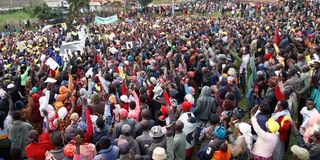
A political rally.

The next Kenyan election is 17 months away, but politics has already warmed up nicely. We are in for a ride, and it is great fun to see the coded, and sometimes deadly, language in which power contestation is conducted in Kenya roaring back to life. It brings back a familiar feeling that reaffirms we are still very much at latitude 0.0236° S and longitude 37.9062° E.
Like in many other places in Africa, the true power of the tongue lies in a rich basket of metaphors and coded expressions designed to signal loyalty, deflect blame, rally ethnic bases, demonise an opponent, stick a knife in a rival’s back, or say the opposite of what is actually said. To the casual observer or a new visitor, a politician’s speech might sound like a standard report on government progress or a routine campaign cry.
To those tuned into the frequency of Kenyan double-speak, however, these phrases are tactical.
This theatre of language has become the primary tool for the country’s elite to manage public perception while shielding themselves from the consequences of their actions. One of the most potent shields in this arsenal is the claim that critics are merely “people opposed to the President’s development agenda.”
This phrase is deployed to beat down anyone questioning issues like the rising cost of living or regionally skewed appointments to government jobs. By framing a technical or economic disagreement as an act of sabotage against the nation’s growth, the speaker paints the critic as unpatriotic. It builds a narrative in which “development”, often defined as large infrastructure projects such as railways or highways, is treated as a sacred goal that must not be scrutinised for cost or transparency.
Narrow grievances
Similarly, when a politician decides to abandon their political home to join a rival camp, they rarely admit to chasing power or money. Instead, they solemnly declare that their former party has “betrayed its principles.” Since most Kenyan parties are built around individuals, narrow grievances, and regional pursuits of a slice of the national cake, rather than fixed ideologies, these “principles” are often invisible. They serve as a convenient moral mask for what is, in essence, a business decision to switch sides.
The art of coded pushback often relies on invoking the ethnic group (the community) to escape the law. When a high-ranking official or politician faces a corruption probe, the standard defence is to cry that “our people are being targeted.” This is a calculated move to turn a personal legal problem into a communal crisis, persuading an entire ethnic group that the authorities are coming for them, not just one individual and his bank account.
This ethnic shield is often paired with the claim of being “misquoted.” It is the ultimate get-out-of-jail card used by leaders who make an ethnic slur or a reckless promise and then, confronted by public outrage the next morning, blame journalists for failing to grasp their intent. It allows them to retain the support of those who liked the message while officially maintaining that they never said it.
One of the most dreaded phrases for a political strategist is “the ground is hostile.” In Kenyan usage, “the ground” refers to ordinary voters in a politician’s stronghold. If the ground is hostile, it means people are no longer buying the usual stories, and the politician risks losing their seat.
This often triggers a hurried period of “consulting my people”, a euphemism for stepping back to gauge which side offers the biggest reward or the safest route before making the next move.
Political divisions
Then, when political divisions lead to a contested election, the winners often deploy the most cutting phrase of all: “accept and move on.” While it sounds like a call for national healing, it is frequently used as a taunt, signalling that the losers’ grievances will not be heard and that the new administration has already turned to the spoils of office.
In power, to explain why essentials like electricity or food remain expensive despite grand promises, the political class points to “cartels and shadowy forces.” This paints a picture of ghostly enemies, nameless and faceless actors supposedly more powerful than the government itself. It allows leaders to portray themselves as fellow victims alongside citizens, rather than take responsibility for failed policies.
When a politician finally accepts they cannot win in their current position, they announce they are “seeking a fresh mandate”, a polite way of stepping aside to run for a different seat where prospects look better.
In the end, this layered vocabulary ensures that the Kenyan political class can change their minds, their parties, and their alliances without ever having to explain themselves. It is a language of survival that keeps the elite in place by leaving the ordinary mwananchi guessing about the true meaning of the words from the podium.
As the 2027 vote nears, these codes remain the main way power is negotiated, traded, and defended, making it essential for so-called “alien” observers and analysts to read between the lines of every official statement.
Follow our WhatsApp channel for breaking news updates and more stories like this.
The author is a journalist, writer and curator of the Wall of Great Africans. X@cobbo3