In a fractured world, credibility has become the ultimate currency
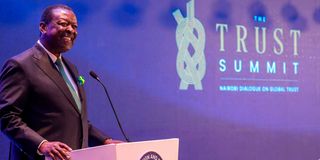
Prime Cabinet Secretary and Cabinet Secretary for Foreign and Diaspora Affairs, Musalia Mudavadi, delivers his remarks at the Trust Summit in Nairobi on October 22, 2026.

What you need to know:
- Kenya’s economic diplomacy must seek to convert this trust into trade, investment and employment.
- A trusted nation can attempt almost anything; a mistrusted one finds even modest ambitions elusive.
In an age of fracture, the decisive variable for nations, markets and citizens is no longer capacity alone, but credibility.
More than half a century ago, the economist Kenneth Arrow observed that virtually every commercial transaction contains within it an element of trust (Arrow, 1972).
Seldom has that insight carried greater consequence. As governments, markets and citizens contemplate 2027, forecasts are crowded with growth rates, debt ratios and commodity prices; yet beneath each figure lies a variable that no statistical bureau records and no central bank can issue.


Whether an investor believes the rules will endure, whether a neighbouring state expects an agreement to be honoured, and whether a young citizen believes the state is attentive to his or her concerns: these convictions determine whether the numbers move at all.
It was in recognition of this reality that we recently convened a summit devoted to trust in Nairobi. The gathering was deliberately broad, bringing together heads of state and ministers, multilateral and regional institutions, diplomatic missions and development partners, regulators, business leaders, the media and technology sectors, universities, civil society, faith communities and young people.
That breadth reflected a proposition Francis Fukuyama advanced three decades ago: that a nation’s prosperity is conditioned by the level of trust inherent in its society (Fukuyama, 1995). Trust belongs to no single constituency; it is co-produced among all of them.
Four questions for a fractured age
First, do citizens experience authority as legitimate and capable? The OECD’s 2024 Trust Survey found that only about four in 10 citizens across its member states expressed high or moderately high trust in their national governments.
From Kathmandu to Antananarivo, young people have signalled their impatience with institutions they perceive as distant, and Kenya has heard a similar message.
The fitting response is not rhetoric but performance: visible delivery, transparent decision-making and institutions answerable to citizens rather than to the electoral cycle. As Onora O’Neill reminded us in her 2002 Reith Lectures, the task is not to demand trust but to demonstrate trustworthiness.
Second, can international commitments still be relied upon? The paralysis of the World Trade Organization’s Appellate Body since 2019, the disruption of maritime traffic through the Red Sea and the return of tariffs as instruments of statecraft all attest to an order under strain.
Robert Keohane argued that international institutions endure because they reduce uncertainty and the costs of cooperation (Keohane, 1984).
For Kenya, host to the only United Nations headquarters in the Global South, the renewal of multilateralism envisaged in the Pact for the Future, adopted in 2024, is not an abstraction but a strategic imperative.
Third, what is the price of mistrust? Markets answer with unforgiving speed. In September 2022, a fiscal statement in the United Kingdom provoked such a sharp loss of confidence that the Bank of England intervened to stabilise the gilt market.
Mistrust is priced into sovereign risk premia, goods delayed at borders and investment deferred. Douglass North taught that institutions matter because they lower transaction costs (North, 1990); credible institutions, by extension, lower the cost of capital. Investors do not require perfection. They require predictability.
Fourth, whose truth prevails in the digital age? The World Economic Forum’s Global Risks Report 2024 ranked misinformation and disinformation as the most severe global risk in the short term.
Generative artificial intelligence has lowered the cost of fabrication, even as the European Union’s AI Act signals an emerging effort to restore accountability. Kenya’s digital openness is a considerable asset, but it calls for shared stewardship among governments, platforms, the media and citizens.
The nexus
There is a clear nexus between these questions. A citizenry that doubts its institutions is more susceptible to falsehood; a state divided at home commands less credibility abroad; and a nation that is not trusted pays more for everything, from credit to energy.
Kenya’s economic diplomacy bears this out. Notwithstanding widened market access and a near doubling of foreign direct investment since 2022, we frequently find that the facts about Kenya outpace the sentiment about Kenya. That gap is, at its core, a deficit of trust.
A season of decision
The year 2027 will test institutions everywhere. Kenya will hold a general election, the global order will continue to recalibrate, and new technologies will interrogate old certainties. In such a season, trust cannot be relegated to the category of soft issues.
It is the load-bearing pillar upon which institutions, individuals and governments must rest. Kenya’s economic diplomacy must seek to convert this trust into trade, investment and employment.
A trusted nation can attempt almost anything; a mistrusted one finds even modest ambitions elusive.
Dr Korir Sing’oei is the Principal Secretary for Foreign Affairs