It is with a heavy heart and a bleeding conscience that I pen this.
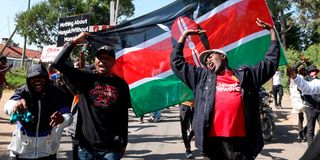
In Nanyuki, Laikipia County, citizens exercising their constitutional right to peaceful assembly have been met with live ammunition.
Three people are now dead. At least 15 have been arrested. A man who had simply closed his shop to avoid the unrest was shot on his way home.
And most alarmingly, hooded police officers, unidentifiable and therefore unaccountable, were among those who fired into crowds of unarmed Kenyans.
At Multimedia University’s Rongai Campus, students who were demonstrating over the suspension of examinations were met not with dialogue but with armed officers, some in plain clothes, who entered the institution, roamed the hostels, and fired live rounds at young men and women on their own campus. Four students were shot.
Right to peaceful assembly
Victor Kariuki has a bullet lodged near his spine. His mother is at Kenyatta National Hospital praying that surgeons can remove it without destroying his future. These are students. Kenya’s students.
I want to be precise about what is happening here, because precision matters in the law, and these are fundamentally legal questions.
Article 37 of the Constitution of Kenya guarantees every person the right to peaceably assemble, to demonstrate, to picket, and to petition. That right is not granted by the government. It is not a privilege extended at the discretion of an OCS or a police inspector. It is a fundamental liberty that inheres in every Kenyan by virtue of being Kenyan.
When police officers ban demonstrations, promise restraint and then renege on that promise, deploy hooded operatives who cannot be identified or held to account, and fire live ammunition into crowds of unarmed citizens, they are not enforcing the law. They are violating it.
The National Police Service Act and the National Police Service Standing Orders are not ambiguous on the use of force. Force must be proportionate. It must be a last resort. Lethal force is permitted only where there is an imminent and serious threat to life.
A man carrying a placard that says “Reject Ebola” poses no such threat. A student demanding that her examination be rescheduled poses no such threat. No honest reading of our law, no good-faith application of any standing order, justifies what has happened in Nanyuki and on the Rongai Campus this past week.
Fresh deaths and fresh bodies
The hooded officers in Nanyuki deserve particular attention. When a state agent covers their face while executing a state function, they sever the chain of accountability that democracy depends on. They act in the name of the Republic while making it impossible for the Republic to answer for their actions. That is not policing. That is something far more sinister. It is the operating logic of impunity, and it must be named as such.
We are days away from the second anniversary of June 25, 2024. The families of those who were killed two years ago when young Kenyans marched on Parliament are still waiting for justice. The Independent Policing Oversight Authority has cases it has not concluded. Officers who fired into crowds have not faced consequences proportionate to the lives they took.
And yet here we are again, with fresh deaths, fresh bullets in fresh bodies, and a police spokesperson who told Reuters he had no information about any of it.
I am not willing to accept that this is simply the way things are in Kenya. I refuse that conclusion. Our Constitution was not written to be observed selectively, honoured during elections and forgotten when citizens assemble.
It was written as a living covenant, and every arm of the state is bound by it, including, and especially, the security forces.
I call on the Independent Policing Oversight Authority to move with urgency, not months from now, on both the Nanyuki killings and the Multimedia University shootings.
I call on the Director of Public Prosecutions to apply their mind to the available evidence, including the CCTV footage from the university campus, and determine whether criminal charges are warranted.
Mr Maraga, a former Chief Justice, is a presidential candidate for the United Green Movement party