The government has launched a fresh physical headcount of public servants as investigations into suspected Sh6.2 billion payroll fraud widen, in a renewed push to identify irregular recruitment and weaknesses in the management of public funds.
The exercise comes as the government investigates suspicious salary payments involving human resource officials in the Kenya Prisons Service, the Kenya Police Service and the Ministry of Health, with 84 officials implicated and barred from accessing the government payroll system.
The headcount to start with the Education ministry is intended to establish the accuracy of public service records by physically verifying employees on the government payroll, amid revelations of workers whose employment records contain implausible details, shared bank accounts and payments to individuals without valid bank account information.
A memo dated October 16, 2026, from the Ministry of Education’s State Department for Basic Education provides an indication of how the exercise is being rolled out, directing heads of directorates to ensure all employees under their supervision are physically accounted for.
The memo signed by Secretary of Administration at the Ministry of Education James Kianda on behalf of Principal Secretary seen by the Daily Nation, cites a recent payroll audit conducted by the State Department for Public Service and Human Capital Development across State departments and counties.
“Following recent payroll audit conducted in various state departments and counties by the State Department for Public Service and Human Capital, it has become necessary that a physical headcount of all employees on the payroll be conducted in all state departments,” the memo states.
The document directs all employees to present themselves for verification at Jogoo House on today (October 19) and onwards to Tuesday and Wednesday carrying their original national identity cards, Kenya Revenue Authority PIN certificates, first appointment letters and current appointment letters.
The exercise will cover all staff including those who are hospitalised or on annual, sick, maternity, paternity or other authorised leave, according to the memo.
“Salary for officers who would not have been counted will be stopped. If you transferred your services from TSC to the ministry, your letter of 1st appointment will be the letter you were given by the ministry. For the new Quality Assurance and Standards Officers (Qasos), their letters of first and current appointment will be the same. The exercise should be treated as urgent and mandatory and strict compliance with these instructions is expected,” Mr Kianda says.
The verification comes as Public Service Cabinet Secretary Geoffrey Ruku’s ministry intensifies efforts to establish how the suspected payroll fraud was executed, who benefited from the transactions and the extent of the financial loss to the government.
The Ministry of Education headquarters at Jogoo House in Nairobi.
Photo credit: File | Nation Media Group
Mr Ruku said the Ministry of Public Service had received findings from investigations by the Directorate of Criminal Investigations (DCI), which implicated 84 human resource officials in the alleged scheme.
The officials were drawn from the Kenya Prisons Service, the Kenya Police Service and the Ministry of Health’s Department of Medical Services, Public Health and Professional Standards.
Mr Ruku directed principal secretaries and accounting officers in the affected departments to ensure that the officials relinquished their payroll access rights and stepped aside for 30 working days as investigations continued.
“We have credible evidence as far as Kenya Prisons, Ministry of Health and also Kenya Police Service. And therefore any human resource manager with the user right to get into the payroll system must step aside for a period of 30 working days,” he said.
The 84 officials have had their access rights withdrawn preventing them from executing transactions on the payroll platform. The Ministry of Public Service has deployed its own human resource officers to take over their responsibilities to ensure government operations continue uninterrupted.
Mr Ruku warned that arrests were expected before the 30 working days elapsed, particularly among officials in the Kenya Prisons Service.
'Recruited before they were born'
“There will be arrests before the end of those working days, especially, and I want to say without fear of contradiction, from Kenya Prisons Service. People will be arrested before those working days come to an end,” he said.
The preliminary findings have raised questions about how employees are recruited, verified and paid through the government payroll.
Mr Ruku said the review had uncovered cases in which employment records indicated that some civil servants had been recruited before they were born, while others were listed as having joined the public service before attaining the age of 18.
“There were also issues of employees or civil servants who are employed before they were born. There are also cases of employees or civil servants who are employed before the age of 18,” he said.
Investigators also flagged multiple salary payments channelled into a single bank account, employees sharing bank accounts and payments made to individuals whose records did not contain valid bank account details.
“There are those employees who are sharing bank accounts. They are employees with no bank account, but money has been paid,” Mr Ruku said.
Preliminary findings suggest that some beneficiaries of the suspicious payments were recruited through colleagues, including human resource officers, and allegedly used as conduits for channelling irregular payments through the government payroll.
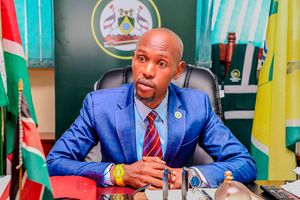
Cabinet Secretary for Public Service Geoffrey Ruku during the pass-out parade of 15,361 National Youth Service recruits in Gilgil on October 2, 2026.
Photo credit: Boniface Mwangi | Nation Media Group
Investigators are examining whether some of the money was subsequently transferred to other accounts believed to be operated by officials who facilitated the transactions.
The probe is expected to establish how the alleged scheme operated, identify those responsible and determine the extent of the financial loss.
In June, Cabinet has directed the Directorate of Criminal Investigations (DCI) to uncover payroll fraud that has occurred over the years.
"Cabinet directed the Directorate of Criminal Investigations to investigate payroll fraud, verify personal numbers used in payroll processing, dismantle criminal networks manipulating Government payroll systems, recover lost public funds, and ensure the immediate arrest and prosecution of all persons found culpable," the Cabinet dispatch read.
The Cabinet also approved far-reaching reforms aimed at cleaning up the public payroll and restoring integrity to the management of the government's wage bill.
These measures include a government-wide audit of all remaining state departments and public institutions and the mandatory migration of all ministries, departments, agencies, and state corporations to the revamped Integrated Human Resource and Payroll System.
Central Bank of Kenya Governor Kamau Thugge said on Friday that the government was in discussions with multilateral lenders, including the World Bank and the African Development Bank (AfDB), over financing expected to materialise in the current financial year.
Speaking on the sidelines of the annual meetings of the International Monetary Fund (IMF) and World Bank in Bangkok, Dr Thugge said the discussions included potential budget support and a World Bank Development Policy Operation.
“They are looking at all kinds of financing... there's quite a number of sources that they are trying to access,” he told Reuters.
A debt-for-food swap is also among the options under consideration, although Dr Thugge said he was not directly involved in those discussions.
An IMF team is expected to visit Nairobi in December for a regular Article IV consultation, Dr Thugge said, adding that discussions on a new programme with the Fund would form part of the engagement.
The financing talks underscore the government's need to mobilise resources to meet its obligations, while the payroll investigation highlights the importance of ensuring that public funds are paid to legitimate employees and properly accounted for.